

+2 Daha

Beijinho is one of Brazil’s traditional sweets, commonly served during social events such as children’s birthday parties, weddings, and religious holidays. The name Beijinho, meaning “little kiss” in Portuguese, reflects both its visual appeal and its symbolic role as a token of affection in celebratory contexts. Owing to its simple and affordable ingredients, Beijinho has become widespread across Brazil, gaining popularity in both homemade preparations and industrial production. With its main components being sweetened condensed milk and coconut, Beijinho shares similarities with other Brazilian desserts such as Brigadeiro and Quindim.
The historical origins of Beijinho date back to the mid-20th century, coinciding with the increased availability of sweetened condensed milk in Brazil. The introduction of Nestlé products into the Brazilian market during the 1940s significantly facilitated the domestic production of confections and desserts. Alongside the development of Brigadeiro, recipes such as Beijinho emerged during this period. One of Beijinho’s key ingredients, coconut, is abundantly found in Brazil’s northeastern states. Consequently, the dessert initially gained popularity in that region before spreading throughout the country.
Traditionally, Beijinho is among the sweets offered at birthday celebrations and religious festivities. It is particularly favored at children’s events due to its visual appeal and simplicity. The whole clove placed atop each Beijinho serves both as a decorative element and as a subtle aromatic enhancer, reinforcing the dessert’s link to cultural and aesthetic traditions.

Beijinho (Generated by Artificial Intelligence)
The core ingredients of Beijinho are sweetened condensed milk, grated coconut, and butter. The combination of these three elements, when mixed and cooked, yields a thick and cohesive dough. During preparation, the mixture is cooked over low heat with constant stirring to ensure a uniform consistency and to prevent sticking. The mixture is considered ready once it begins to pull away from the sides of the pan.
After the cooking process, the mixture is allowed to cool and is then shaped into small balls. These are typically coated with grated coconut and traditionally topped with a single clove for both visual appeal and aromatic enhancement. In some recipe variations, the surface may be decorated with sugar coatings or colorful sprinkles. Beijinho is usually presented in small paper cups and prepared in bite-sized portions.
Beijinho is among the most commonly served sweets at children’s birthday parties in Brazil. Alongside Brigadeiro, it constitutes a central element of traditional celebratory confections. Its simple appearance and ease of preparation have contributed to its popularity in both homemade and commercial settings. In particular, during Brazil’s post-1950s industrialization and urbanization period, packaged versions with extended shelf lives emerged in the market.
From a nutritional standpoint, Beijinho is high in both sugar and fat content. As a calorie-dense confection, its consumption should be moderated within the framework of balanced dietary guidelines. Nevertheless, the sweetened condensed milk and coconut provide a limited source of protein and dietary fiber, offering some nutritional value despite its energy-dense profile.
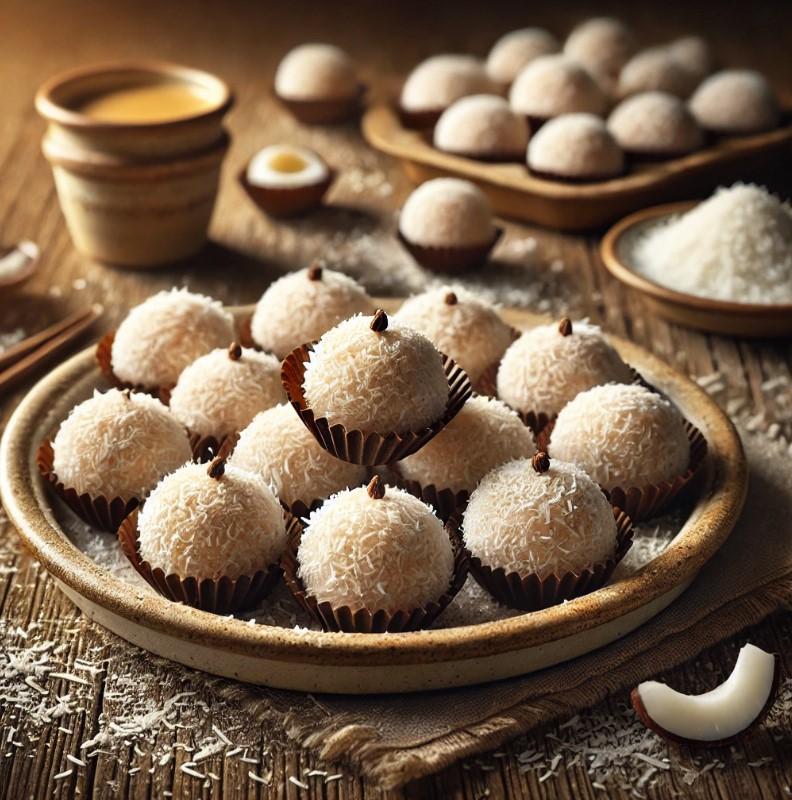
Beijinho (Generated by Artificial Intelligence)
Anadolu Üniversitesi. World Cuisines I. Edited by Assoc. Prof. Dr. Hakan Yılmaz, Anadolu University, Eskişehir, August 2018.
Brezilya Kültür. "Brezilya Kültürü." Accessed March 24, 2025. https://www.brezilyakultur.com/brezilya-kulturu/.
DaMatta, Roberto. Carnivals, Rogues, and Heroes: An Interpretation of the Brazilian Dilemma. Notre Dame, IN: University of Notre Dame Press, 1991.
Ermağan, İsmail, Emine Tahsin, and Segâh Tekin, eds. Dünya Siyasetinde Latin Amerika 4. Ankara: Nobel Akademik Yayıncılık Eğitim Danışmanlık Tic. Ltd. Şti., 2021. Accessed March 21, 2025.
Pilcher, Jeffrey M. Food in World History. New York: Routledge, 2006.
Tourism Journal. "Brezilya’nın Tatlı ve Eşsiz Mutfağı." Accessed March 24, 2025. https://www.tourismjournal.com.tr/turizm/brezilya-nin-tatli-ve-essiz-mutfagi-1016375.
Türkiye Turizm Ansiklopedisi. "Brezilya Mutfağı." Accessed March 24, 2025. https://turkiyeturizmansiklopedisi.com/brezilya-mutfagi.
Özkaya, Fügen Durlu, and Batuhan Sarican. “The Cultural Interaction Journey of Latin American Cuisine.” Journal of Tourism and Gastronomy Studies 2, no. 1 (2014): 36-45. Accessed March 19, 2025.

Henüz Tartışma Girilmemiştir
"Beijinho" maddesi için tartışma başlatın
Historical and Cultural Origins of Beijinho
Structural Characteristics and Preparation Process
Socio-Cultural and Nutritional Context
Beijinho: Ingredients and Preparation Process
Main Ingredients
Preparation Steps
Preparing the Mixture
Cooling Process
Shaping and Coating
Serving and Consumption
Nutritional and Health Perspective
Bu madde yapay zeka desteği ile üretilmiştir.