

Bu içerik Türkçe olarak yazılmış olup yapay zeka ile otomatik olarak İngilizceye çevrilmiştir.
+2 Daha
The Berlin Wall was a concrete barrier constructed by East Germany between 1961 and 1989 to prevent movement from East Berlin to West Berlin and became a symbol of the division of Europe during the Cold War. It was erected on 13 August 1961 as a tangible representation of the division of Germany into East and West during the Cold War.
Established by the East German authorities to stem the intense migration and emigration toward West Berlin, the wall represented the division of Europe for nearly thirty years. Encircled by concrete barriers barbed wire observation towers and minefields the Berlin Wall became one of the most prominent dividing lines not only in German but also in global politics. Its demolition in 1989 marked a pivotal turning point in the dissolution of the Eastern Bloc and the end of the Cold War.

Infographic of the Berlin Wall (Anadolu Agency)
After the end of the Second World War in 1945 Germany was divided into four occupation zones controlled by the United States the United Kingdom France and the Soviet Union. The capital Berlin located within the Soviet zone was also divided among the four Allied powers. The three western zones American British and French merged to form West Berlin while the eastern zone under Soviet control became known as East Berlin.
1949 marked a turning point in the institutionalization of this division. The three western occupation zones united to form the Federal Republic of Germany Bundesrepublik Deutschland BRD with Bonn as its capital. In the East the German Democratic Republic Deutsche Demokratische Republik DDR was established under Soviet influence and East Berlin was declared its official capital. Thus Germany was split into two separate states embodying the ideological divide between the capitalist West and the socialist Eastern Bloc.
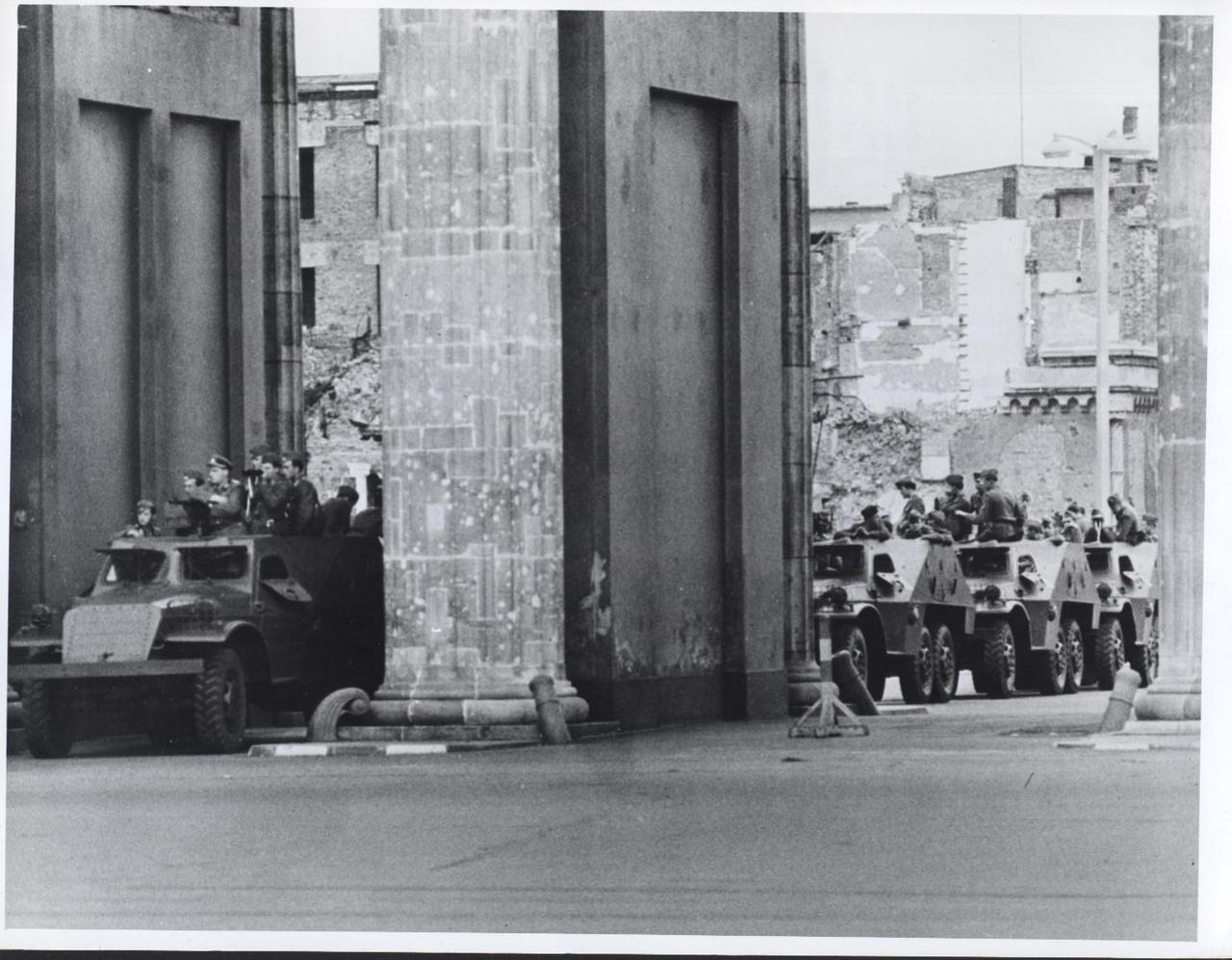
East German Armored Vehicles Waiting to Prevent Refugee Flow from East Germany – 1961. (National Archives Catalog)
Berlin became the only city where the two systems faced each other directly. West Berlin functioned as an enclave of the Federal Republics free market economy and democratic structure while East Berlin became a symbol of the centrally planned single party socialist system. The first major crisis of this tension occurred in 1948 when the Soviet Union blockaded West Berlin by land and water. The Berlin Airlift Luftbrücke in which Western Allies delivered 2.3 million tons of food and fuel to the city by air over fifteen months became a landmark diplomatic and logistical operation of the Cold War.
Throughout the 1950s economic difficulties production quotas and restrictive policies in East Germany drove large segments of the population toward the West. Between 1949 and 1961 approximately 2.7 million people most of them young and skilled workers left East Germany for the West. This migration weakened the state’s labor capacity reduced economic productivity and undermined the regime’s legitimacy.

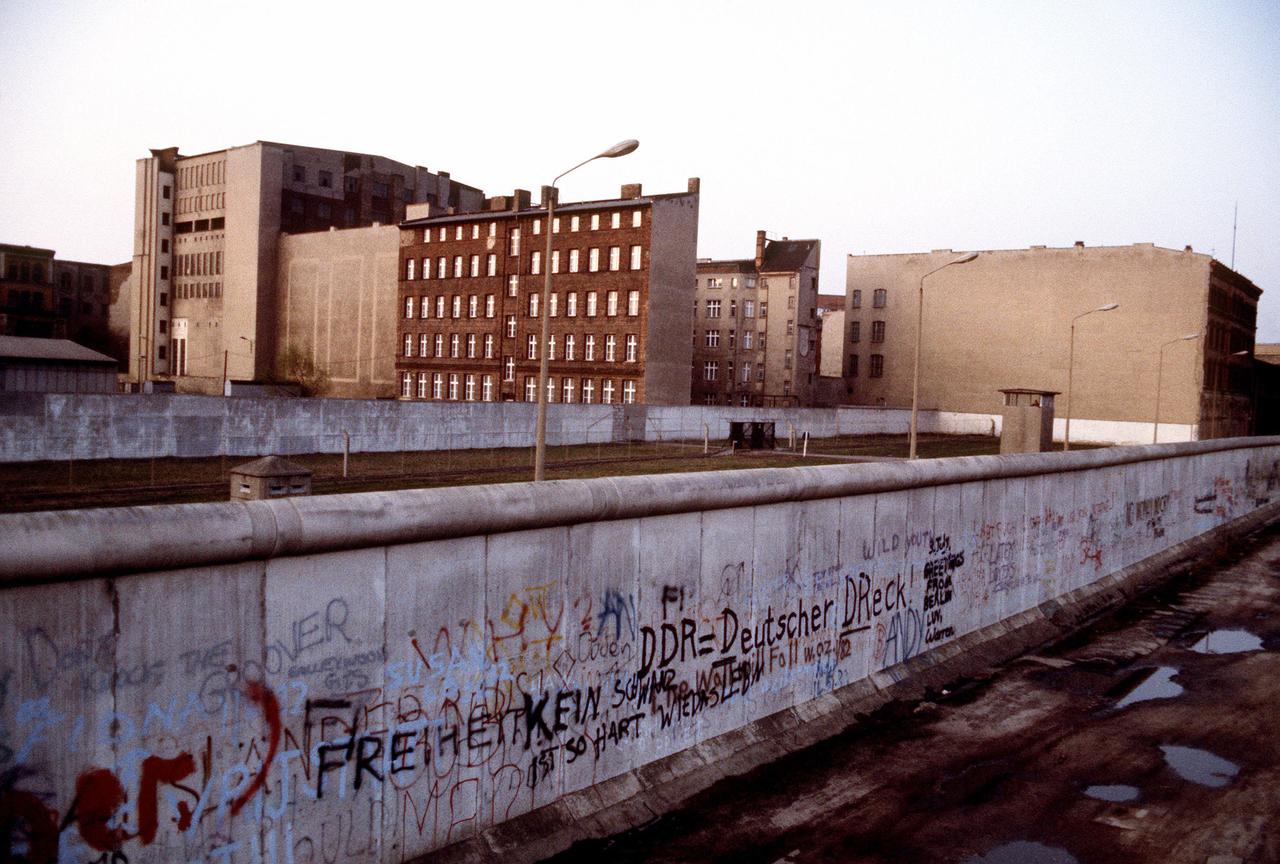
A Section of the Berlin Wall Kreuzberg – 1963 (National Archives Catalog)
To halt the exodus of its population and workforce to the West the East German government decided to close its borders. On the night of 12 August 1961 the East German Council of Ministers effectively halted crossings around Berlin by deciding to implement “ordinary border controls.” By the morning of 13 August the People’s Police the Border Police and volunteer units known as “worker militias” began erecting barbed wire along Berlin’s main thoroughfares.
Roads along the border were dug up railways severed and neighborhood connections severed. The initial barrier of barbed wire was replaced within weeks by a permanent wall constructed from concrete blocks. The East German government officially named the structure the Anti-Fascist Protection Rampart Antifaschistischer Schutzwall. The official justification was to prevent the infiltration of “fascist and militarist elements” from West Germany; however the real purpose was to prevent mass emigration from East to West.

An East German Soldier Observing to Prevent Escape from East Berlin – 1964. (National Archives Catalog)
The construction of the Berlin Wall transformed the city’s fabric overnight. Along streets such as Bernauer Strasse the border ran along the front facades of buildings; some families attempted to escape by jumping from their windows into West Berlin. The first fatalities occurred during this period. On the same day West Berlin’s mayor Willy Brandt denounced the wall’s construction as an “illegal and inhumane act” though international reactions remained limited.
In its early years the Berlin Wall was an irregular structure built from various materials. From the mid-1960s onward it was systematically transformed into a “multi-layered border complex.” From the East Berlin side this structure consisted of the following elements:

A Volkspolizei Officer Controlling the Passage Between the Wall and Barbed Wire in Kreuzberg – 1961 (National Archives Catalog)
The final generation of the wall developed in the 1970s known as Grenzmauer 75 consisted of concrete panels 3.6 meters high and 1.2 meters wide. The semicircular concrete pipe at the top was designed to make climbing physically difficult. The total length of the wall reached 155 kilometers around Berlin and extended 43 kilometers through the city center.
The Berlin Wall was not merely a physical boundary but the concrete manifestation of the ideological division of the Cold War. To the Western world the wall symbolized the line between freedom and totalitarianism; to the Eastern Bloc it was a protective barrier safeguarding the socialist regime. U.S. President John F. Kennedy’s 1961 statement “A wall is better than a war”【1】 reflected the Western policy of avoiding direct military confrontation.
The wall fundamentally altered daily life. Approximately 5000 people succeeded in escaping across the wall between 1961 and 1989; some used sewers hot air balloons or modified vehicles. However at least 140 people lost their lives attempting to cross most shot by East German border guards.

A Memorial Dedicated to Peter Fechter a Young Man Killed While Attempting to Escape from East Berlin (National Archives Catalog)
The wall permanently separated families and communities. Many people were unable to see their loved ones for years. Economically West Berlin flourished through free trade and foreign investment while East Berlin stagnated under the constraints of a centrally planned economy. This disparity deepened the gap in income and living standards between the two parts of Germany.
Shortly after the wall’s construction in October 1961 a direct confrontation occurred at the Checkpoint Charlie crossing on Friedrichstrasse between U.S. and Soviet tanks. Both sides’ forces stood for 16 hours only meters apart; the crisis was resolved diplomatically preventing a potential nuclear conflict.

A West German Man Attempting to Demolish the Berlin Wall with a Hammer and Chisel. (National Archives Catalog)
In 1963 U.S. President John F. Kennedy delivered his famous “Ich bin ein Berliner” (“I am a Berliner”)【2】 speech in Berlin expressing solidarity with the people of West Berlin. In 1987 U.S. President Ronald Reagan’s call at the Brandenburg Gate “Mr. Gorbachev tear down this wall!”【3】 signaled that the Cold War was nearing its end.
By the late 1980s reform movements gained momentum across the Eastern Bloc. In the Soviet Union Mikhail Gorbachev’s policies of glasnost (openness) and perestroika (restructuring) emboldened social demands in East Germany. Meanwhile Hungary’s removal of its border fence with Austria opened a route to the West for thousands of East German citizens.

A Section of the Berlin Wall Near the Brandenburg Gate Being Removed – 1989 (National Archives Catalog)
In East Germany growing demonstrations coalesced around the slogan “Wir sind das Volk” (“We are the people”). Hundreds of thousands took to the streets in Leipzig Dresden and Berlin demanding democratic reforms and freedom of movement. Faced with these developments the East German government was forced to retreat. On the evening of 9 November 1989 East German government spokesman Günter Schabowski announced at a press conference that travel restrictions would be lifted “immediately.”
As a result thousands of East Berliners rushed to border crossings. Overwhelmed by the crowds border guards did not use firearms and opened the barriers. Thus the Berlin Wall which had stood for 28 years was effectively demolished on the night of 9 November 1989. Citizens climbed onto the wall to celebrate; West and East Berliners embraced each other marking the first step toward reunification.

A West German Girl Talking to an East German Man Through an Opening in the Berlin Wall – 1989 (National Archives Catalog)
The fall of the Berlin Wall symbolized not only the end of Germany’s division but also the symbolic end of the Cold War. On 3 October 1990 East and West Germany officially reunified and Berlin was reinstated as the nation’s capital. This process was formalized internationally through the Two Plus Four Treaty signed between the two German states and the four Allied powers of the postwar era which restored full sovereignty to Germany.
After its demolition fragments of the Berlin Wall were displayed in cities around the world. The Berlin Wall Memorial Gedenkstätte Berliner Mauer on Bernauer Strasse has been preserved as a historical site of memory. The wall’s fall paved the way for accelerated European integration the eastward expansion of NATO and the European Union and the spread of democratic transitions across Eastern Europe.
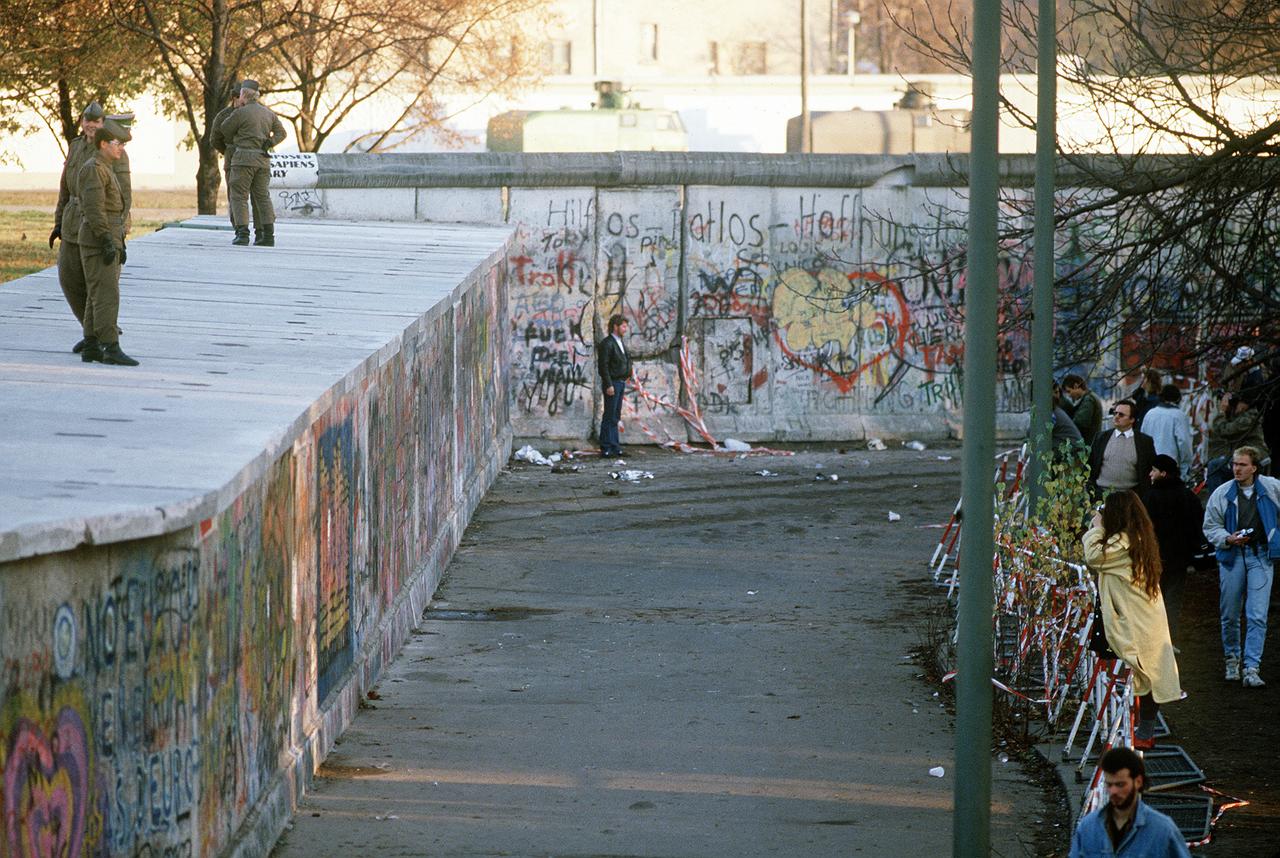
East German Police Officers on Duty atop a Section of the Berlin Wall Near the Brandenburg Gate. (National Archives Catalog)
From 13 August 1961 to 9 November 1989 the Berlin Wall symbolized not only a single city but an entire era. Encircled by concrete walls minefields and observation towers this structure endured as one of the most visible ideological boundaries in human history. Its demolition demonstrated the historical power of individual freedoms political change and popular will. Today the Berlin Wall Memorial on Bernauer Strasse stands as a physical and historical reminder of the past. The remnants of the wall represent the deep imprint of the Cold War on human history and the universal symbol of the quest for freedom.
Anadolu Ajansı. “Berlin Duvarı’nın Yıkılışının 30. Yıl Dönümü.” Accessed October 6, 2025. https://www.aa.com.tr/tr/dunya/berlin-duvarinin-yikilisinin-30-yil-donumu/1639121
Anadolu Ajansı. “Berlin Duvarı’nın Yıkılışının 35. Yılı.” Accessed October 6, 2025. https://www.aa.com.tr/tr/dunya/berlin-duvarinin-yikilisinin-35-yili/3388056
Anadolu Ajansı. “Berlin Duvarı’nın Yıkılışının Üzerinden 34 Yıl Geçti.” Accessed October 6, 2025. https://www.aa.com.tr/tr/dunya/berlin-duvarinin-yikilisinin-uzerinden-34-yil-gecti/3047117
Anadolu Ajansı. “Soğuk Savaş'ın Sembolü Berlin Duvarı.” Accessed October 6, 2025. https://www.aa.com.tr/tr/info/infografik/25615
Anadolu Ajansı. “Soğuk Savaş'ın Sembolü Berlin Duvarı’nın Yıkılışının Üzerinden 33 yıl Geçti.”
Anadolu Ajansı. “Soğuk Savaş’ın Sembolü Berlin Duvarı’nın Yıkılışının Üzerinden 33 Yıl Geçti.” Accessed October 6, 2025. https://www.aa.com.tr/tr/dunya/soguk-savasin-sembolu-berlin-duvari-nin-yikilisinin-uzerinden-33-yil-gecti/2732319
BBC Bitesize. “The Berlin Wall.” Accessed October 6, 2025.
BBC Newsround. “Berlin Wall anniversary: What was the Berlin Wall?” Accessed October 6, 2025. https://www.bbc.co.uk/newsround/29913833
Berlin.de. “Construction of the Berlin Wall.” Accessed October 6, 2025. https://www.berlin.de/mauer/en/history/construction-of-the-berlin-wall/
Blakemore, Erin. “Why the Berlin Wall Was Built—and How It Fell.” National Geographic. Accessed October 6, 2025. https://www.nationalgeographic.com/history/article/why-berlin-wall-built-fell
Bundeszentrale für politische Bildung (bpb). "Berliner Mauer." Accessed October 6, 2025. https://www.bpb.de/kurz-knapp/lexika/das-junge-politik-lexikon/319931/berliner-mauer/
History.com. "Berlin Wall." Accessed October 6, 2025. https://www.history.com/articles/berlin-wall
Imperial War Museums (IWM). “What Was the Berlin Wall and How Did It Fall?” Accessed October 6, 2025. https://www.iwm.org.uk/history/what-was-the-berlin-wall-and-how-did-it-fall
Landesdenkmalamt Berlin. “Building and Development of the Berlin Wall.” *Highlight: Berliner Mauer.* Accessed October 6, 2025. https://www.berlin.de/landesdenkmalamt/denkmale/highlight-berliner-mauer/aufbau-und-entwicklung/building-and-development-of-the-berlin-wall-648927.php
NATO. “Building the Berlin Wall.” Accessed October 6, 2025. https://www.nato.int/cps/en/natohq/declassified_136183.htm
National Archives Catalog. “A Column of East German Armored Cars Lines Up Behind Brandenburg Gate Against Background of War-Scarred Buildings of East Berlin.” Accessed October 8, 2025. https://catalog.archives.gov/id/6003296
National Archives Catalog. “A West German girl speaks with an East German guard through an opening in the Berlin Wall.” Accessed October 8, 2025. https://catalog.archives.gov/id/6460721
National Archives Catalog. “A West German man uses a hammer and chisel to chip off a piece of the Berlin Wall as a souvenir. A portion of the Wall has already been demolished at Potsdamer Platz.” Accessed October 8, 2025. https://catalog.archives.gov/id/6460160
National Archives Catalog. “A crane removes a section of the Berlin Wall beside the Brandenburg Gate.” Accessed October 8, 2025. https://catalog.archives.gov/id/6460675
National Archives Catalog. “A memorial on the western side of the Berlin Wall dedicated to Peter Fecter, a young man who died while attempting to flee East Berlin.” Accessed October 8, 2025. https://catalog.archives.gov/id/6388374
National Archives Catalog. “A view of 'The Wall,' which separates communist-controlled East Germany from West Germany. Graffiti marks the West Berlin side while the East side remains spotless.” Accessed October 8, 2025. https://catalog.archives.gov/id/6376545
National Archives Catalog. “Berlin Wall Reinforced. Under The Watchful Eye of Communist Police, East German Workers Near The Brandenburg Gate Reinforce The Wall Dividing The City.” Accessed October 8, 2025. https://catalog.archives.gov/id/6003284
National Archives Catalog. “Between the Wall and Barbed Wire in Kreuzberg Is a 'Dead' Street Controlled By Volkspolizei.” Accessed October 8, 2025. https://catalog.archives.gov/id/6003238
National Archives Catalog. “East German policemen stand atop a section of the Berlin Wall near their Brandenburg Gate as a crowd maintains a vigil for the demolition of the Wall. A portion of the Wall has already been demolished at Potsdamer Platz.” Accessed October 8, 2025. https://catalog.archives.gov/id/6460148
National Archives Catalog. “Graffiti on the west side of the Berlin Wall offers a glimpse into East Germany.” Accessed October 8, 2025. https://catalog.archives.gov/id/6460199
National Archives Catalog. “Part of the Wall at Sebastionstrasse in the District of Kreuzberg.” Accessed October 8, 2025. https://catalog.archives.gov/id/6003178
National Archives Catalog. “Watchful Communist Border Guard Mans The Berlin Wall and Keeps a Constant Lookout for Persons Attempting to Escape from East Berlin.” Accessed October 8, 2025. https://catalog.archives.gov/id/6003288
Stiftung Berliner Mauer. "Berlin Wall Memorial: Bernauer Strasse." Accessed October 6, 2025. https://www.stiftung-berliner-mauer.de/en/berlin-wall-memorial/historical-site/bernauer-strasse
Stiftung Berliner Mauer. "The Berlin Wall." Accessed October 6, 2025. https://www.stiftung-berliner-mauer.de/en/topics/berlin-wall
TRT Haber. “Demir Perde'nin Sonu: Berlin Duvarı'nın Yıkılışı.” YouTube. Accessed October 6, 2025. https://www.youtube.com/watch?v=WXdbXdqFxlo
The National Museum of American Diplomacy. “The Rise and Fall of the Berlin Wall.” Accessed October 6, 2025. https://diplomacy.state.gov/berlin-wall/
YouTube. Accessed October 6, 2025. https://www.youtube.com/watch?v=sNKHEGk7GY8
Yıldırım, Cem. “Soğuk Savaşın Simgesi Berlin Duvarı ve Sinemadaki Yansımaları.” *OPUS International Journal of Society Researches* 16, no. 32 (2020): 5176–5203. Accessed October 6, 2025. https://dergipark.org.tr/tr/download/article-file/1300023
[1]
History.com. “Berlin Wall.” Erişim 6 Ekim 2025. https://www.history.com/articles/berlin-wall
[2]
The National Museum of American Diplomacy. “The Rise and Fall of the Berlin Wall.” Erişim 6 Ekim 2025. https://diplomacy.state.gov/berlin-wall/
[3]
The National Museum of American Diplomacy. “The Rise and Fall of the Berlin Wall.” Erişim 6 Ekim 2025. https://diplomacy.state.gov/berlin-wall/

Henüz Tartışma Girilmemiştir
"Berlin Wall" maddesi için tartışma başlatın
Historical Background
Construction of the Wall (1961)
Structure and Development of the Wall
Social and Political Impact of the Berlin Wall
The Berlin Wall and International Tensions
Demolition of the Wall (1989)
Consequences of the Demolition and German Reunification