


Bu içerik Türkçe olarak yazılmış olup yapay zeka ile otomatik olarak İngilizceye çevrilmiştir.
+1 Daha
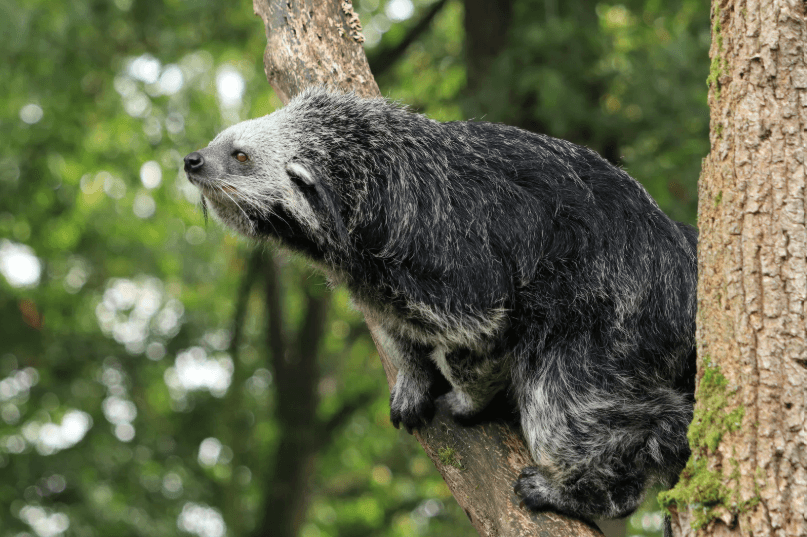
Bear Cat
(Generated with Artificial Intelligence)
Bear Cat (Arctictis binturong)
Branch | Chordata (Chordates) | ||||||||
|---|---|---|---|---|---|---|---|---|---|
Team(s) | Carnivora (Carnivores) | ||||||||
Family | Viverridae (Civets) | ||||||||
Conservation Status | Vulnerable (VU) – IUCN Red List | ||||||||
Natural Distribution | Philippines Indonesia Malaysia Thailand Myanmar Bangladesh Nepal India | ||||||||
Habitat | Tropical and subtropical rainforests | ||||||||
Species | Arctictis binturong | ||||||||
Genus | Arctictis | ||||||||
Class | Mammalia (Mammals) | ||||||||
World | Animalia (Animals) | ||||||||
Binturong (Arctictis binturong) is a tree-dwelling mammal species belonging to the Viverridae family and inhabiting the dense tropical forests of Southeast Asia. Although commonly referred to as the "bearcat," it is not directly related to either cats or bears; instead, it shows greater similarity to civets and genets. The origin of the term "binturong" remains uncertain due to the extinction of the local language that originally used it.
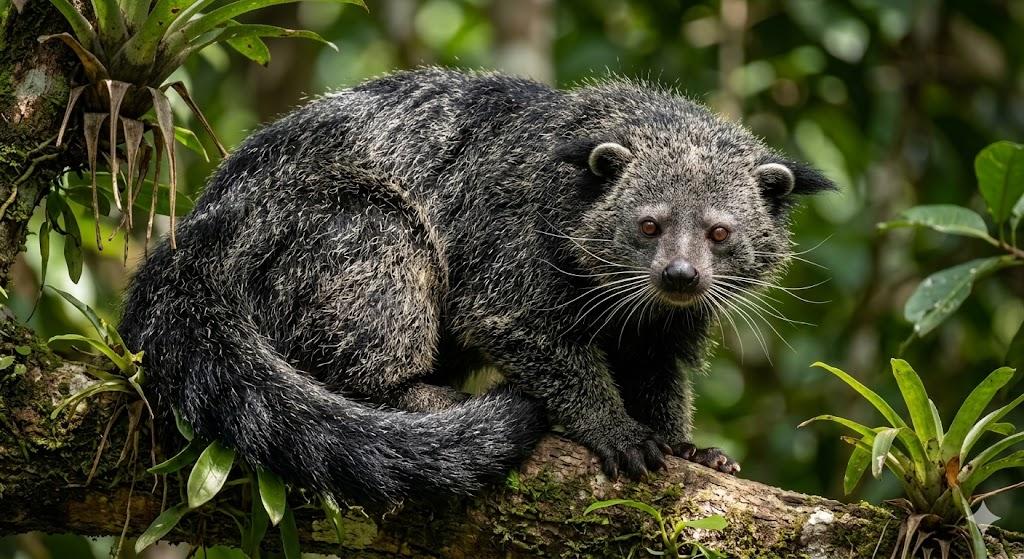
Binturong (Arctictis binturong)
(Generated by Artificial Intelligence)
Binturongs are covered in coarse, typically black fur with tips that may appear gray or silvery. Their body length ranges from 60 to 96 centimeters, and they possess a tail nearly as long as their body, measuring between 50 and 84 centimeters. Their weight varies from 9 to 20 kilograms, with individuals in captivity reaching up to 22 kilograms. Females are the dominant sex, being approximately 20 percent larger and heavier than males.
One of their most distinctive features is their prehensile tail, the only such tail among all mammals in the Old World (Africa, Asia, or Europe) and one of only two carnivorous species worldwide to possess it. This tail functions as an additional limb during climbing. Additionally, binturongs have hind ankle joints capable of rotating up to 180 degrees, allowing them to descend tree trunks headfirst.
This species has a wide distribution across Bangladesh, Bhutan, China, India, countries of Southeast Asia, and Indonesian islands such as Java and Sumatra. They primarily inhabit the upper canopy of tropical rainforests and spend much of their time sleeping or climbing among tree branches. Despite their arboreal lifestyle, their body size prevents them from leaping between trees, so they typically descend to the ground to move from one tree to another.
Although taxonomically classified within the order Carnivora, binturongs are primarily frugivorous. They particularly consume the fruits of the strangler fig (Ficus altissima) and, thanks to specialized enzymes in their digestive system, facilitate the germination of these seeds, playing a keystone species role in forest regeneration. As opportunistic feeders, their diet also includes small mammals, birds, fish, insects, eggs, and plant shoots.
Binturongs generally adopt a nocturnal lifestyle but may also be active during twilight hours. Mostly solitary animals, they typically avoid one another rather than defend territorial boundaries. Olfaction plays a crucial role in their communication; they mark their territory with a scent resembling buttered popcorn, produced by glands beneath their tail and a chemical compound in their urine. They also produce a variety of vocalizations: chuckling and growling when content, and high-pitched screams, hissing, or howling when disturbed.

Binturong (Arctictis binturong)
(Generated by Artificial Intelligence)
Binturongs can breed throughout the year, but most births occur between January and March, a pattern linked to their ability for delayed implantation (the postponement of embryonic attachment to the uterus). Gestation lasts approximately 84 to 92 days, and a litter typically consists of two offspring, though up to six may be born.
Newborns are born with their eyes closed and remain hidden in their mother’s fur for about six to eight weeks. In the wild, binturongs live approximately 18 years, while in captivity they can survive over 25 years.
Binturong populations have declined by more than 30 percent over the past 30 years and are listed as Vulnerable on the IUCN Red List. Major threats include deforestation, habitat loss, illegal hunting for traditional Asian medicine, and the illegal pet trade and fur trade. In some regions, they are also hunted for their meat.
Hardian, Andreas Bandang, Irhamna Putri Rahmawati, Rini Widayanti, and Sabhrina Gita Aninta. “Distinct Island Lineages of Binturong (Arctictis binturong) from Indonesia and Its Conservation Implications.” HAYATI Journal of Biosciences 31, no. 5 (2024): 916–928. Accessed March 14, 2026. https://doi.org/10.4308/hjb.31.5.916-928
National Geographic. "Binturong." National Geographic. Accessed March 14, 2026. https://www.nationalgeographic.com/animals/mammals/facts/binturong
San Diego Zoo Wildlife Alliance. "Binturong." *San Diego Zoo Animals & Plants*. Accessed March 14, 2026. https://animals.sandiegozoo.org/animals/binturong
Schleif, Molly. “Arctictis binturong.” *Animal Diversity Web*. 2013. Accessed March 14, 2026. https://animaldiversity.org/accounts/Arctictis_binturong/
Semiadi, Gono, Joanna Ross, Andrew J. Hearn, Michael Heydon, Hiroshi Samejima, Jedediah Mathai, David Augeri, et al. “Predicted Distribution of the Binturong Arctictis binturong (Mammalia: Carnivora: Viverridae) on Borneo.” Raffles Bulletin of Zoology (2016): 96–102. Accessed March 14, 2026. https://www.biology.ox.ac.uk/publication/636678/scopus


Bear Cat
(Generated with Artificial Intelligence)
Bear Cat (Arctictis binturong)
Branch | Chordata (Chordates) | ||||||||
|---|---|---|---|---|---|---|---|---|---|
Team(s) | Carnivora (Carnivores) | ||||||||
Family | Viverridae (Civets) | ||||||||
Conservation Status | Vulnerable (VU) – IUCN Red List | ||||||||
Natural Distribution | Philippines Indonesia Malaysia Thailand Myanmar Bangladesh Nepal India | ||||||||
Habitat | Tropical and subtropical rainforests | ||||||||
Species | Arctictis binturong | ||||||||
Genus | Arctictis | ||||||||
Class | Mammalia (Mammals) | ||||||||
World | Animalia (Animals) | ||||||||
Henüz Tartışma Girilmemiştir
"Binturong (Arctictis binturong)" maddesi için tartışma başlatın
Physical Characteristics and Morphology
Habitat and Geographic Distribution
Diet and Ecological Importance
Behavior and Communication
Reproduction and Life Cycle
Conservation Status and Threats