

+2 Daha

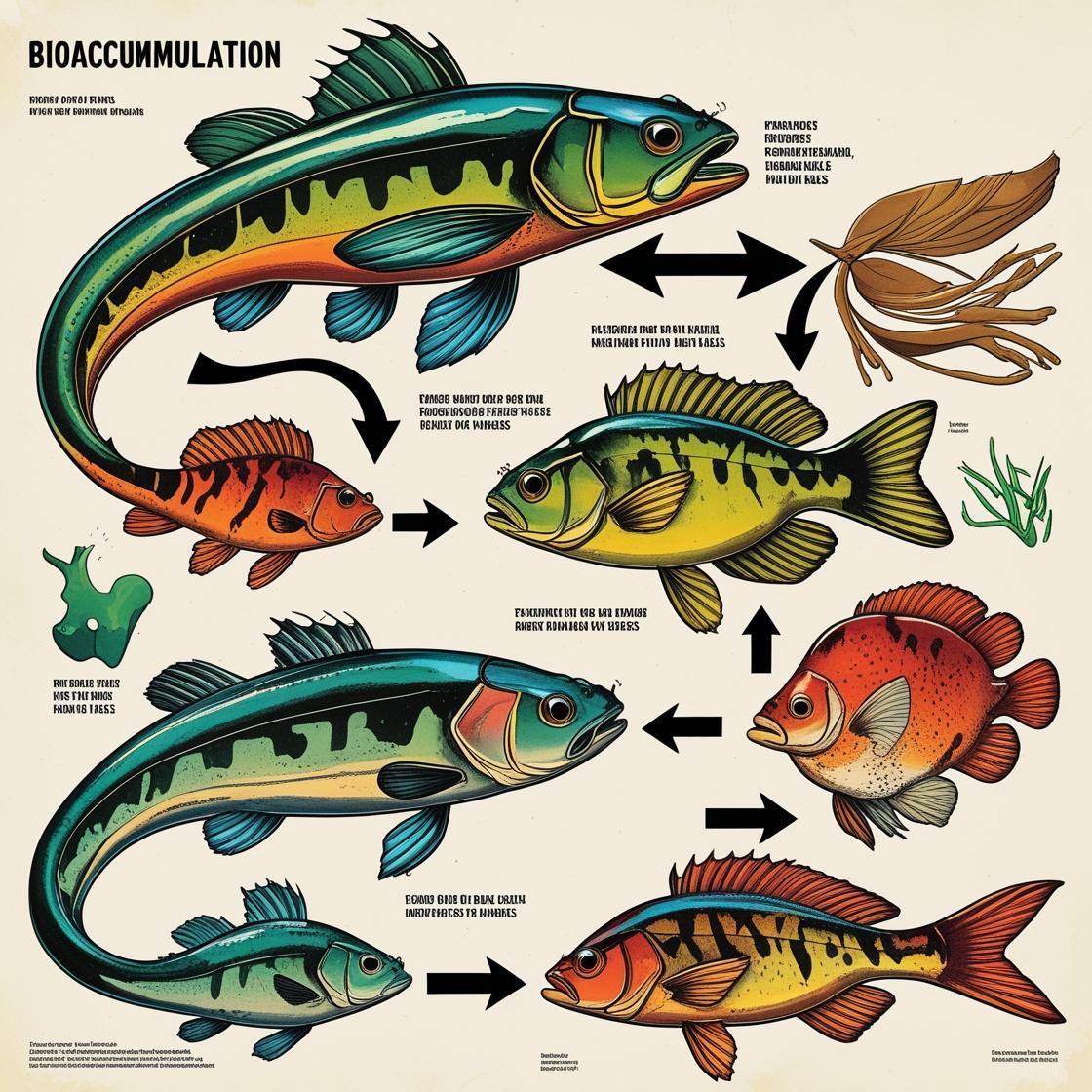
(Generated by Artificial Intelligence)
Bioaccumulation
Bioaccumulation Process | Elimination Metabolism Distribution Uptake | ||||||||
|---|---|---|---|---|---|---|---|---|---|
Measurement and Assessment of Bioaccumulation | Elimination Half-Life (CT50) Bioaccumulation Factor (BAF) Bioconcentration Factor (BCF) | ||||||||
Bioaccumulation is the process by which environmental contaminants accumulate in an organism's tissues and organs either through direct absorption from its surrounding environment (water, soil, air) or indirectly via the food chain. This accumulation generally involves substances that are not metabolically required or used as nutrients by the organism and are often toxic. Examples of bioaccumulative substances include metallic elements such as mercury and lead, organochlorine compounds like DDT and PCBs, and other persistent pollutants such as dioxins, certain pharmaceuticals, and microplastics. Bioaccumulation contributes to the chemical persistence of pollutants within ecosystems by physically and chemically stabilizing these substances within organisms. This process affects not only individual organisms but can also impact overall ecosystem health and biodiversity.

Bioaccumulation Example (Unsplash)
The bioaccumulation process involves four fundamental stages: chemical uptake by the organism, internal distribution, metabolism, and elimination.
Bioconcentration refers to the increase in chemical concentration within an organism resulting directly from uptake from its surrounding environment, such as water. This is especially observed in aquatic organisms. Biomagnification describes the process whereby the concentration of a chemical increases progressively at higher trophic levels in the food chain. For example, mercury absorbed by plankton accumulates in small fish, which are then eaten by larger predatory fish, and ultimately by humans, with concentrations rising at each step. This accumulation poses significant toxicological risks, particularly for apex predators.
Both bioaccumulation and biomagnification elevate the chemical burden on ecosystems, potentially reducing reproductive success, causing developmental anomalies, and impairing behavior and immune responses. The structure of food webs and trophic relationships directly influences the potential for bioaccumulation.
Studies of bioaccumulation are critical for evaluating the ecotoxicological risks posed by chemicals.
Regulatory frameworks, such as the European Union’s REACH regulation, utilize BCF and BAF values to classify chemicals according to their bioaccumulative potential. These classifications inform environmental and human health risk management.
Modern risk assessments increasingly employ in silico quantitative structure-activity relationship (QSAR) models to predict bioaccumulation potential, complemented by in vitro and in vivo testing to enhance assessment accuracy.
Bioaccumulation provides essential information on the persistence and long-term effects of environmental pollutants in organisms. This knowledge underpins ecosystem protection strategies, public health policies, and the development of chemical regulations. Moreover, bioaccumulation data guide advancements in remediation technologies for wastewater treatment and contaminated soils. Techniques such as phytoremediation (using plants to remove pollutants) and microbial bioremediation harness bioaccumulation processes to mitigate contamination. International environmental policies also rely on bioaccumulation data—for instance, the Stockholm Convention on Persistent Organic Pollutants targets the control and elimination of highly bioaccumulative substances. Future research is expected to expand in areas including the bioaccumulation of nanoparticles, the influence of climate change on bioaccumulation dynamics, and the genetic factors that affect bioaccumulation processes.
Akşit, İsmail. “Research on the Concepts of Bioaccumulation, Bioconcentration, and Biomagnification within the Scope of Occupational Health and Safety.” Presentation at the Conference on Bioaccumulation, Bioconcentration and Biomagnification, Mexico City, September 2023. Accessed July 16, 2025. https://www.researchgate.net/publication/373864400_IS_SAGLIGI_VE_GUVENLIGI_KAPSAMINDA_BIYOBIRIKIM_BIYOKONSANTRASYON_VE_BIYOBUYUTME_KAVRAMLARI_UZERINE_BIR_ARASTIRMA.
BBC Bitesize. “What Is Bioaccumulation?” BBC Bitesize. Accessed July 16, 2025. https://www.bbc.co.uk/bitesize/articles/z7x6xbk#zg8d8hv.
European Environment Agency. “Bioaccumulation.” GEMET – Environmental Thesaurus. Accessed July 16, 2025. https://www.eea.europa.eu/help/glossary/gemet-environmental-thesaurus/bioaccumulation.
Franke, Christian, et al. “The Assessment of Bioaccumulation.” Chemosphere 29, no. 7 (1994): 1501–1514. Accessed July 16, 2025. https://www.sciencedirect.com/science/article/abs/pii/004565359490281X.
Rinaldi, Iqro. “A Herd of Goats Standing on Top of a Pile of Garbage.” Unsplash. July 7, 2024. Accessed July 16, 2025. https://unsplash.com/photos/a-herd-of-goats-standing-on-top-of-a-pile-of-garbage-yhQD1np9yz0.
Streit, B. “Bioaccumulation Processes in Ecosystems.” Experientia 48 (1992): 955–970. Accessed July 16, 2025. https://doi.org/10.1007/BF01919142.

(Generated by Artificial Intelligence)
Bioaccumulation
Bioaccumulation Process | Elimination Metabolism Distribution Uptake | ||||||||
|---|---|---|---|---|---|---|---|---|---|
Measurement and Assessment of Bioaccumulation | Elimination Half-Life (CT50) Bioaccumulation Factor (BAF) Bioconcentration Factor (BCF) | ||||||||
Henüz Tartışma Girilmemiştir
"Bioaccumulation" maddesi için tartışma başlatın
Mechanisms of Bioaccumulation
Bioaccumulation in Ecosystems
Assessment and Risk Analysis of Bioaccumulation
Importance and Applications of Bioaccumulation
Bu madde yapay zeka desteği ile üretilmiştir.