

Bu içerik Türkçe olarak yazılmış olup yapay zeka ile otomatik olarak İngilizceye çevrilmiştir.
+1 Daha
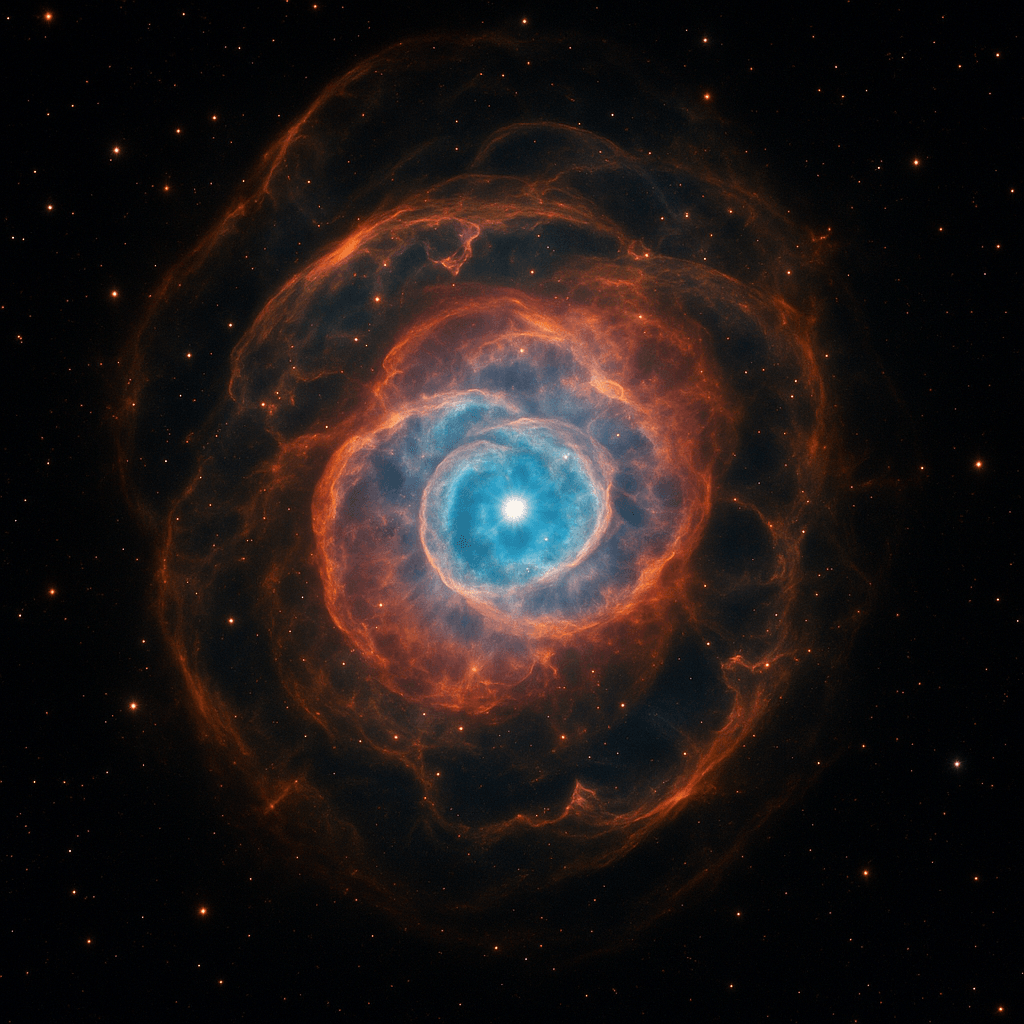
The Cat’s Eye Nebula (NGC 6543) is a planetary nebula located approximately 3,300 light-years from Earth in the constellation Draco. It is renowned for its highly complex structure.

Image of the Cat’s Eye Nebula generated by Artificial Intelligence.
First discovered in 1786 by William Herschel, this nebula has attracted significant scientific interest due to high-resolution images captured by the Hubble Space Telescope. It holds major astrophysical importance, particularly for its reflection of the late evolutionary phase of its central star.
Although classified as a planetary nebula, NGC 6543 exhibits morphological complexity far beyond that of a typical planetary nebula. It formed approximately 20,000 years ago when a medium-mass star expelled its outer layers during its red giant phase. The central star is currently undergoing transformation into an extremely hot white dwarf with a temperature of around 80,000 K.
The Cat’s Eye Nebula possesses a multilayered and symmetric structure. Its most striking feature is its intricate composition of nested shells, ring-like formations, jets and irregular wave patterns. These features arise from the interaction between ionized radiation and stellar winds emitted by the central star and the surrounding gas. Hubble Space Telescope observations reveal a highly dense core at the nebula’s center, which ejects gas in a symmetric pattern.
Spectroscopic analyses have shown that the nebula consists largely of hydrogen, helium, oxygen, nitrogen and sulfur. The relative abundances of these elements provide critical insights into the nucleosynthesis processes that occurred during the central star’s life cycle. The significant presence of oxygen, in particular, indicates that the star underwent advanced stages of thermonuclear fusion.
The formation of the Cat’s Eye Nebula is the result of the final evolutionary stages of medium-mass stars. Such stars, during the last phases of their lives, enter the red giant phase and shed their outer layers through stellar winds. The remaining core transforms into a hot white dwarf composed primarily of carbon and oxygen. The surrounding gas is ionized by intense ultraviolet radiation from the central star, giving the nebula its luminous appearance.
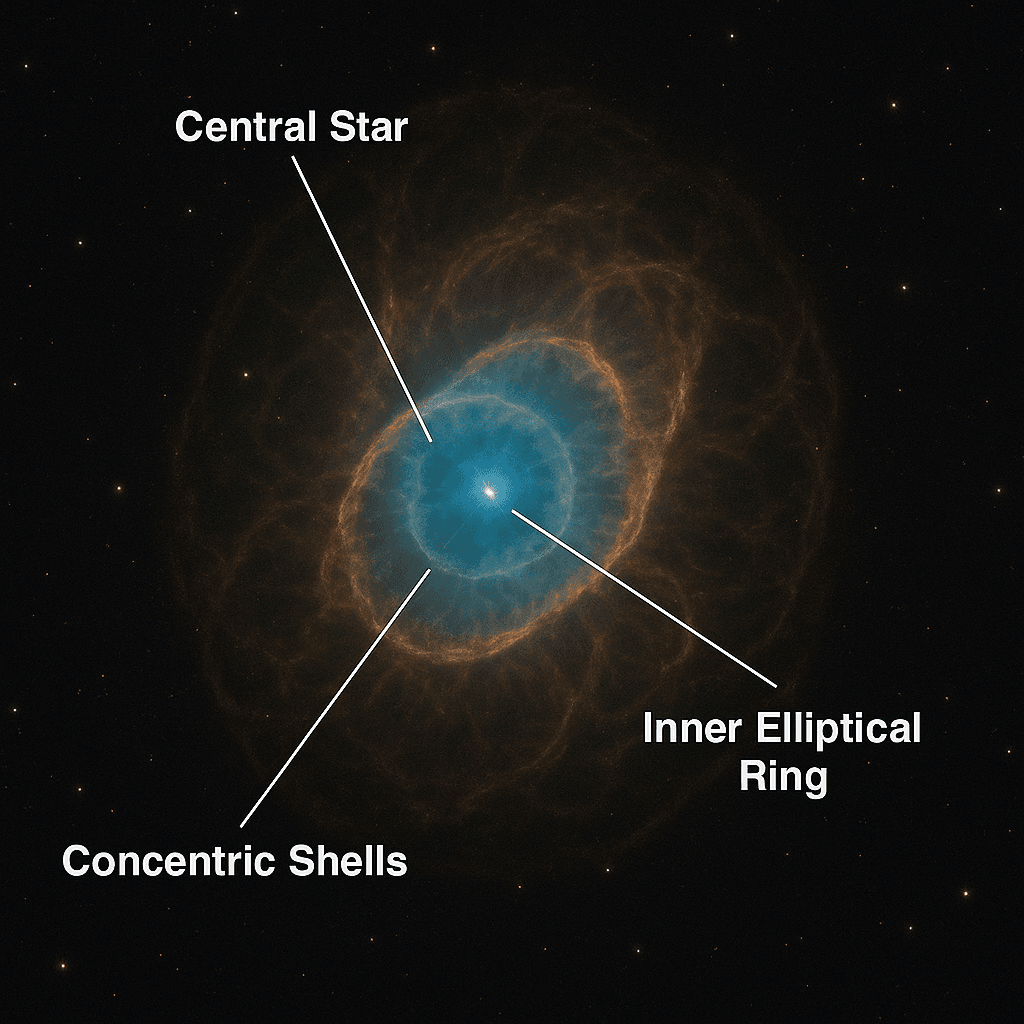
Technical image of the Cat’s Eye Nebula generated by Artificial Intelligence.
The concentric rings observed in the Cat’s Eye Nebula were formed by the star’s pulsational ejections of gas layers. The regularity of these structures results from sudden energy releases occurring at specific intervals during the central star’s evolutionary process.
NGC 6543 is among the most complex structures known among planetary nebulae. The jets, shock waves and bipolar features observed in its structure are the result of interactions between stellar winds and the surrounding environment. Some studies suggest that the central star may be part of a binary system. Such a binary configuration could help explain the symmetry of the gas outflows and shell formations.
Images obtained by the Hubble Space Telescope have played a critical role in revealing the structural details of the Cat’s Eye Nebula. These images show that the inner shells consist of high-density gas, while the outer rings contain lower-density material. Additionally, X-ray observations have confirmed the presence of gas clouds at temperatures of millions of degrees at the nebula’s center.

"Caldwell 6." NASA Science – Hubble Caldwell Catalog. Location of the Cat’s Eye Nebula -
NGC 6543 is important not only for its aesthetic qualities but also for testing evolutionary models of stars. This nebula offers a unique laboratory for understanding how medium-mass stars die and how they enrich the galactic environment with material. Its multilayered structure is especially valuable for modeling changes in stellar winds over time and their interactions with the surrounding medium.
Planetary nebulae play a crucial role in recycling heavy elements such as carbon and oxygen back into the interstellar medium. These elements are essential for the formation of new stars and planetary systems. In this context, objects like the Cat’s Eye Nebula serve as key indicators for understanding the chemical evolution of the interstellar medium.
The Cat’s Eye Nebula holds a unique position among planetary nebulae due to its morphology and evolutionary history. Its multilayered structure, chemical composition and dense, hot central core provide deep insights into the advanced stages of stellar evolution.
Thanks to modern astronomical observatories such as the Hubble Space Telescope and the Chandra X-ray Observatory, such celestial objects can now be studied in greater detail, yielding more information about the life cycles of stars. The Cat’s Eye Nebula is not only a cornerstone of astronomical science but also a vital component of our understanding of cosmic history.

Henüz Tartışma Girilmemiştir
"Cat's Eye Nebula" maddesi için tartışma başlatın
General Properties
Formation and Evolutionary Process
Morphological Complexity
Hubble Observations
Scientific Significance