

Bu içerik Türkçe olarak yazılmış olup yapay zeka ile otomatik olarak İngilizceye çevrilmiştir.
+1 Daha
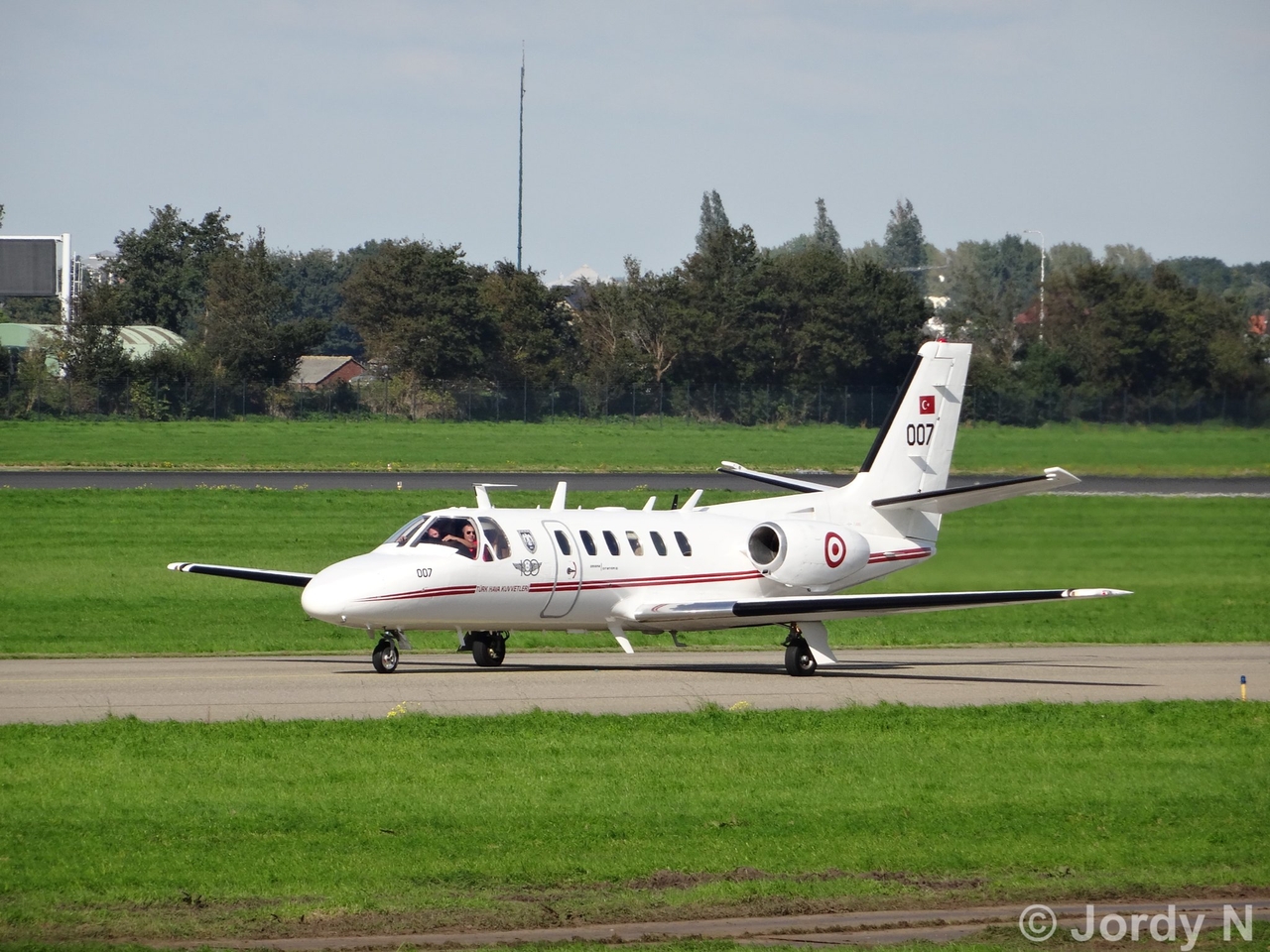
The is a twin-engine, pressurized turbofan aircraft belonging to the light business jet category, developed and manufactured by Cessna Aircraft Company. It is a member of the Cessna Citation family and is defined as a stretched and performance-enhanced derivative of the Citation I, the first model in this family.
In international civil aviation classifications, the Cessna Citation II is categorized under narrow-body, fixed-wing, multi-engine jet aircraft and is assigned the ICAO type code L2J. The aircraft was primarily designed for corporate transportation, private aviation, government and military missions, as well as research and test platform applications.

Cessna Citation II (Rob Hodgkins)
The development of the Cessna Citation II was initiated in response to criticisms of the Citation I model regarding its limited range and relatively low cruise speed. Designated as Model 550, the Citation II was announced in September 1976, made its first flight on 31 January 1977, and entered service after completing certification in March 1978.
Production began in 1978 and continued until 2006, encompassing the base Citation II model as well as variants such as the single-pilot certified Citation II/SP, the improved Citation S/II, and the subsequent Citation Bravo. A total of 1,184 aircraft from the Citation II family were produced, a significant portion of which entered the inventories of military and public institutions alongside civilian operators.
Throughout its production life, the Citation II gained widespread use in various regions due to its short-field performance, twin-engine jet configuration, and cabin layout suited for corporate transportation.
The fuselage of the Cessna Citation II is designed around an aluminum alloy semi-monocoque structure. The aircraft has an overall length of approximately 14.40 metres, a wingspan of approximately 15.9 metres, and a height of approximately 4.57 metres.
The pressurized cabin offers an average height of 1.42–1.43 metres and a width of approximately 1.46–1.47 metres. The cabin length is approximately 4.8 metres, with a total cabin volume of approximately 8.3 m³.
The Citation II is equipped with two Pratt & Whitney Canada JT15D-4 or JT15D-4B turbofan engines. Each engine delivers a takeoff thrust of approximately 2,500 lbf (11.1 kN). The engines are mounted on the rear fuselage, a configuration that contributes to reduced cabin noise levels.
The aircraft’s maximum cruise speed is reported to be in the range of 355–403 knots (657–746 km/h). The service ceiling is defined as 43,000 ft (approximately 13,100 m).
The range varies between approximately 1,900–2,000 nautical miles (approximately 3,500–3,700 km), depending on configuration and load. The takeoff distance at sea level is approximately 990–1,050 metres, while the landing distance is approximately 900 metres.
In standard configuration, the Citation II is fitted with analog flight and navigation systems manufactured by Sperry and Collins. The aircraft is certified for operation by either a single pilot or two pilots, depending on the variant.
The passenger capacity typically ranges from 6 to 8 passengers, with additional seating configurations available in some variants. The baggage compartment volume is specified as approximately 2.18 m³.

Cessna Citation II (Armada)
The Cessna Citation II has been widely used in civil aviation for private business jets, charter operations, and corporate transportation. Additionally, it has been adopted by the air forces, coast guard, and government agencies of many countries.
The T-47A variant operated by the United States Navy was used for radar systems training.
Furthermore, the Dutch National Aerospace Laboratory (NLR) has modified a Citation II to serve as a research platform for flight testing, aerodynamic research, and avionics system evaluations.
The Cessna Citation II family includes the base Model 550 Citation II, the single-pilot certified Model 551 Citation II/SP, the Citation S/II with an improved wing profile, and the Citation Bravo variant featuring more powerful engines and modernized systems.
In addition, certain aircraft have undergone certified modification programs by third-party firms involving engine replacements, avionics upgrades, and structural improvements.

Cessna Citation II (Rob Hodgkins)
Over its long service life, the Cessna Citation II family has been involved in various accidents and serious incidents across multiple countries. These include accidents during takeoff and landing phases, technical failures, and operational-related events.
On 18 December 2025, a Cessna Citation II aircraft crashed during an emergency landing at Statesville Regional Airport in North Carolina, United States, resulting in the loss of all six people on board. Following the incident, the U.S. Federal Aviation Administration (FAA) and the National Transportation Safety Board (NTSB) initiated technical and operational investigations.

Henüz Tartışma Girilmemiştir
"Cessna Citation II" maddesi için tartışma başlatın
Development Process and Historical Background
Technical Specifications
Fuselage, Dimensions and Structural Features
Engine and Power System
Performance Data
Avionics Systems and Capacity
Operational Use and Application Areas
Variants and Modifications
Accidents, Incidents and Losses