


Bu içerik Türkçe olarak yazılmış olup yapay zeka ile otomatik olarak İngilizceye çevrilmiştir.
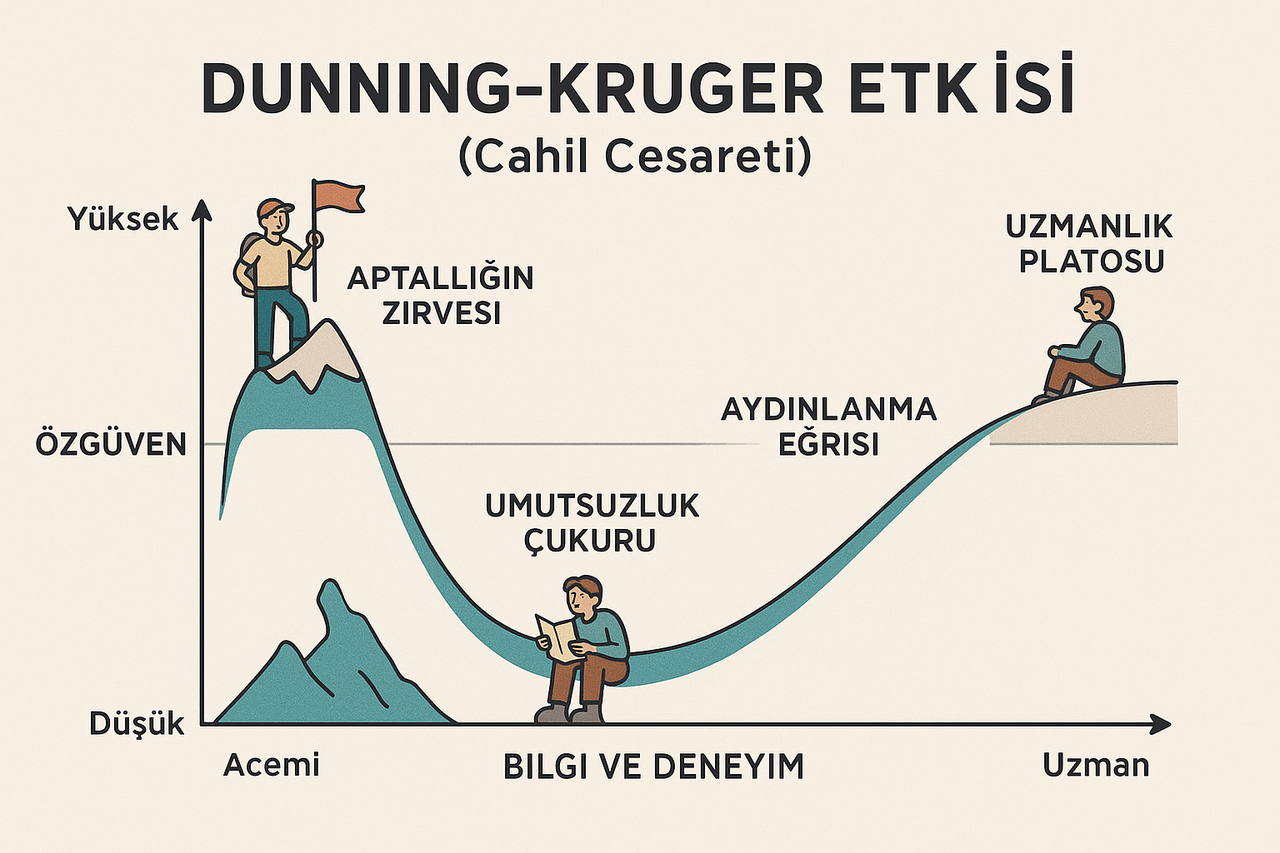
Dunning Kruger Etkisi (Yapay Zeka Tarafından Oluşturulmuştur)
The Dunning-Kruger effect is a cognitive bias in psychology that examines the relationship between individuals’ actual competence in a specific domain and their self-assessment of that competence. First proposed in 1999 by social psychologists David Dunning and Justin Kruger, the theory posits that individuals with limited knowledge or skill in a particular area tend to overestimate their performance and abilities. Conversely, individuals with high competence in the relevant domain may underestimate their own skills and knowledge levels. In Turkish, the effect is often associated with the phrase “foolish courage.”
The Dunning-Kruger effect is a type of cognitive bias that describes how individuals with low competence in a specific domain are also deficient in their ability to recognize their own inadequacies. This leads them to perceive their performance as significantly higher than it actually is. The effect is based on two key observations:
This cognitive bias is defined as a psychological phenomenon arising when an individual lacks metacognitive self-awareness and is therefore unable to objectively assess their level of competence.
The underlying idea of the Dunning-Kruger effect is not new. In the 19th century, naturalist Charles Darwin noted this phenomenon when he wrote, “Ignorance more frequently begets confidence than does knowledge.”
The modern psychological origin of the effect stems from an incident in 1995. A man named McArthur Wheeler, believing that lemon juice could act as invisible ink, smeared it on his face and attempted to rob two banks, convinced he would not be recognized by surveillance cameras. Wheeler’s illogical behavior and unwavering confidence caught the attention of David Dunning and his graduate student Justin Kruger at Cornell University, prompting them to investigate the psychological mechanisms behind such errors in self-assessment.
In 1999, Dunning and Kruger introduced the theory to the scientific community through their article titled “Unskilled and Unaware of It: How Difficulties in Recognizing One's Own Incompetence Lead to Inflated Self-Assessments” published in the Journal of Personality and Social Psychology. This study was based on a series of experiments in areas such as humor, logic, and grammar. The theory earned Dunning and Kruger the Ig Nobel Prize in 2000.
The theoretical foundation of the Dunning-Kruger effect lies in the idea that an individual’s competence in a domain is intrinsically linked to their ability to evaluate their own performance in that domain. Incompetent individuals lack the standards, knowledge, or rules required to accurately assess their performance, and therefore cannot recognize their own inadequacies.
The effect is commonly visualized as a curve illustrating the relationship between knowledge or experience and self-confidence. This curve typically consists of the following stages:
The point at which individuals with very little knowledge about a subject exhibit the highest level of confidence. At this stage, the person is unaware of how complex the subject truly is.
As individuals acquire more knowledge and experience, they begin to recognize how little they know and how deep the subject matter is. This awareness leads to a sharp decline in self-confidence.
As individuals continue to learn and gain experience, their knowledge and competence increase. Along with this growth, their self-confidence also rises again—but now in a more realistic and grounded manner.
As individuals become experts in the domain, their self-confidence reaches a high and stable level, though it rarely reaches the excessive levels seen at the Peak of Stupidity.
Dunning and Kruger’s 1999 study summarized the effect through four key findings:
The Dunning-Kruger effect is closely related to the phenomenon of overconfidence and is viewed as one of its underlying mechanisms. In psychological literature, overconfidence is defined as an individual’s excessive belief in the accuracy of their knowledge. The Dunning-Kruger effect argues that this overconfidence is particularly prevalent among individuals with low levels of knowledge.
Some studies in machine learning and cognitive science approach the Dunning-Kruger effect from a different perspective. One interpretation suggests that an individual’s confidence in a subject is inversely proportional to the time required to access specific knowledge about it. The faster the access to information (i.e., the less and more superficial the data processed in the brain), the higher the confidence may be. This parallels the concept of the “curse of dimensionality” in machine learning, where an excess of data (dimensions) impairs system performance. This model explains the phenomenon by treating the human brain as a storage system.
The effect is clearly observable among investors in financial markets. Individuals with limited financial literacy or investment experience may make overly confident decisions based on their restricted knowledge. This often manifests as blind adherence to simplistic strategies such as “buy low, sell high,” excessive trading, and ultimately financial losses. For example, an economist without sufficient expertise frequently appearing on television programs to make definitive statements about capital markets can be seen as a manifestation of this effect.
Studies have demonstrated the presence of the Dunning-Kruger effect in students’ self-assessments of academic performance. For instance, students who score poorly on exams often believe they performed well, while high-performing students tend to evaluate their performance more modestly. Similarly, a study on aviation students found that those with low scores overestimated their abilities, while those with high scores underestimated them.
Business managers who perceive themselves as more competent than the average manager, individuals with weak social skills who describe themselves as adept at making friends, or employees who have never managed a project but consider themselves top-tier project managers—all represent everyday manifestations of the effect.
The effect has been studied and evidenced in various other domains, including political knowledge perception, information literacy, and organizational communication.
The primary way to overcome the Dunning-Kruger effect is through education and feedback. Research shows that training low-competence individuals not only improves their skills but also enables them to recognize their previous inadequacies and make more accurate self-assessments.
As individuals become more competent in a particular area, they gain a deeper understanding of its complexity and the limits of their own knowledge. This replaces the initial unfounded confidence with a more realistic and grounded self-assessment. Therefore, educating individuals in logical reasoning and providing them with objective feedback on their performance is considered a strategy for mitigating this cognitive bias. In fields such as financial markets, increasing financial literacy is viewed as a prerequisite to prevent investors from falling into this trap.

Dunning Kruger Etkisi (Yapay Zeka Tarafından Oluşturulmuştur)
Henüz Tartışma Girilmemiştir
"Dunning-Kruger Effect (Ignorance Bias)" maddesi için tartışma başlatın
Historical Development and Origins
Theoretical Approaches and Key Findings
The Dunning-Kruger Curve
Peak of Stupidity
Valley of Despair
Slope of Enlightenment
Plateau of Sustainability
Key Findings
Related Theoretical Perspectives
Overconfidence
Relationship with the Curse of Dimensionality
Applications and Examples
Finance and Investment Markets
Education and Academic Performance
Professional Life and Social Relationships
Other Areas
Related Debates and Proposed Solutions