

+2 Daha


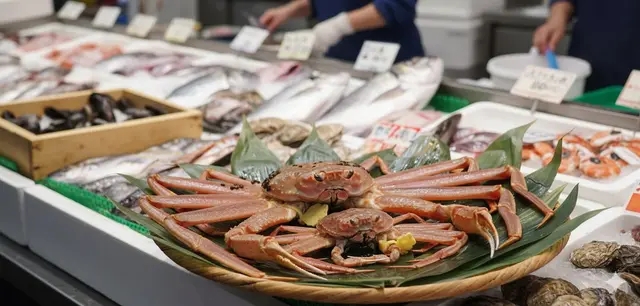
Echizen Gani / Echizen Kani (Generated by Artificial Intelligence)
Echizen Gani is a snow crab variety native to Fukui Prefecture, Japan, and is known as both "Echizen Gani" and "Echizen Kani." It is registered as a Geographical Indication (GI) in the seafood category. It is recognized in Japan as a representative aquatic product of the prefecture, its price per weight exceeds the national average, and its quality makes it a local specialty of Fukui Prefecture.
The production area for Echizen Gani is Fukui Prefecture. The sea west of the Noto Peninsula in the Sea of Japan is home to snow crabs and a fishing ground for Japan. The topography off the Echizen Coast, in particular, is characterized by a drop in depth, which has contributed to the creation of a fishing ground for snow crabs a short distance from the coast. This geographical advantage has made Fukui Prefecture a traditionally known producer of snow crabs.
The Echizen Coast refers to the Sea of Japan coastline centered on Cape Echizen in north-central Fukui Prefecture, and is a tourist area consisting of continuous coastal terraces formed by coastal uplift and rocky coastal landscapes formed by wave erosion. It is often sold retail as boiled snow crab.
About Echizen Gani and Echizen Kani (地理的表示産品情報発信サイト)
This crab is caught by bottom trawling offshore and in surrounding marine areas of Fukui Prefecture and landed in ports in Fukui Prefecture. One of the key characteristics of Echizen Gani is that it is stored at cool temperatures immediately after capture until it reaches its landing port. This practice ensures the preservation of the freshness and quality of its meat, which can be off-season, and its flavored crab paste (kanimiso) and ovaries (uchiko). Kanimiso is the paste-like substance found when the shell is removed, biologically referred to as the hepatopancreas (digestive gland).
Echizen Gani are caught by offshore bottom trawling or small boat bottom trawling in designated fishing areas of Fukui Prefecture and are landed only in Fukui Prefecture ports. These fishing areas include the surrounding sea areas west of the Noto Peninsula in the Sea of Japan. Immediately after catching, the crabs are stored in seawater tanks cooled by refrigeration systems or in fish boxes with ice beds. There are established standards for shipping: Male crabs must have a shell width of 9 cm or more, but newly molted soft-shell crabs (mizugani) are not included in this standard. Female crabs must be mature, spawned, and carrying their eggs in their abdomens; the exception is akako crabs, which carry unfertilized, unobserved red eggs. The region has a tradition of "rigorous distributors" in the snow crab trade, requiring fishermen to consistently land crabs of sufficient quality.

Echizen Gani / Echizen Kani (Generated by Artificial Intelligence)
Henüz Tartışma Girilmemiştir
"Echizen Gani / Echizen Kani" maddesi için tartışma başlatın
Geographical Conditions
Characteristics and Hunting
Production Method and Shipping Standards
Bu madde yapay zeka desteği ile üretilmiştir.