


Bu içerik Türkçe olarak yazılmış olup yapay zeka ile otomatik olarak İngilizceye çevrilmiştir.
Epistemic disobedience (epistemic disobedience) is a theoretical framework that seeks to delink knowledge production and knowledge itself from geopolitics and to dismantle colonial power dynamics. The term was introduced into the literature in 2009 through Walter Mignolo’s article titled "Epistemic Disobedience, Independent Thought and De-Colonial Freedom".【1】 At its core, it involves rejecting the hegemonic epistemic valuation rules imposed by Eurocentric and imperial knowledge systems and engaging in modes of thought grounded in epistemologies marginalized outside the colonial matrix of power.【2】
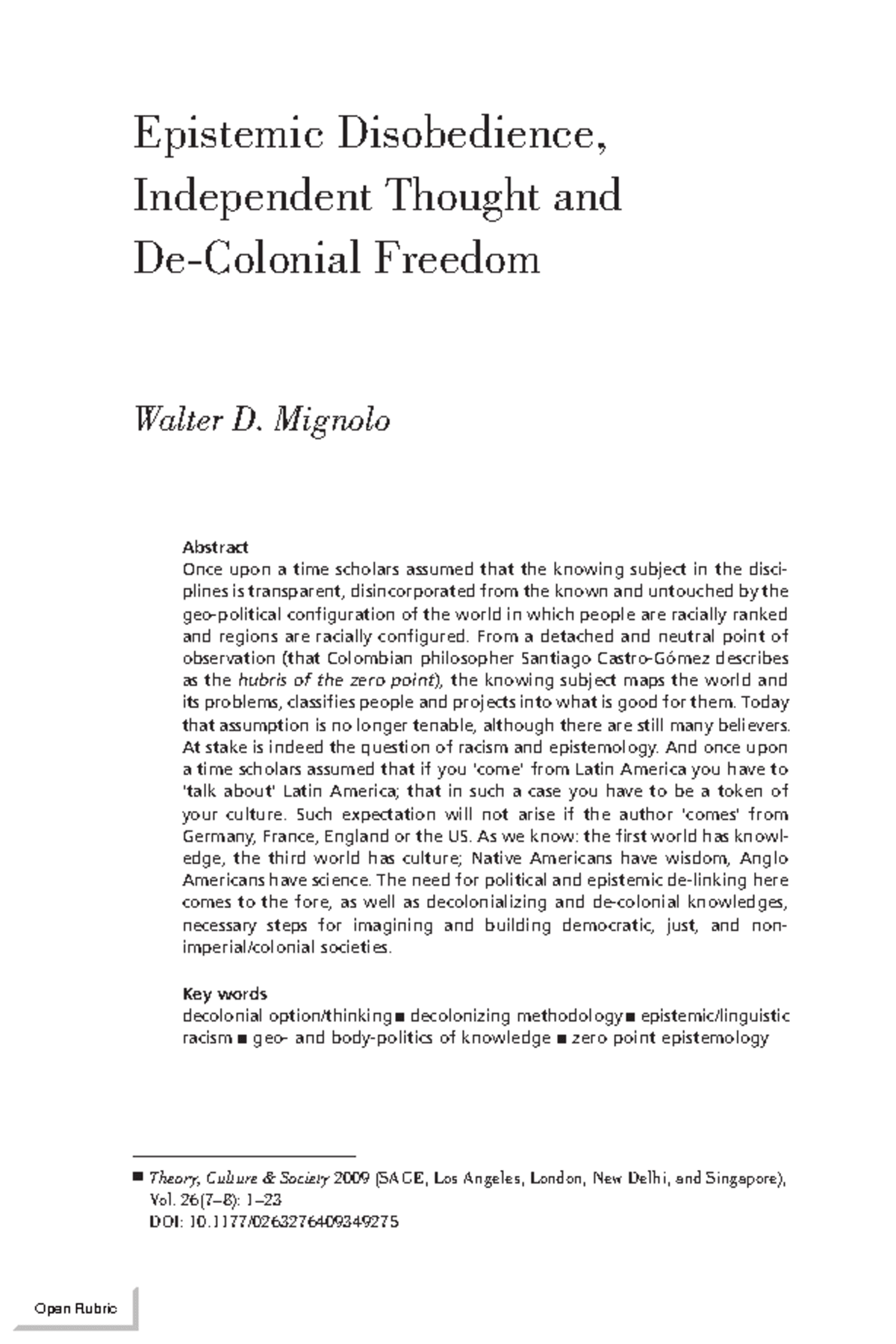
Walter Mignolo Tarafından Epistemik İtaatsizlik Kavramının Literatüre Kazandırıldığı Makale Kapağı (Sage Journals)
Epistemic disobedience, as part of the broader project of decoloniality, draws its political and philosophical roots from the Bandung Conference of 1955, which brought together 29 countries.【3】 The conference’s primary aim was to chart a path of decolonization that refused alignment with either capitalism or communism and sought to break away from both dominant Western macro-narratives.【4】
The historical genealogy of the concept within decolonial thought extends back to figures such as Waman Puma de Ayala in the 16th century in Tawantinsuyu (the Inca Empire) and Ottobah Cugoano, a formerly enslaved man in 18th century England.【5】 These thinkers challenged the emancipatory and progressive rhetoric of modernity, critiquing imperial exploitation through Christian ethics and opening a space for thought outside European political theory.【6】 At the same time, Frantz Fanon’s concept of “sociogenesis” is also regarded as a foundational example of epistemic disobedience, as it represents an epistemic rupture from Western categories of phylogenesis and ontogenesis in order to account for the experiences of racialized subjects.【7】
Epistemic disobedience finds application beyond decolonial theory in various fields such as sociology and public health:
McGovern, Justine, and Lisa Fusco. "70 years of decoloniality: epistemic disobedience and global public health." *Frontiers in Public Health* 13 (2025): 1-5. Accessed August 15, 2026.https://www.frontiersin.org/journals/public-health/articles/10.3389/fpubh.2025.1658591/full
Meghji, Ali. "Dwelling in epistemic disobedience: A reply to Go." *The British Journal of Sociology* 74, no. 3 (2023): 294-301. Accessed August 15, 2026.https://onlinelibrary.wiley.com/doi/epdf/10.1111/1468-4446.12987
Mignolo, Walter. "Epistemic Disobedience and the Decolonial Option: A Manifesto." *Transmodernity: Journal of Peripheral Cultural Production of the Luso-Hispanic World* 1, no. 2 (2011): 44-66. Accessed August 15, 2026.https://escholarship.org/content/qt62j3w283/qt62j3w283.pdf
Mignolo, Walter. "Epistemic Disobedience, Independent Thought and De-Colonial Freedom." *Theory, Culture & Society* 26, no. 7-8 (2009): 159-181. Accessed August 15, 2026.https://doi.org/10.1177/0263276409349275
Mignolo, Walter. "Geopolitics of sensing and knowing: On (de)coloniality, border thinking, and epistemic disobedience." *Confero* 1, no. 1 (2013): 129-150. Accessed August 15, 2026.https://journal.ep.liu.se/confero/article/view/3593
Saint-Tepes. "Colonialism Imperialism World Map." DeviantArt. Accessed August 15, 2026.
Vitantonio, Carla. "Decolonizing the aid sector: How the Global Minority is holding onto power through language." CDA Collaborative Learning. October 17, 2024. Accessed August 15, 2026.https://www.cdacollaborative.org/blog/decolonizing-the-aid-sector-how-the-global-minority-is-holding-onto-power-through-language/
[1]
Justine McGovern ve Lisa Fusco, "70 years of decoloniality: epistemic disobedience and global public health," Frontiers in Public Health 13 (2025): 1, erişim tarihi 15 Ağustos 2026, https://www.frontiersin.org/journals/public-health/articles/10.3389/fpubh.2025.1658591/full
[2]
Ali Meghji, "Dwelling in epistemic disobedience: A reply to Go," The British Journal of Sociology 74, no. 3 (2023): 295-296, erişim tarihi 15 Ağustos 2026, https://onlinelibrary.wiley.com/doi/epdf/10.1111/1468-4446.12987
[3]
Walter Mignolo, "Geopolitics of sensing and knowing: On (de)coloniality, border thinking, and epistemic disobedience," Confero 1, no. 1 (2013): 130; McGovern ve Fusco, "70 years of decoloniality," 2, erişim tarihi 15 Ağustos 2026, https://journal.ep.liu.se/confero/article/view/3593
[4]
Mignolo, "Geopolitics of sensing and knowing," 130.
[5]
Walter Mignolo, "Epistemic Disobedience and the Decolonial Option: A Manifesto," Transmodernity: Journal of Peripheral Cultural Production of the Luso-Hispanic World 1, no. 2 (2011): 47-48, erişim tarihi 15 Ağustos 2026, https://escholarship.org/content/qt62j3w283/qt62j3w283.pdf
[6]
Mignolo, "Epistemic Disobedience and the Decolonial Option," 48.
[7]
Mignolo, "Geopolitics of sensing and knowing," 139-141.
[8]
Mignolo, "Epistemic Disobedience and the Decolonial Option," 46.
[9]
Mignolo, "Epistemic Disobedience and the Decolonial Option," 47; Mignolo, "Geopolitics of sensing and knowing," 133.
[10]
Mignolo, "Geopolitics of sensing and knowing," 131-132.
[11]
Meghji, "Dwelling in epistemic disobedience," 297.
[12]
Meghji, "Dwelling in epistemic disobedience," 298.
[13]
Meghji, "Dwelling in epistemic disobedience," 298.
[14]
Meghji, "Dwelling in epistemic disobedience," 295.
[15]
Meghji, "Dwelling in epistemic disobedience," 296-297.
[16]
McGovern ve Fusco, "70 years of decoloniality," 2.
[17]
McGovern ve Fusco, "70 years of decoloniality," 2-3.

Henüz Tartışma Girilmemiştir
"Epistemic Disobedience" maddesi için tartışma başlatın
Historical and Intellectual Origins
Core Framework and Concepts
Its Place Across Disciplines