


Bu içerik Türkçe olarak yazılmış olup yapay zeka ile otomatik olarak İngilizceye çevrilmiştir.

Ethem Dede
(Generated with Artificial Intelligence)
Other Names | Göbek Atan Ethem Dede Göbekçi İzzet Baba | ||||||||
|---|---|---|---|---|---|---|---|---|---|
Type | Folk belief figure Ancestor cult element | ||||||||
Positions | Bursa (Meydancık Neighborhood) Istanbul (Sulukule) Cyprus (Lefkoşa) | ||||||||
Mode of Recognition | Prayer for a child Ritual belly beating at the grave | ||||||||
Purpose of Visit | To have a baby (to desire a child) To find lost objects and people | ||||||||
Ethem Dede (Göbek Atan Ethem Dede / Göbekçi İzzet Baba) is a folk figure in Turkish popular culture associated with rituals surrounding tomb and grave visits, for whom no official historical records exist.
Ethem Dede is a well-known figure of popular belief and saintly veneration whose existence and image have been sustained through oral traditions and hagiographic narratives, with no definitive information found in official historical documents or written sources. Despite lacking a verifiable historical identity or inscribed epitaphs, he is regarded by the public as a saint whose prayers are accepted, a site for making vows, and a source of divine aid. In Turkish cultural tradition, the title "dede", given to individuals possessing knowledge and experience, signifies his positioning in popular consciousness as an ancestral and spiritual guide.

Ethem Dede Tasviri (Yapay Zekâ ile Oluşturulmuştur)
Narratives regarding Ethem Dede’s origins and identity vary by region and period:
In popular accounts from Bursa, it is said that he was a soldier or commander who lived during the reign of Yıldırım Bayezid.【1】According to this narrative, Ethem Dede vowed to perform three belly jumps if his side won a battle; after the victory, he fulfilled his vow by being struck by an arrow and martyred, subsequently buried at the place where he died.【2】
In oral traditions from Istanbul and its surroundings, he is described as one of Fatih Sultan Mehmed’s bearded attendants or as a madman who wandered the streets performing belly jumps. It is also reported that residents of the Roman neighborhood in Sulukule, Istanbul, believe Ethem Dede brought the first settlers to the area and founded the neighborhood himself.【3】
The miracles attributed to him and his spiritual roles have evolved over time. Initially, he was described as a saint whose divine standing facilitated the acceptance of prayers, particularly sought by women hoping to conceive and those searching for lost belongings or relatives. However, from the late 20th century onward, his identity was transformed under the influence of media, mass communication, and official informational plaques. During this process, new narratives emerged claiming that his real name was "Göbekçi İzzet Baba" or "Göbek Attıran Dede," and that he was not a saint but a folk healer who cured or repositioned herniated abdomens. These narratives were incorporated into collective memory.【4】
Beliefs, narratives, and pilgrimage sites centered on Ethem Dede have not been confined to a single location but have persisted to the present day through various tombs and shrines across different geographical regions. Although no clear information exists in official records or inscriptions, sites attributed to Ethem Dede have emerged in settlements such as Bursa, Istanbul, and Cyprus.
The site in Bursa is located in Meydancık, on Yeşil Street in Yeşil Mahallesi. This single tomb structure, built of reinforced concrete, lies beneath a large plane tree at the intersection of two roads within the neighborhood. The grave is surrounded by short iron railings, and on the marble stone only the saint’s name is inscribed, as his birth and death dates are unknown.【5】
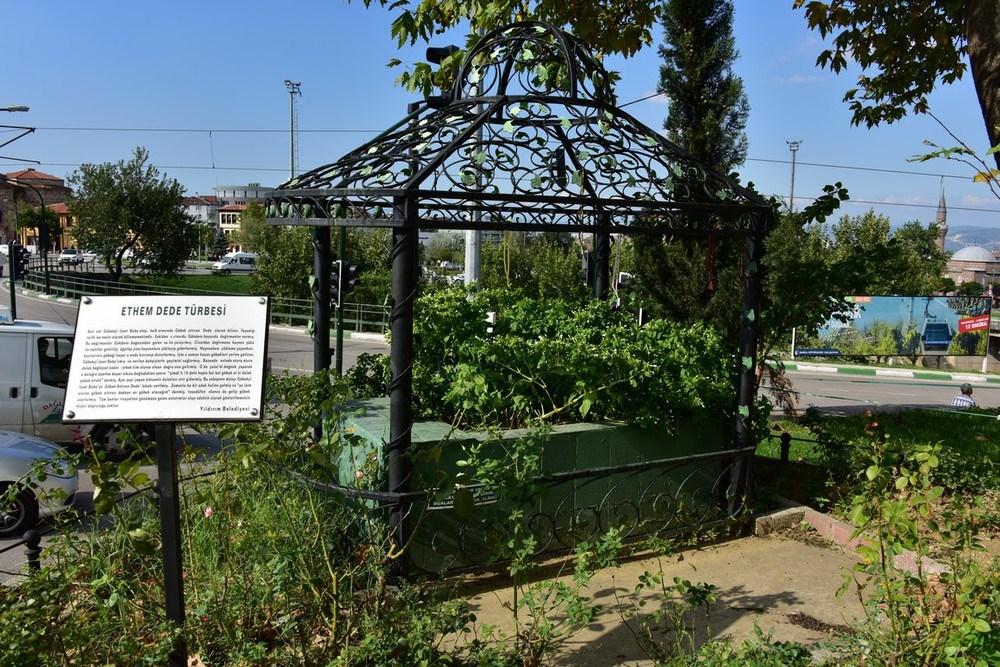
Ethem Dede Türbesi (Yıldırım Kaymakamlığı)
Legends circulating among the public that excavation equipment or bulldozers used during road expansion projects in the area were unable to damage or destroy the tomb have reinforced the site’s perception of sanctity. In later years, during road reorganization, the short railings around the tomb at the four-way intersection were removed, and a fully enclosed cage structure was constructed over and around it.
As part of this change, the marble tombstone was removed and replaced by an informational plaque erected by local authorities near the cage. The plaque, titled "Ethem Dede Türbesi," contains unfounded claims and numerous spelling errors.【6】
The site in Istanbul is located within the historic Sulukule neighborhood, along the inner face of the city walls between Topkapı and Edirnekapı. The tomb, situated on a raised platform, is surrounded by a wooden railing painted green and adorned with pink minarets. Inside the tomb are three green-painted tombstones; one is believed to belong to Fethi Abdullah Paşa, another to one of Fatih Sultan Mehmed’s bearded attendants, and the third to the unidentified Ethem Dede.【7】Behind these tombstones rises a historic service tree taller than the city walls. The site was illuminated at night by a sailor’s lantern and maintained by an elderly woman named "Güllü," who lived in a shanty adjacent to the tomb.【8】This site, frequently visited by Istanbul residents and especially local neighborhood dwellers, serves as the center for vow-making rituals involving belly jumps accompanied by tambourine music.【9】
In addition to the sites in Bursa and Istanbul, traces of the Ethem Dede belief can also be found in Cyprus. In Lefkoşa, it is believed that Ethem Dede’s grave is located next to Deveciler Hanı, where he holds an important place in local folk culture and vow traditions.【10】At this site, candles are lit, alms are distributed to the poor, and belly-jump vows are performed, similar to practices in Anatolia and Istanbul, particularly for the recovery of lost items or the fulfillment of intentions.【11】
The wish rituals performed at the Ethem Dede site possess distinctive characteristics that differentiate them from traditional tomb or grave visitation practices in popular belief. Visitors to this site primarily focus on two main intentions: the desire to have a child and the wish to recover a lost object or person.
After offering prayers and stating their wishes at the site, visitors perform a ritual dance involving belly jumps—a practice not found in other tomb visits—as a form of vow fulfillment. This belly-jump act is directly accepted as an expression of gratitude and devotion.【12】
The belly-jump ritual is not performed randomly but follows symbolic odd numbers—three, five, or seven—as dictated by popular belief.【13】The act is accompanied by rhyming, formulaic chants. Women seeking children recite:Ethem Dede Ethem Dede / Gömleği keten Dede / Al sana göbek / Ver bana bebek Dede, while those seeking lost objects or people recite:Ethem Dede Ethem Dede / Gömleği keten Dede / Yitirdiğimi geri ver / Üç göbek atam Dede.
These wish and ritual patterns have not remained confined to a single region but have been replicated at Ethem Dede sites across different geographies. In the Ethem Dede site in Istanbul’s Sulukule, it is known that women who have had their wishes fulfilled perform the number of belly jumps they vowed, while bystanders beat the tambourine to maintain rhythm, alms are given to poor children and the tomb caretaker, and the vow is completed.【14】Similarly, in Cypriot folk beliefs, when a lost object is sought, a vow is made to perform seven belly jumps, and the ritual is carried out once the object is recovered.【15】
Popular beliefs surrounding Ethem Dede and the ritual dances performed at his site have undergone transformation since the late 20th century due to the influence of mass media, media outlets, and popular culture. Widespread publications, informational plaques, and digital content have created conditions for the alteration of traditional beliefs and practices embedded in the collective memory of local communities.
During the first field research conducted in 1992, Ethem Dede was entirely regarded by the local population as a miracle-working saint and a source of divine aid.【16】At that time, the belly-jump act performed during tomb visits was accepted as a natural folk ritual, performed to complete a prayer, fulfill a vow, and express gratitude. Visitors and neighborhood residents viewed this practice as an integral part of their belief system and did not question its validity.
By 2019, the first cracks in public perception began to emerge due to informational panels installed by local authorities or official institutions and media reports. Media publications questioned Ethem Dede’s traditional image as a saint and promoted alternative narratives claiming he was in fact "Göbekçi İzzet Baba," a folk healer who treated or repositioned herniated abdomens. As a result of these new narratives, Ethem Dede’s status gradually shifted in public perception from a miracle-working saint to that of an ordinary folk healer.【17】
As of 2024, the portrayal of the subject in internet content, YouTube videos, and popular television series such as Süper Baba and Kızılcık Şerbeti has solidified the transformative impact of mass culture. The widespread media narrative that belly-jumping at graves is religiously incorrect, superstitious, or sinful has led even the oldest local residents to reject the traditional knowledge they learned from their ancestors and to doubt their own memories.【18】
Keser, Ulvi. “Kıbrıs Adasında Kadın Eksenli Olarak Adak ve İnanç Dünyasına Kesitsel Bir Bakış”. *Motif Akademi Halkbilimi Dergisi* 3, no. 6 (2010): 108–128. Accessed October 13, 2026.https://dergipark.org.tr/en/pub/mahder/article/410694
Yıldırım Kaymakamlığı. "Ethem Dede Türbesi." Accessed October 13, 2026.https://yildirim.gov.tr/ethem-dede-turbesi
Çobanoğlu, Sacide. “Yığın Kültürü Kuramı ile Göbek Atan Ethem Dede Örnekleminde Halkhayatında Kültürel Tematik Seyir”. *SÜREK Alevilik - Bektaşilik ve Kültür Araştırmaları Dergisi*, no. 4 (2025): 30–52. Accessed October 13, 2026.https://dergipark.org.tr/tr/pub/surekdergi/article/1680449.
İstanbul Ansiklopedisi. "Edhem Dede." Accessed October 13, 2026.https://istanbulansiklopedisi.org/handle/rek/9506.
[1]
Sacide Çobanoğlu, “Yığın Kültürü Kuramı ile Göbek Atan Ethem Dede Örnekleminde Halkhayatında Kültürel Tematik Seyir”. SÜREK Alevilik - Bektaşilik ve Kültür Araştırmaları Dergisi, sy 4: (2025): 40. erişim tarihi: 13 Ekim 2026. https://dergipark.org.tr/tr/pub/surekdergi/article/1680449.
[2]
Çobanoğlu, “Yığın Kültürü Kuramı ile Göbek Atan Ethem Dede Örnekleminde Halkhayatında Kültürel Tematik Seyir”. 37.
[3]
İstanbul Ansiklopedisi, "Edhem Dede." erişim tarihi: 13 Ekim 2026. https://istanbulansiklopedisi.org/handle/rek/9506.
[4]
Çobanoğlu, “Yığın Kültürü Kuramı ile Göbek Atan Ethem Dede Örnekleminde Halkhayatında Kültürel Tematik Seyir”. 47.
[5]
Çobanoğlu, “Yığın Kültürü Kuramı ile Göbek Atan Ethem Dede Örnekleminde Halkhayatında Kültürel Tematik Seyir”. 35-36.
[6]
Çobanoğlu, “Yığın Kültürü Kuramı ile Göbek Atan Ethem Dede Örnekleminde Halkhayatında Kültürel Tematik Seyir”. 39.
[7]
İstanbul Ansiklopedisi, "Edhem Dede."
[8]
İstanbul Ansiklopedisi, "Edhem Dede."
[9]
İstanbul Ansiklopedisi, "Edhem Dede."
[10]
Ulvi Keser, “Kıbrıs Adasında Kadın Eksenli Olarak Adak Ve İnanç Dünyasına Kesitsel Bir Bakış”. Motif Akademi Halkbilimi Dergisi 6, (2010): 125. Erişim tarihi: 13 Ekim 2026. https://dergipark.org.tr/en/pub/mahder/article/410694.
[11]
Keser, “Kıbrıs Adasında Kadın Eksenli Olarak Adak Ve İnanç Dünyasına Kesitsel Bir Bakış”, 125.
[12]
Çobanoğlu, “Yığın Kültürü Kuramı ile Göbek Atan Ethem Dede Örnekleminde Halkhayatında Kültürel Tematik Seyir”. 41.
[13]
Çobanoğlu, “Yığın Kültürü Kuramı ile Göbek Atan Ethem Dede Örnekleminde Halkhayatında Kültürel Tematik Seyir”. 39.
[14]
İstanbul Ansiklopedisi, "Edhem Dede."
[15]
Keser, “Kıbrıs Adasında Kadın Eksenli Olarak Adak Ve İnanç Dünyasına Kesitsel Bir Bakış”. 125.
[16]
Çobanoğlu, “Yığın Kültürü Kuramı ile Göbek Atan Ethem Dede Örnekleminde Halkhayatında Kültürel Tematik Seyir”. 44.
[17]
Çobanoğlu, “Yığın Kültürü Kuramı ile Göbek Atan Ethem Dede Örnekleminde Halkhayatında Kültürel Tematik Seyir”. 44.
[18]
Çobanoğlu, “Yığın Kültürü Kuramı ile Göbek Atan Ethem Dede Örnekleminde Halkhayatında Kültürel Tematik Seyir”. 45-46.

Ethem Dede
(Generated with Artificial Intelligence)
Other Names | Göbek Atan Ethem Dede Göbekçi İzzet Baba | ||||||||
|---|---|---|---|---|---|---|---|---|---|
Type | Folk belief figure Ancestor cult element | ||||||||
Positions | Bursa (Meydancık Neighborhood) Istanbul (Sulukule) Cyprus (Lefkoşa) | ||||||||
Mode of Recognition | Prayer for a child Ritual belly beating at the grave | ||||||||
Purpose of Visit | To have a baby (to desire a child) To find lost objects and people | ||||||||
Henüz Tartışma Girilmemiştir
"Ethem Dede" maddesi için tartışma başlatın
Definition and Identity
Geographical Spread and Sites
Wish Rituals and the Belly-Jump Act
The Impact of Media and Mass Culture on Perception Shifts