Bu içerik Türkçe olarak yazılmış olup yapay zeka ile otomatik olarak İngilizceye çevrilmiştir.
+1 Daha
Location | Near Dalyan village Çanakkale Ezine district | ||||||||
|---|---|---|---|---|---|---|---|---|---|
Depth(s) | 2 to 3 metres | ||||||||
Color Change | It is caused by the proliferation of the microscopic algae Dunaliella salina. | ||||||||
Scientific Importance | It is studied in terms of microbial diversity. The discovery of new microorganisms and the presence of microorganisms with biotechnological potential are being investigated. | ||||||||
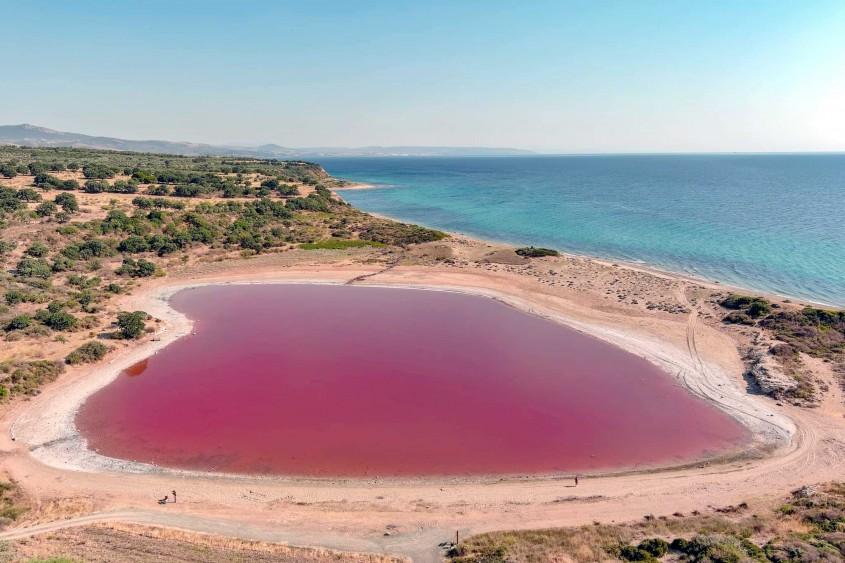
Pembe Göl (Kalpli Göl) is a lake located near Dalyan Village in the Ezine district of Çanakkale, within the boundaries of the ancient city of Alexandria Troas. Known for its water turning pink or reddish hues during certain times of the year, the lake is also referred to as Pembe Göl. This area, once used as an inland harbor, has gradually transformed into a lake through natural processes. Its heart-shaped form emerges due to fluctuations in water levels.

Pembe Göl (Anadolu Agency)
Pembe Göl is situated on a former inland harbor area of the ancient city of Alexandria Troas, near Dalyan Village in the Ezine district of Çanakkale Province. The lake has a depth of approximately 2 to 3 meters, and its water level varies throughout the year. During the summer months, as the water level recedes, the lake assumes a heart-shaped form, accompanied by noticeable color changes. When salinity and temperature rise, the water takes on pinkish and reddish tones. This coloration results from the dense proliferation of the microscopic organism Dunaliella salina. Thanks to its natural conditions and geographical characteristics, Pembe Göl has become a site of interest for both scientific research and tourism.
Pembe Göl hosts an ecosystem notable particularly for its microbial diversity. The saline and warm water conditions support the survival of certain microorganisms. Among these, the phytoplankton Dunaliella salina is responsible for the pinkish and reddish hues observed in the lake. In addition, various bacteria, molds, and yeasts are also present. Scientists anticipate that the microorganisms in the lake, especially endemic species, may make significant contributions to Türkiye’s microbial biodiversity. Research has increased the likelihood of discovering previously unknown microbial species in the lake. This biological diversity not only helps maintain ecological balance but also offers considerable potential for biotechnological applications.
The color changes in Pembe Göl are caused by environmental factors such as high salinity and temperature. These conditions, especially during summer, trigger excessive reproduction of the microscopic algae Dunaliella salina. The pigments produced by these algae cause the water to take on pink or reddish tones. As the lake exhibits different colors throughout the year, these variations reflect changes in its chemical composition. Such shifts in water chemistry are an important subject of study for understanding how microorganisms adapt and respond to environmental changes. The salinity and chemical composition of the lake also influence the sustainability of its ecosystem.
Pembe Göl is located on the site of what was once the inland harbor of the ancient city of Alexandria Troas. This ancient city functioned as an important commercial center during the Roman period and served as a port for exporting large structures such as granite columns. Over time, as economic conditions in the city changed, the use of the inland harbor ceased, and the area gradually transformed into a lake through natural processes. The current form of Pembe Göl developed atop the remnants of the Roman harbor, giving it historical significance both in terms of the ancient city and the natural environment.
Pembe Göl is a focal point of scientific research due to its biological and microbiological diversity. Çanakkale Onsekiz Mart University (ÇOMÜ) and other research institutions regularly collect and analyze samples from the lake to study its microorganisms. These studies may lead to the discovery of new species contributing to Türkiye’s microbial flora. Scientists are particularly investigating the potential biotechnological applications of algae such as Dunaliella salina and other microscopic organisms in the lake. Furthermore, research on the lake’s ecosystem suggests the presence of microorganisms that could be beneficial in fields ranging from new antibiotic discoveries to the food industry. These findings demonstrate that Pembe Göl is not only a natural beauty but also a scientifically valuable site.
Pembe Göl is an ecosystem requiring careful monitoring for environmental protection and sustainability. Salinity and temperature levels in the lake directly affect the survival of microorganisms. Therefore, maintaining a balance in environmental factors is crucial for the healthy persistence of the lake’s ecosystem. Scientific studies aimed at preserving the lake’s biological diversity seek to identify potential environmental threats and implement preventive measures. As the lake’s tourist appeal grows, managing the associated environmental impacts becomes increasingly important. Various local and regional projects are being developed to protect the lake, promote sustainable tourism, and reduce negative ecological effects. In this context, regulatory measures around the lake and awareness campaigns contribute to preserving ecological balance.
"Project Submitted to TÜBİTAK for Study of the Pink Lake in Çanakkale." Anadolu Ajansı. January 3, 2023. Accessed July 7, https://www.aa.com.tr/tr/gundem/canakkaledeki-pembe-golun-incelenmesi-icin-tubitaka-proje-sunuldu-/2758423.
"Scientists Are Trying to Discover New Species of Microorganisms in LakeKalpli Göl Çanakkale." *Anadolu Ajansı*. July 3, 2024. Accessed July 7, https://www.aa.com.tr/tr/bilim-teknoloji/bilim-insanlari-canakkaledeki-kalpli-golde-yeni-tur-mikroorganizmalar-kesfetmeye-calisiyor/3002770.
Anadolu Ajansı. "Pembe Göl" başlıklı haber kapsamında kullanılan görsel. Accessed July 7, https://cdnuploads.aa.com.tr/uploads/Contents/2023/09/28/thumbs_b_c_f45b6ae2dc9b47ef46d86bef8ef0024b.jpg?v=132757.
Çanakkale Bisiklet Platformu. "Ezine Pembe Göl Turu." Accessed July 7, 2025. https://www.canakkalebisikletplatformu.org/rota/ezine-pembe-gol-turu/.
Çanakkale Travel. “Pembe Göl TÜBİTAK Projesi ile İncelenecek.” Görsel. December 18, 2022. Accessed July 7, 2025. https://www.canakkaletravel.com/images/news/l/pembe-gol-tubitak-projesi-ile-incelenecek-81646.jpg.

Location | Near Dalyan village Çanakkale Ezine district | ||||||||
|---|---|---|---|---|---|---|---|---|---|
Depth(s) | 2 to 3 metres | ||||||||
Color Change | It is caused by the proliferation of the microscopic algae Dunaliella salina. | ||||||||
Scientific Importance | It is studied in terms of microbial diversity. The discovery of new microorganisms and the presence of microorganisms with biotechnological potential are being investigated. | ||||||||
Henüz Tartışma Girilmemiştir
"Ezine Pink Lake (Kalpli Lake)" maddesi için tartışma başlatın
Geographical Features
Biological Diversity
Color Variation and Chemical Properties
Historical Significance
Scientific Research and Discoveries
Environmental Protection and Sustainability