

+1 Daha


The painting Frederick the Great Playing the Flute at Sanssouci, created by Adolph Menzel between 1850 and 1852, depicts a scene in which Frederick II is playing the flute at Sanssouci Palace in Potsdam, accompanied by his fellow musicians. Through music and aesthetic values, Menzel symbolically represents the intellectual and cultural side of the Prussian monarch, Frederick II.
Menzel’s detailed technique aims to convey the cultural atmosphere of the era. The arrangement of figures, the architectural elements of the setting, and the interplay of light and shadow reflect the characteristic features of 19th-century German painting, creating a historical and ideological narrative. Today, the work is exhibited in the collection of the Alte Nationalgalerie in Berlin.
The composition and iconography of Frederick the Great Playing the Flute at Sanssouci reflect Adolph Menzel’s blend of historical realism and symbolic storytelling. Menzel employs an orderly, hierarchical structure that places Frederick II in a central position. The figures are arranged according to perspective rules that emphasize spatial depth. The architectural details of Sanssouci Palace are prominently featured in the background, reinforcing the historical context. The distribution of light and shadow highlights the three-dimensionality of the scene, naturally directing the viewer’s attention to Frederick II.
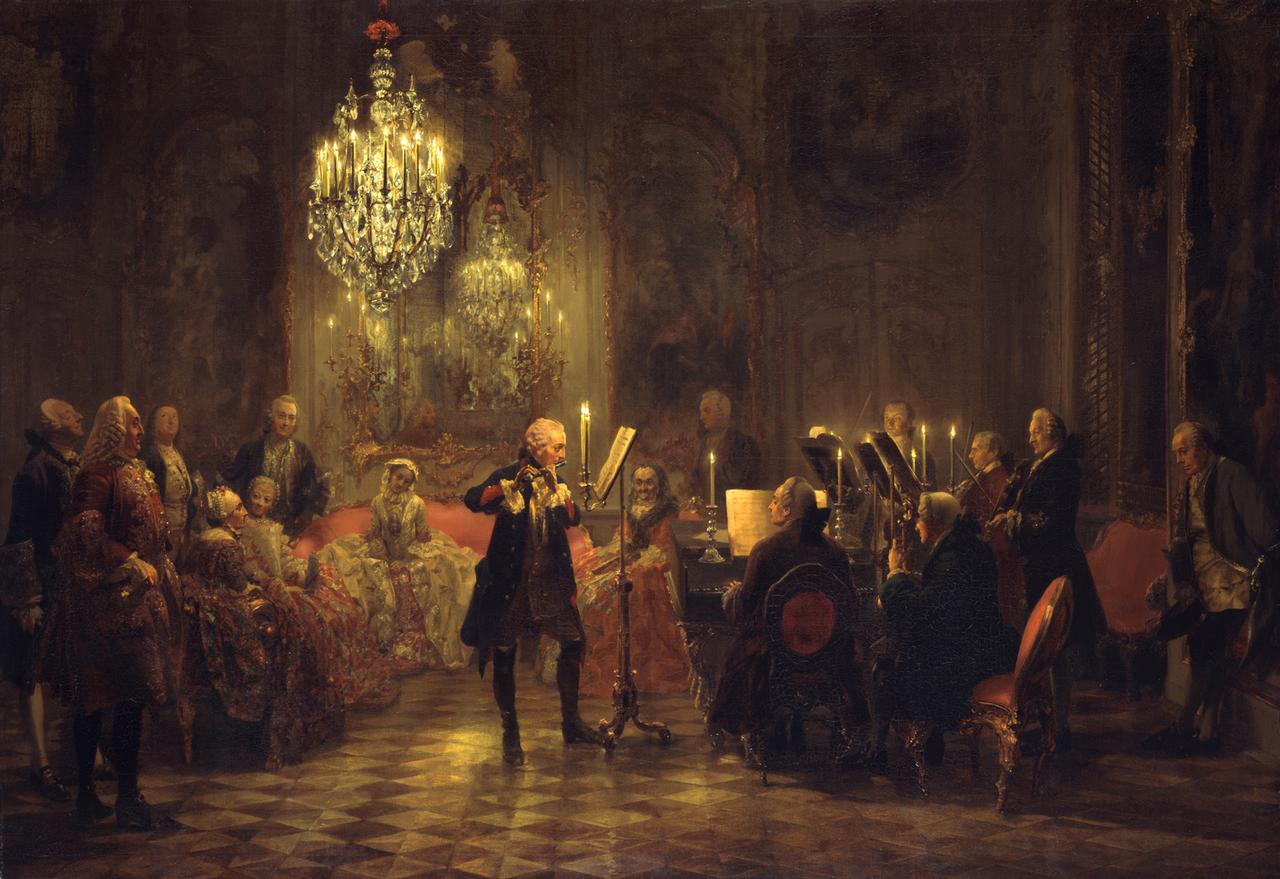
The Flute Concert with Frederick the Great at Sanssouci (Source: Staatliche Museen zu Berlin)
The painting portrays an evening concert held in honor of Frederick’s sister, Margravine Wilhelmine of Bayreuth, during her visit to Potsdam in 1750. The concert takes place in a hall at Sanssouci Palace, illuminated by the atmospheric glow of candles and chandeliers. The décor of the venue is notable for the decorative work of court painter Antoine Pesne and plasterer Johann August Nahl. 【1】
In the composition, the learned Wilhelmine—also a composer—appears seated on a bright red sofa, her head bowed thoughtfully beside Princess Amalie. Conductor Carl Heinrich Graun stands at the back, while Pierre-Louis Moreau de Maupertuis, President of the Academy of Sciences as well as a mathematician and physicist, gazes up at the ceiling. On the far left, behind opera director Gustav Adolf von Gotter (known for his refined lifestyle), Baron Jakob Friedrich von Bielfeld can be seen as an observer. In the final moments of the flute cadenza, Carl Philipp Emanuel Bach, seated at the harpsichord, becomes more conspicuous among the musicians focusing on the soloist; also present are Franz Benda and the king’s close flute instructor Johann Joachim Quantz. Differences in rank within the group are disregarded.【2】
In the painting, Frederick keeps time with his left foot, and the tall music stand supporting his instrument creates a setup that prevents direct eye contact with the ensemble. As a result, the arrangement—constructed parallel to the plane of the painting—clearly separates the figure on the left from the gathering on the right.【3】
By incorporating reflections from both candles and chandeliers, Adolph Menzel reinforces the dramatic impact of the scene and draws further attention to the Prussian monarch, Frederick II.
[1]
SMB Museum, "Flötenkonzert Friedrichs des Großen in Sanssouci,” Staatliche Museen zu Berlin, Son erişim: 8 Mart 2025, https://recherche.smb.museum/detail/966477/fl%C3%B6tenkonzert-friedrichs-des-gro%C3%9Fen-in-sanssouci
[2]
SMB Museum, "Flötenkonzert Friedrichs des Großen in Sanssouci,” Staatliche Museen zu Berlin, Son erişim: 8 Mart 2025, https://recherche.smb.museum/detail/966477/fl%C3%B6tenkonzert-friedrichs-des-gro%C3%9Fen-in-sanssouci
[3]
Google Art & Culture, ”Flute Concert with Frederick the Great in Sanssouci,” Art & Culture, son erişim: 8 Mart 2025, https://artsandculture.google.com/asset/flute-concert-with-frederick-the-great-in-sanssouci-adolph-menzel/WAFEF2zy8Ym8vQ?hl=en

Henüz Tartışma Girilmemiştir
"Frederick the Great Playing the Flute at Sanssouci (painting)" maddesi için tartışma başlatın
Composition and Iconography