

Bu içerik Türkçe olarak yazılmış olup yapay zeka ile otomatik olarak İngilizceye çevrilmiştir.
+1 Daha

The inner and outer halos of the Milky Way galaxy (NASA)
Galactic Halo Structures are extended, spherically distributed formations composed of stars and gas that surround the disk and central regions of galaxies. These structures extend beyond the visible boundaries of galaxies and contain both stellar populations and hot, diffuse, often clustered gas environments. Obtained data demonstrate that galactic halos are directly linked to galaxy evolution, matter circulation, and intergalactic interaction processes.
Unlike the disk plane, galactic halos exhibit a spherical geometry. Artist renderings and research studies reveal that the halo is a vast three-dimensional structure enveloping the galaxy. Within the halo, both stellar structure and hot gas structure are present. These two primary structures provide insights into the dynamic history of the galaxy and its interaction processes with the surrounding environment.
The Milky Way’s halo is defined as a multilayered structure that surrounds the galactic disk and extends over a wide area. Artist illustrations published by NASA show that the halo extends far beyond the visible disk of the galaxy and displays a spherical distribution.
The outer halo star map published by NASA’s Jet Propulsion Laboratory reveals the spatial distribution of stars located in the outer regions of the Milky Way. This map demonstrates that halo stars possess a spatial organization distinct from that of the galactic disk. These stars form a spherical distribution, encircling the galaxy and providing direct data on the extent of galactic boundaries.
Mapping the outer halo stars plays a fundamental role in determining the structural limits of the Milky Way and in understanding the galaxy’s large-scale architecture.
Findings published by NASA indicate that the gas surrounding the Milky Way does not form a homogeneous medium but instead exhibits a clustered and fragmented structure. This gas is composed of material ejected from stars and recycled matter. The hot gas forms a halo that envelops the galaxy on a large scale.
The gas halo is crucial for understanding matter circulation in the galactic environment. The transport of material from stars into the galactic surroundings and its subsequent redistribution reveal that the halo structure is a dynamic element.
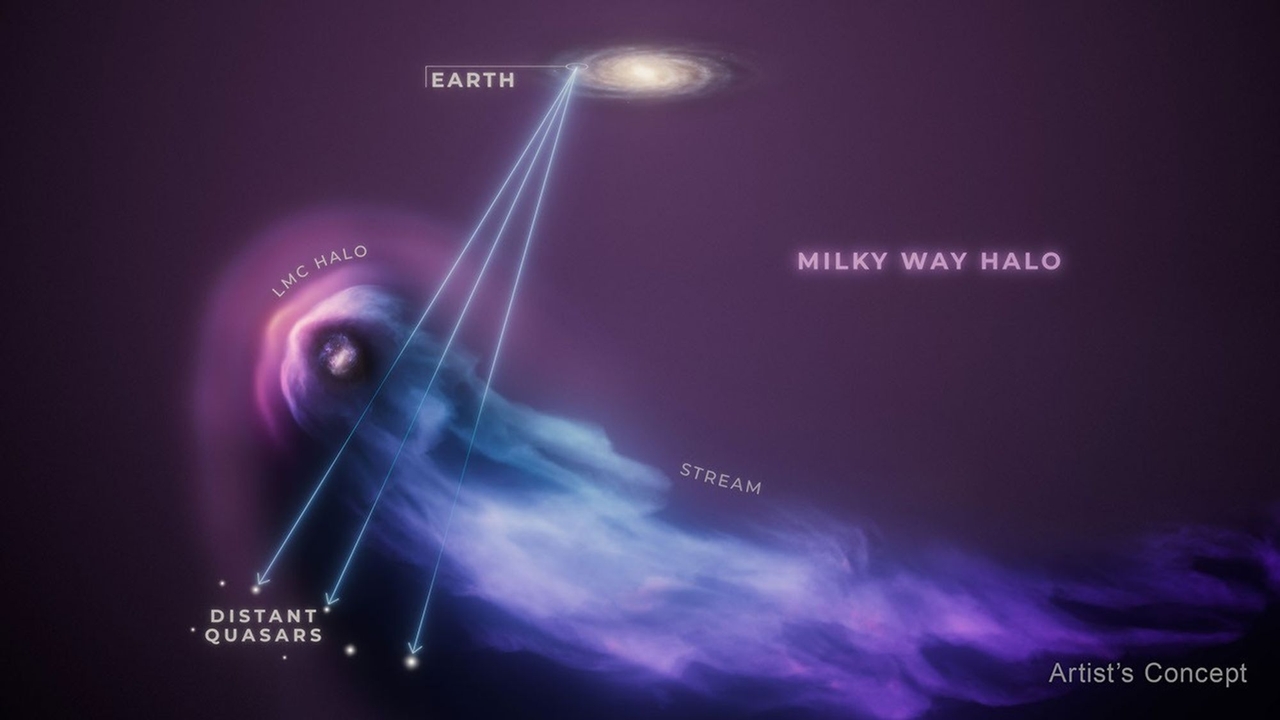
Galactic halos are in interaction with satellite galaxies. Visualizations depicting the passage of the Large Magellanic Cloud through the Milky Way’s halo show that satellite galaxies move within the halo medium. This demonstrates that the halo’s gas and stellar structure are shaped not only by the galaxy’s internal dynamics but also by external interaction processes.
The passage of satellite galaxies through the halo can influence the distribution and density of gas. These processes indicate that galactic structure is a property that evolves over time.
Hubble observations of the Andromeda Galaxy have revealed that it is surrounded by an extremely large and complex gas halo. Findings show that Andromeda’s halo is larger than expected and envelops the galaxy over a vast volume.
Comparisons based on investigative data between the Andromeda halo and the Milky Way halo demonstrate that galactic halos are not unique to individual galaxies but can exhibit common structural features among large spiral galaxies. These comparative data contribute to a broader understanding of the general properties of galactic halos.
The study of galactic halos is conducted through space telescopes and wide-area stellar mapping projects. Hubble observations have particularly revealed the size and structure of the Andromeda Galaxy’s gas halo. For the Milky Way, stellar position mapping based on observational data has determined the distribution of outer halo stars.
Artist renderings serve as visual representations of investigation-based data to illustrate the three-dimensional structure of the halo. When evaluated together, these data reveal that galactic halos are vast, dynamic structures composed of both stellar and gaseous components.

Henüz Tartışma Girilmemiştir
"Galactic Halo Structures" maddesi için tartışma başlatın
General Structure of the Galactic Halo
The Milky Way Galaxy and Its Halo Structure
Outer Halo Stars
Hot and Clustered Gas Halo
Interaction with Satellite Galaxies
Comparison with the Andromeda Galaxy
Investigation Methods and Data Sources