Bu içerik Türkçe olarak yazılmış olup yapay zeka ile otomatik olarak İngilizceye çevrilmiştir.
African Giant Snail (Achatina fulica) (Bowdich, 1822) is a terrestrial gastropod species native to the Africa continent and belongs to the family Achatinidae. It is considered the most important terrestrial snail pest in tropical and subtropical regions. The family is represented by approximately 200 species and 13 genera in Africa.【1】 The shell shape is high and pointed, consistent with the bimodality observed in stylommatophoran snails.【2】
The native range of the species extends along the eastern African coast from Mozambique and Natal to Kenya and Somalia. With increased human mobility and the globalization of transportation and trade, Achatina fulica has been accidentally or intentionally introduced to many regions outside Africa. The species reached Madagascar in the 1800s and from there spread to the islands of the Indian Ocean, India, Southeast Asia and the Pacific islands.【3】
Its spread in South America is linked to commercial attempts to breed “escargot” snails, particularly in Brazil. The first introduction to Brazil occurred in 1988 in the state of Paraná, where specimens imported from Indonesia were sold at agricultural fairs. After the commercial venture failed and no market developed, producers released the snails into the wild, landfills and riverbanks. This led to rapid spread of the species in urban areas ornamental gardens and agricultural fields, establishing it as an invasive species.【4】

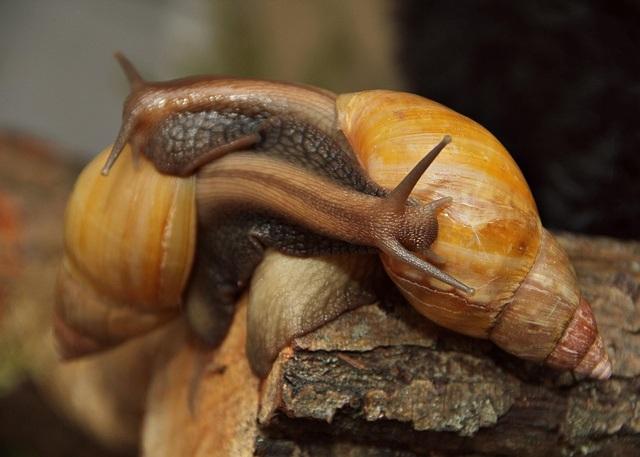
African Giant Snail (Achatina fulica) - Pixabay
The digestive system of Achatina fulica consists of the buccal mass, esophagus, crop, stomach, intestine and rectum; associated structures include salivary glands and the digestive gland. The mouth is located ventrally at the anterior tip of the snout and is semicircular in shape.【5】
Feeding Mechanism: During feeding, the protractor muscles of the buccal mass contract to push the radula toward the mouth. The radula has transverse rows of teeth arranged in a 64.1.64 formula, with approximately 140 rows in an adult individual. The central tooth has a narrow and elongated body; ectocones and endocones are present in lateral teeth up to the 14th row, while marginal teeth have larger ectocones compared to lateral teeth.
Digestive Organs: The esophagus is narrow with thick walls and extends posteriorly to join the crop. The crop is a large, thin-walled, two-chambered sac approximately 50 mm long, functioning in storage and preliminary digestion. The stomach is heart-shaped and embedded within the digestive gland. The salivary glands are paired, lobed and cream-white in color; their secretions may contain amylase enzymes.【6】
Activity and Dormancy: Achatina fulica is a nocturnal organism. Its activity is dependent on humidity levels; it becomes active when relative humidity exceeds 50%. During dry periods or unfavorable conditions, it enters estivation (summer dormancy) or hibernation (winter dormancy). During estivation, it seals the aperture of its shell with a protective layer called an epifragm. During this process, heart rate can drop from 52 to as low as 8 beats per minute.【7】
Reproduction: The species is hermaphroditic. During shell growth, male gametes are produced first; after growth ceases, both male and female gametes are produced, achieving full sexual maturity. Mutual copulation is common, but self-fertilization is rare and results in mostly sterile eggs. Achatina fulica is oviparous. After mating, sperm can be stored for extended periods, allowing egg production even 341–382 days after a single mating event. An individual may lay an average of 900–1200 eggs per year. Hatchlings remain underground for the first 5–15 days, consuming their own eggshells.【8】

African Giant Snail (Achatina fulica) - Pixabay
As an Agricultural Pest: It is a polyphagous herbivore that damages numerous crop plants, ornamental plants and tree seedlings. Seedlings are the most vulnerable stage. Economically significant plants affected include banana, papaya, coffee, cocoa, rubber, beans, peanuts and various vegetables. It can also feed on decaying plant material and carrion (necrophagous behavior).【9】
As a Disease Vector: Achatina fulica poses serious risks to human health. It serves as an intermediate host for the nematode Angiostrongylus cantonensis, which causes eosinophilic meningoencephalitis in humans. It is also a potential host for Angiostrongylus costaricensis, which causes abdominal angiostrongylosis in the Americas. In terms of plant pathology, it has been shown to spread spores of Phytophthora palmivora, the pathogen responsible for black pod disease in cocoa plants, via its feces.【10】
Physical Control: Manual collection and destruction of snails and eggs is a common method. Collected snails are crushed, buried in deep pits or covered with lime. Additionally, digging trenches or installing barriers around agricultural areas is recommended.
Chemical Control: Poisoned baits containing metaldehyde and calcium arsenate have historically been the most frequently used chemical method. However, their effectiveness decreases during rainy weather.【11】
Biological Control: Predatory snails such as Euglandina rosea and Gonaxis species, as well as flatworms like Platydemus manokwari, have been introduced in various regions to control Achatina fulica. However, there is no conclusive evidence that these generalist predators effectively suppress A. fulica populations. Instead, documented cases show they have caused severe ecological damage by driving native snail species to extinction. For this reason, the use of such biological control methods is not recommended in countries like Brazil.【12】
Caitriana. "Achatina fulica, Büyük Akik Salyangoz". Pixabay, June 16, 2017. Accessed January 26, 2026. https://pixabay.com/tr/photos/achatina-fulica-büyük-akik-salyangoz-2409213/
Ghose, K. C. "The Alimentary System of Achatina fulica." *Transactions of the American Microscopical Society* 82, no. 2 (1963): 149-167. Accessed January 26, 2026. https://www.jstor.org/stable/3223991?seq=1
Raut, S. K., and G. M. Barker. "Achatina fulica Bowdich and Other Achatinidae as Pests in Tropical Agriculture." In *Molluscs as Crop Pests*, edited by G. M. Barker, 55-114. Wallingford: CABI Publishing, 2002. Accessed January 26, 2026. https://www.researchgate.net/publication/242289306_Achatina_fulica_Bowdich_and_Other_Achatinidae_as_Pests_in_Tropical_Agriculture
Thiengo, Silvana C., F. A. Faraco, N. C. Salgado, R. H. Cowie, and M. A. Fernandez. "Rapid spread of an invasive snail in South America: The giant African snail, Achatina fulica, in Brasil". *Biological Invasions* 9, no. 6 (2007): 693-702. Accessed January 26, 2026. https://www.researchgate.net/publication/225582459_Rapid_spread_of_an_invasive_snail_in_South_America_The_giant_African_snail_Achatina_fulica_in_Brasil
megobit. "Salyangoz, Achatina Fulica." Pixabay, March 22, 2015. Accessed January 26, 2026. https://pixabay.com/tr/photos/salyangoz-achatina-fulica-685476/
[1]
S. K. Raut ve G. M. Barker, "Achatina fulica Bowdich and Other Achatinidae as Pests in Tropical Agriculture," içinde Molluscs as Crop Pests, ed. G. M. Barker (Wallingford: CABI Publishing, 2002), s. 1. https://www.researchgate.net/publication/242289306_Achatina_fulica_Bowdich_and_Other_Achatinidae_as_Pests_in_Tropical_Agriculture
[2]
S. K. Raut ve G. M. Barker, "Achatina fulica Bowdich and Other Achatinidae as Pests in Tropical Agriculture," içinde Molluscs as Crop Pests, ed. G. M. Barker (Wallingford: CABI Publishing, 2002), s. 4. https://www.researchgate.net/publication/242289306_Achatina_fulica_Bowdich_and_Other_Achatinidae_as_Pests_in_Tropical_Agriculture
[3]
S. K. Raut ve G. M. Barker, "Achatina fulica Bowdich and Other Achatinidae as Pests in Tropical Agriculture," içinde Molluscs as Crop Pests, ed. G. M. Barker (Wallingford: CABI Publishing, 2002), s. 7-8. https://www.researchgate.net/publication/242289306_Achatina_fulica_Bowdich_and_Other_Achatinidae_as_Pests_in_Tropical_Agriculture
[4]
Silvana C. Thiengo vd., "Rapid spread of an invasive snail in South America: the giant African snail, Achatina fulica, in Brasil," Biological Invasions 9 (2007): s. 2. https://www.researchgate.net/publication/225582459_Rapid_spread_of_an_invasive_snail_in_South_America_The_giant_African_snail_Achatina_fulica_in_Brasil
[5]
Krishna Chandra Ghose, "The Alimentary System of Achatina fulica," Transactions of the American Microscopical Society 82, no. 2 (1963): s. 1-2. https://www.jstor.org/stable/3223991?seq=1
[6]
Krishna Chandra Ghose, "The Alimentary System of Achatina fulica," Transactions of the American Microscopical Society 82, no. 2 (1963): s. 4-6. https://www.jstor.org/stable/3223991?seq=1
[7]
S. K. Raut ve G. M. Barker, "Achatina fulica Bowdich and Other Achatinidae as Pests in Tropical Agriculture," içinde Molluscs as Crop Pests, ed. G. M. Barker (Wallingford: CABI Publishing, 2002), s. 19-21. https://www.researchgate.net/publication/242289306_Achatina_fulica_Bowdich_and_Other_Achatinidae_as_Pests_in_Tropical_Agriculture
[8]
S. K. Raut ve G. M. Barker, "Achatina fulica Bowdich and Other Achatinidae as Pests in Tropical Agriculture," içinde Molluscs as Crop Pests, ed. G. M. Barker (Wallingford: CABI Publishing, 2002), s. 24-28. https://www.researchgate.net/publication/242289306_Achatina_fulica_Bowdich_and_Other_Achatinidae_as_Pests_in_Tropical_Agriculture
[9]
S. K. Raut ve G. M. Barker, "Achatina fulica Bowdich and Other Achatinidae as Pests in Tropical Agriculture," içinde Molluscs as Crop Pests, ed. G. M. Barker (Wallingford: CABI Publishing, 2002), s. 39-41. https://www.researchgate.net/publication/242289306_Achatina_fulica_Bowdich_and_Other_Achatinidae_as_Pests_in_Tropical_Agriculture
[10]
Silvana C. Thiengo vd., "Rapid spread of an invasive snail in South America: the giant African snail, Achatina fulica, in Brasil," Biological Invasions 9 (2007): s. 7-8. https://www.researchgate.net/publication/225582459_Rapid_spread_of_an_invasive_snail_in_South_America_The_giant_African_snail_Achatina_fulica_in_Brasil
S. K. Raut ve G. M. Barker, "Achatina fulica Bowdich and Other Achatinidae as Pests in Tropical Agriculture," içinde Molluscs as Crop Pests, ed. G. M. Barker (Wallingford: CABI Publishing, 2002), s. 48. https://www.researchgate.net/publication/242289306_Achatina_fulica_Bowdich_and_Other_Achatinidae_as_Pests_in_Tropical_Agriculture
[11]
S. K. Raut ve G. M. Barker, "Achatina fulica Bowdich and Other Achatinidae as Pests in Tropical Agriculture," içinde Molluscs as Crop Pests, ed. G. M. Barker (Wallingford: CABI Publishing, 2002), s. 50-51. https://www.researchgate.net/publication/242289306_Achatina_fulica_Bowdich_and_Other_Achatinidae_as_Pests_in_Tropical_Agriculture
[12]
S. K. Raut ve G. M. Barker, "Achatina fulica Bowdich and Other Achatinidae as Pests in Tropical Agriculture," içinde Molluscs as Crop Pests, ed. G. M. Barker (Wallingford: CABI Publishing, 2002), s. 53. https://www.researchgate.net/publication/242289306_Achatina_fulica_Bowdich_and_Other_Achatinidae_as_Pests_in_Tropical_Agriculture
Silvana C. Thiengo vd., "Rapid spread of an invasive snail in South America: the giant African snail, Achatina fulica, in Brasil," Biological Invasions 9 (2007): s. 8. https://www.researchgate.net/publication/225582459_Rapid_spread_of_an_invasive_snail_in_South_America_The_giant_African_snail_Achatina_fulica_in_Brasil

Henüz Tartışma Girilmemiştir
"Giant African Snail (Achatina fulica)" maddesi için tartışma başlatın
Origin and Geographic Distribution
Anatomy and Physiology
Biological Characteristics and Life Cycle
Ecological and Economic Impacts
Control Methods