+1 Daha

Göynük Tokalı Örtme
Region(s) | Göynük / BOLU | ||||||||
|---|---|---|---|---|---|---|---|---|---|
Product / Product Group(s) | Textiles | ||||||||
Registration Number | 218 | ||||||||
Type of Registration | Designation of Origin | ||||||||
Registration Date | 18.09.2017 | ||||||||
Weaving Technique | Plain weave | ||||||||
Colors | Patterns: White–green- yellow–red–navy blue–black Ground: Ochre–cream–white tones | ||||||||
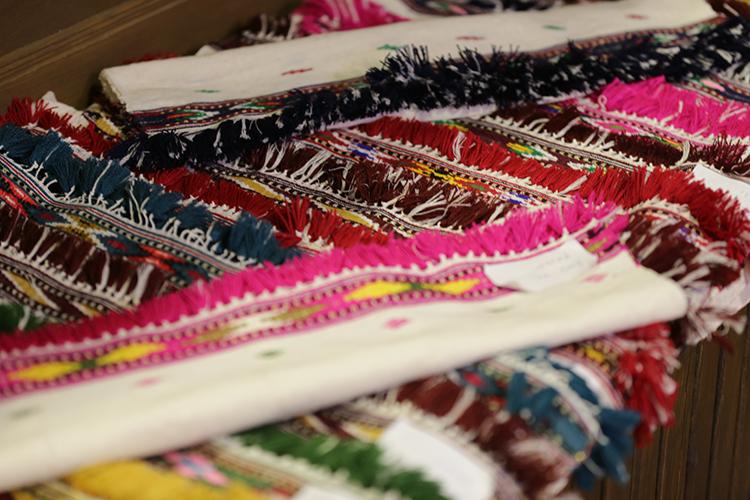
Göynük Tokalı Örtme is a traditional woven textile product registered as a geographical indication (Registration No: 218), specific to the Göynük district of Bolu and its surrounding villages. The term “örtme” refers to a headscarf used for covering. This textile, formed by combining two pieces of fine cotton cloth, is distinguished by red tassels (“toka”) attached to its short edges. Produced in Göynük, where weaving has been practiced for centuries, the product was applied for registration on May 15, 2015, and was officially registered on September 18, 2017, under the category of “Designation of Origin.”
The headscarf comes in two standard sizes: 173 cm long and 92 cm wide (two 46 cm panels) or 200 cm long and 100 cm wide (two 50 cm panels). It is woven using the plain weave technique; warp and weft yarns consist of 20/1 Ne count, single-ply twisted cotton yarn (“kıvrak”), which gives the fabric a natural curl. The average weaving density is 20 warp × 20 weft threads per cm². The “toka” tassels that characterize the product are made of red orion thread and attached to the short edges after weaving. No color other than red may be used for these tassels.

Göynük Tokalı Örtme (Anadolu Agency)
The decorations of the headscarf are categorized into two main groups: “edge decorations” (on short sides) and “ground/forehead decorations.”
Motifs placed on the short sides are applied using a weft embroidery technique. Each motif is handcrafted using weft threads in different colors.
The main motifs include:
These decorations are applied using the brocade technique (supplementary weft insertion) along the long edges or at the center of the fabric. The most prominent motifs include goguk (wild tulip, V-shaped), para (coin, round or oval), kelebek (butterfly), and gaydırak (slide). The forehead motif is positioned exactly at the center of one of the long edges. The two long edges feature different designs: one is colorful (used in times of joy), while the other is plain (used in times of sorrow). This particular form of usage is unique to Göynük culture.
Background colors include shades of ecru, cream, and white; mustard color is strictly prohibited. Short edge borders have a maroon or dark red background. Patterns predominantly use white, green tones, yellow, red, navy blue, and black. Before the 1980s, dyed cotton or silk threads were used; with the introduction of orion threads, the color variety increased.

Weaving Stage (Anadolu Agency)
All stages of production (weaving, motif design, tassel attachment) must be carried out within the boundaries of Göynük. Inspections are conducted at least twice a year by a committee composed of representatives from Göynük Public Education Center, the District Governorate, and the Chamber of Tradesmen and Artisans. The inspections examine yarn selection, motif accuracy, and adherence to standard production methods.
Tokalı Örtme is an integral part of Göynük’s cultural identity, reflecting its intangible heritage through its motifs and traditional weaving methods passed down through generations. The meanings attributed to motifs (such as emotional states) and the weaving techniques are unique to the region.
Anadolu Agency. “Handwoven Tokalı Örtme by Women Is Being Carried into the Future.” Published January 26, 2023. Accessed July 6, 2025. https://www.aa.com.tr/tr/yasam/kadinlarin-dokudugu-tokali-ortme-gelecege-tasiniyor/2787472.
Turkish Patent and Trademark Office. Geographical Indication Certificate – Tokalı Örtme. Accessed July 6, 2025. https://ci.turkpatent.gov.tr/Files/GeographicalSigns/218.pdf.
Turkish Patent and Trademark Office. Geographical Indication Detail – 38158. Accessed July 6, 2025. https://ci.turkpatent.gov.tr/cografi-isaretler/detay/38158.
Göynük Tokalı Örtme
Region(s) | Göynük / BOLU | ||||||||
|---|---|---|---|---|---|---|---|---|---|
Product / Product Group(s) | Textiles | ||||||||
Registration Number | 218 | ||||||||
Type of Registration | Designation of Origin | ||||||||
Registration Date | 18.09.2017 | ||||||||
Weaving Technique | Plain weave | ||||||||
Colors | Patterns: White–green- yellow–red–navy blue–black Ground: Ochre–cream–white tones | ||||||||
Henüz Tartışma Girilmemiştir
"Göynük Tokalı Örtme" maddesi için tartışma başlatın
Structural and Technical Features
Decoration and Motifs
Edge Decorations
Ground and Forehead Decorations
Color Palette
Production Method
Geographical Boundary and Inspection
Cultural Significance
Bu madde yapay zeka desteği ile üretilmiştir.