
Bu içerik Türkçe olarak yazılmış olup yapay zeka ile otomatik olarak İngilizceye çevrilmiştir.
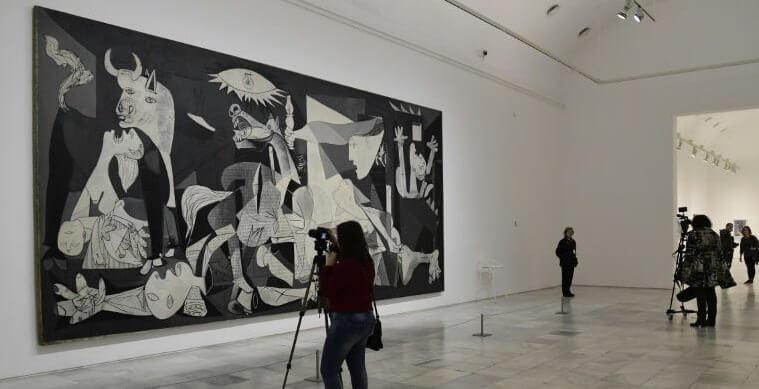
Guernica was created in 1937 by the Spanish painter Pablo Picasso. The painting depicts the destruction of the Basque town of Guernica, which was bombed on 26 April of the same year by the air forces of Nazi Germany during the Spanish Civil War. The work is regarded as one of the artist’s most important statements of political commitment.
The Spanish Republican Government commissioned Picasso to create a special work for the Spanish Pavilion at the 1937 Paris World’s Fair. After learning of the Guernica massacre, Picasso began work on the painting and completed it in approximately two months. The painting was first exhibited at the Paris Fair.

Guernica (Flickr)
Guernica is an oil painting on canvas measuring approximately 3.5 by 7.8 metres. The palette consists exclusively of black, white and grey tones. This limited use of colour is thought to reflect the black-and-white tradition of contemporary press photography and to evoke the dark atmosphere of war.
The work reflects the destructive impact of war and the tragedy endured by civilians. Picasso avoided any direct political or narrative commentary; instead, he employed symbols to convey a universal theme of violence and suffering. Figures in the painting include a bull, a wounded horse, a woman carrying a dead child, screaming women, a soldier with a broken sword, a bird and a woman holding a lamp. The figures in the composition serve not as representations of physical reality but as an expressive portrayal of the terror unleashed by war.
Picasso never provided explicit explanations for the symbols in the painting. This has allowed Guernica to be reinterpreted in different eras and contexts.
Guernica generated widespread resonance not only within the art world but also in the political sphere. Throughout the 20th century, it was embraced as a symbol of anti-war sentiment fascismand resistance against a universal expression. It is known that during Nazi Germany’s occupation of France, Picasso reproduced and distributed images of the painting to raise public awareness against fascism.

Guernica(Flickr)
Picasso stipulated that the painting of Guernica should not be returned to Spain until democracy was restored in the country. As a result, the work remained for many years in the collection of the Museum of Modern Art (MoMA) in New York and was transferred in 1981 to Madrid’s Museo Nacional Centro de Arte Reina Sofía. It is still exhibited there today.
The impact of Guernica extended beyond the original painting. In 1955, Nelson A. Rockefeller commissioned a tapestry inspired by the original painting. The tapestry was woven at the Atelier J. de la Baume-Durrbach in the Var region of France and was personally supervised by the artist Picasso. Measuring approximately 10 by 22 feet (about 3 by 6.7 metres), this tapestry was loaned in 1985 by the Rockefeller family to United Nations’s.
On 13 September 1985, it was hung at the entrance to the UN Security Council Chamber, temporarily removed in 2021 and reinstalled on 5 February 2022. UN Secretary-General Antonio Guterres has highlighted the powerful symbolic value of the tapestry as a message of peace. Internationally, the tapestry is regarded as an artwork that simultaneously embodies the horror of war and the hope for peace.
Pablo Picasso, Guernica(SmartHistory)
Diğler, Mustafa and Rasim Soylu. “Pablo Picasso’nun ‘Guernica’ Adlı Resminin Analizi.” *International Social Sciences Studies Journal* 9, no. 114 (2023): 7910-7920. Accessed August 6, 2025. https://sssjournal.com/files/sssjournal/1892ff71-a729-4d92-981f-aa30a336e0db.pdf.
Flickr. "Pablo Picasso, Guernica." Photograph by Pedro Belleza. January 2, 2010. Accessed August 18, 2025. https://www.flickr.com/photos/pedrobelleza/4245641578/.
Flickr. *Pablo Picasso, Guernica*. Photo: Kanesue. February 24, 2024. Accessed August 18, 2025. https://www.flickr.com/photos/kanesue/53489709493/.
Smarthistory. "Pablo Picasso, Guernica." Accessed August 6, 2025. Smarthistory. https://smarthistory.org/picasso-guernica/.
Tabak, Sevinç. “Bir Savaş Vesikası Olarak Pablo Picasso’nun Guernica Eserindeki Sembollerin İncelenmesi.” Otuzyedi Sanat ve Tasarım Dergisi 1, no. 1 (2022): 55–70. Accessed August 6, 2025. https://dergipark.org.tr/en/download/article-file/2715553.
United Nations (Birleşmiş Milletler). "Guernica Tapestry ‘After Guernica,’ Pablo Picasso." *UN Gifts*. Accessed August 6, 2025. https://www.un.org/ungifts/guernica-tapestry-after-guernica-pablo-picasso.
YouTube. "Pablo Picasso, Guernica." SmartHistory. Accessed August 6, 2025. https://www.youtube.com/watch?v=a3IX1YgRG-g&t=75s

Henüz Tartışma Girilmemiştir
"Guernica (Painting)" maddesi için tartışma başlatın
Creation Process
Technical Features
Themes and Symbolic World
Symbolic Interpretations
Political and Social Impact
The Journey of the Painting
Guernica Tapestry