
Bu içerik Türkçe olarak yazılmış olup yapay zeka ile otomatik olarak İngilizceye çevrilmiştir.
+1 Daha
Ham was the first chimpanzee sent into space and a biological precursor to human spaceflight missions, launched on January 31, 1961, as part of NASA’s Mercury-Redstone 2 (MR-2) mission. Technically known as "No. 65," this primate served as an active operator during flight, performing tasks in real time. His successful mission directly paved the way for the United States’ first human spaceflight, Alan Shepard’s flight【1】.
Ham’s story began in July 1957 in the untouched rainforests of West Africa, in what was then French-controlled Cameroon. Born a baby chimpanzee in its natural habitat, Ham was captured at the age of two. He was then transported thousands of kilometers away to the Miami Rare Bird Farm in Florida.
By July 1959, the space race between the United States and the Soviet Union had intensified, and NASA required primate testing prior to human spaceflight. At the time unnamed and known only as "No. 65" (or occasionally "Chang" in some records), this young chimpanzee was enlisted into military records as a candidate for the Air Force’s Aerospace Medical Center as an "astro-chimpanzee"【2】.
The First Chimpanzee Sent into Space by NASA (Smithsonian Channel)
Ham’s transformation into an astro-chimpanzee was a rigorous journey beginning in 1959 at Holloman Air Force Base in New Mexico, combining military discipline with advanced psychological conditioning. Alongside 39 other candidate chimpanzees, Ham underwent a demanding daily training regimen with zero tolerance for error【3】. The critical component of this training involved psychomotor tests designed to measure the chimpanzees’ cognitive abilities.
In addition to psychological training, Ham underwent a series of strenuous physical tests to prepare his body for the physical effects of spaceflight. Like the "Mercury Seven" astronauts, he was exposed to high G-forces in centrifuges to observe how he would respond under the pressure of launch and re-entry【4】. He also spent extended periods in isolation chambers to adjust his biological clock and metabolism to flight conditions, participated in noise exposure tests, and was conditioned to endure confinement within the cramped "seat-cabin" unit he would occupy during flight.

S63-20804 (January 21, 1961) Activity at Launch Pad 5 During RF Controls and Placement of Primate No. 5 into Capsule No. 5 (Flickr)
Ham’s selection for the space program involved a series of elimination stages conducted with military precision and medical rigor. Of the 40 candidate chimpanzees brought to Holloman Air Force Base in New Mexico in 1959, Ham stood out from the beginning due to his intelligence and physical resilience. NASA’s Space Task Group (STG) sought not only a healthy animal but also a calm, unflappable operator who would not freeze under stress. As training progressed, the candidate pool was reduced first to 18, then to a final group of six—four females and two males—who would undergo final training at Cape Canaveral, Florida. These six finalists were divided into two separate groups to prevent contamination and underwent 29 training sessions in specially prepared Mercury capsule mockups to demonstrate their motor skills.
Until one day before launch, it was not officially determined which chimpanzee would undertake the historic flight; all six candidates competed for the title of "first astro-chimpanzee." The final selection was made by Dr. James P. Henry of NASA’s Space Task Group and veterinarian John D. Mosely of Holloman, following final physical examinations and psychomotor tests. In these tests, Ham not only performed all technical tasks flawlessly but also exhibited a noticeably more cheerful, energetic, and attentive demeanor compared to the other candidates. Experts concluded that Ham’s "positive mood" would provide a distinct advantage in coping with flight stresses such as extreme G-forces and isolation, and thus approved him for the mission【5】. One of the most resilient females in the group was selected as backup in case of an emergency. After selection, Ham was placed on a low-fiber diet 19 hours before launch, fitted with biosensors, and kept under continuous medical observation until the moment of his historic flight【6】.
The Mercury-Redstone 2 (MR-2) launch at 11:55 a.m. on January 31, 1961, appeared on paper to be a routine suborbital test flight, but in practice became a fight for survival for Ham. Four hours before launch, Ham was placed in his specially pressurized cabin and loaded onto the rocket’s top via the "seat" biological transport unit, Mercury capsule. However, immediately after liftoff, things did not go as planned: a malfunction in the rocket’s fuel regulator caused the engines to produce more thrust than intended, resulting in premature fuel depletion. This caused the Launch Escape System (LES) to activate automatically, propelling Ham’s capsule to a height of 157 miles instead of the planned 115 miles. Additionally, the capsule’s speed reached 5,857 miles per hour instead of the planned 4,400, subjecting Ham to G-forces of up to 17G—near the absolute physiological limit for any living creature【7】. During the approximately 16.5-minute flight, Ham experienced a total of 6.6 minutes of weightlessness.

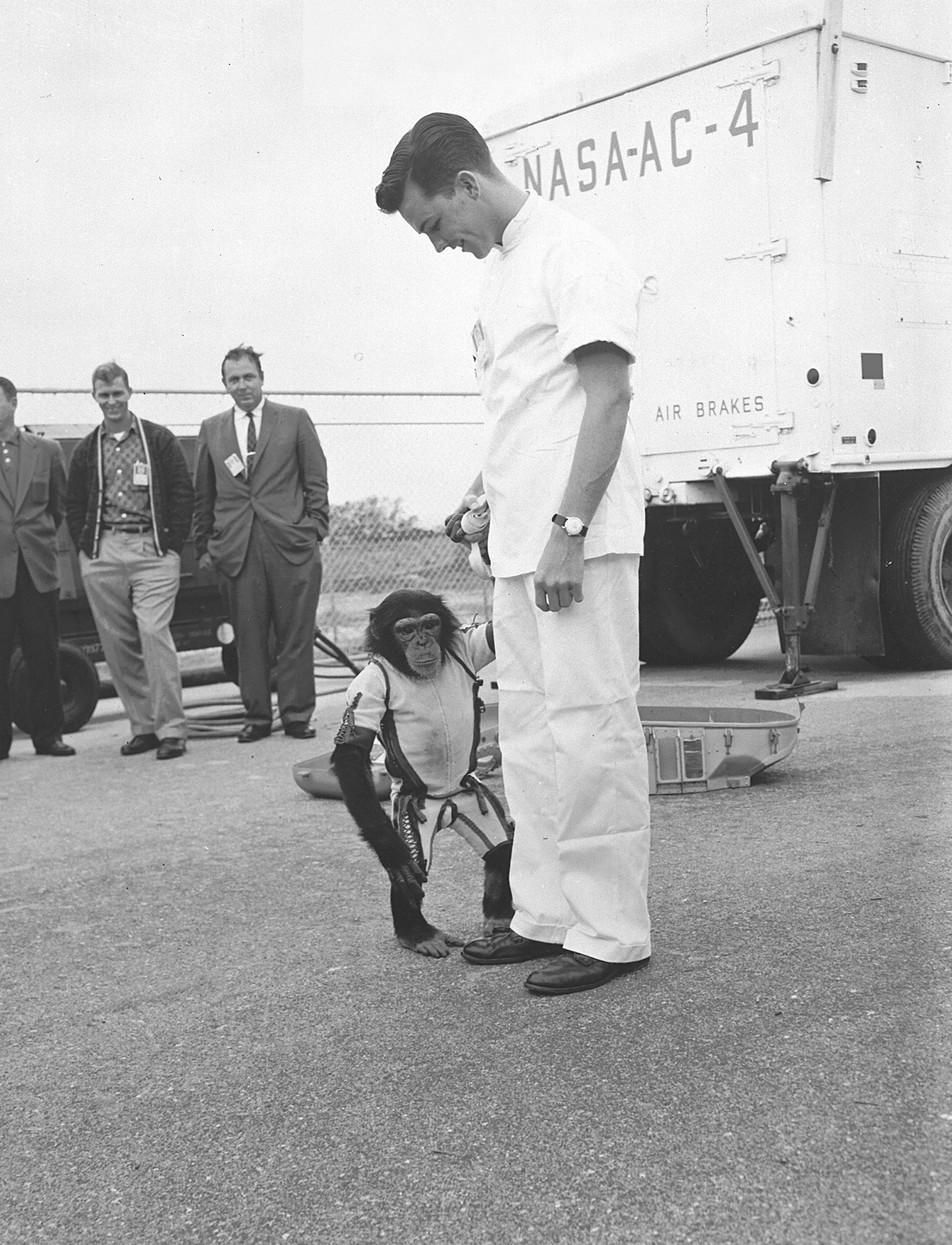
Chimpanzee "Ham" During Pre-Launch Preparations with One of His Caretakers Prior to the Mercury-Redstone 2 (MR-2) Test Flight (Flickr)
The technical deviations experienced during the Mercury-Redstone 2 flight made Ham’s return to Earth more hazardous than planned. Due to the rocket’s excessive thrust, Ham landed approximately 130 miles (about 210 kilometers) off target, in the open Atlantic Ocean【8】. The force of impact damaged the capsule’s heat shield and punctured two holes in the titanium hull at its base. The capsule drifted in ocean waves for nearly two hours, during which Ham was exposed to leaking seawater and the exhaustion following launch.
When Ham was retrieved by the crew and scientists aboard the recovery vessel, he shook hands with the ship’s captain and eagerly accepted an apple offered to him. Shortly after his rescue, when photographers requested he be placed back into the capsule for photos, Ham resisted violently, refusing to relive the experience【9】.
NASA’s decision to use chimpanzees as test subjects before human spaceflight was not arbitrary but based on biological and psychological data. In the late 1950s, scientists feared that the microgravity environment of space might have devastating effects on human consciousness and motor skills. It was unknown whether a human could withstand high G-forces without fainting, or whether basic functions such as swallowing, breathing, and decision-making could be maintained in weightlessness. At this point, chimpanzees emerged as the closest biological analog to human behavior and physiology.
According to NASA data, the average chimpanzee response time to a stimulus was 0.7 seconds—extremely close to the human average of 0.5 seconds—meaning tests on chimpanzees directly reflected human capabilities【10】. Thus, a chimpanzee aboard a spacecraft did not merely test life-support systems; it scientifically demonstrated that control levers could be physically operated and mental focus maintained during launch and weightlessness.

Chimpanzee "Ham" (Flickr)
Following his historic flight on January 31, 1961, Ham became an international phenomenon and a symbol of American space achievement from the moment he was recovered from the ocean. Initial medical examinations aboard the USS Donner revealed only mild fatigue and dehydration; his overall health was good. However, the calm demeanor he displayed immediately after the flight soon gave way to stress. According to NASA reports, being placed back into the capsule for photographs shortly after recovery caused Ham significant distress, requiring intervention from several personnel to calm him【11】.
As NASA’s human spaceflight program accelerated, Ham’s role as an active test subject ended, and in 1963 he was transferred to the Smithsonian National Zoological Park in Washington D.C. There, he spent the majority of his 17 years in isolation, living alone in a single cage【12】. Unlike other primates trained for the space program, Ham was never returned to the harsh laboratory conditions of biomedical research, but his prolonged solitude negatively affected his social development.
By 1980, to allow him to interact with members of his own species and live out his retirement in a more natural environment, he was relocated to the North Carolina Zoological Park. There, for the first time, Ham was able to socialize with other chimpanzees and spent his final years peacefully within a natural social hierarchy.
Ham died on January 18, 1983, at approximately 26 years of age, from heart and liver failure. After his death, his skeleton was sent to the Armed Forces Institute of Pathology for scientific study, while his other remains were ceremonially buried near the International Space Hall of Fame in Alamogordo, New Mexico【13】.
[1]
Save the Chimps, “Ham, the First Chimpanzee in Space,” Save the Chimps, https://savethechimps.org/ham-space-chimp/.
[2]
Smithsonian National Air and Space Museum, “Mercury Primate Capsule and Ham the Astrochimp,” Air & Space Smithsonian, https://airandspace.si.edu/stories/editorial/mercury-primate-capsule-and-ham-astrochimp.
[3]
Smithsonian National Air and Space Museum, “Mercury Primate Capsule and Ham the Astrochimp,” Air & Space Smithsonian, https://airandspace.si.edu/stories/editorial/mercury-primate-capsule-and-ham-astrochimp.
[4]
Smithsonian National Air and Space Museum, “Mercury Primate Capsule and Ham the Astrochimp,” Air & Space Smithsonian, https://airandspace.si.edu/stories/editorial/mercury-primate-capsule-and-ham-astrochimp.
[5]
Smithsonian National Air and Space Museum, “Mercury Primate Capsule and Ham the Astrochimp,” Air & Space Smithsonian, https://airandspace.si.edu/stories/editorial/mercury-primate-capsule-and-ham-astrochimp.
[6]
Smithsonian National Air and Space Museum, “Mercury Primate Capsule and Ham the Astrochimp,” Air & Space Smithsonian, https://airandspace.si.edu/stories/editorial/mercury-primate-capsule-and-ham-astrochimp.
[7]
Smithsonian National Air and Space Museum, “Mercury Primate Capsule and Ham the Astrochimp,” Air & Space Smithsonian, https://airandspace.si.edu/stories/editorial/mercury-primate-capsule-and-ham-astrochimp.
[8]
Save the Chimps, “Ham, the First Chimpanzee in Space,” Save the Chimps, https://savethechimps.org/ham-space-chimp/.
[9]
Smithsonian National Air and Space Museum, “Mercury Primate Capsule and Ham the Astrochimp,” Air & Space Smithsonian, https://airandspace.si.edu/stories/editorial/mercury-primate-capsule-and-ham-astrochimp.
[10]
Smithsonian National Air and Space Museum, “Mercury Primate Capsule and Ham the Astrochimp,” Air & Space Smithsonian, https://airandspace.si.edu/stories/editorial/mercury-primate-capsule-and-ham-astrochimp
[11]
Smithsonian National Air and Space Museum, “Mercury Primate Capsule and Ham the Astrochimp,” Air & Space Smithsonian, https://airandspace.si.edu/stories/editorial/mercury-primate-capsule-and-ham-astrochimp.
[12]
Save the Chimps, “Ham, the First Chimpanzee in Space,” Save the Chimps, https://savethechimps.org/ham-space-chimp/.
[13]
Smithsonian National Air and Space Museum, “Mercury Primate Capsule and Ham the Astrochimp,” Air & Space Smithsonian, https://airandspace.si.edu/stories/editorial/mercury-primate-capsule-and-ham-astrochimp.

Henüz Tartışma Girilmemiştir
"Ham (Astrochimp)" maddesi için tartışma başlatın
Early Life and Capture
Training Process
Selection for Flight
Mercury-Redstone 2 Mission
Water Landing and Recovery
Why NASA Chose Chimpanzees
Life After the Flight
Death