

Bu içerik Türkçe olarak yazılmış olup yapay zeka ile otomatik olarak İngilizceye çevrilmiştir.
+2 Daha
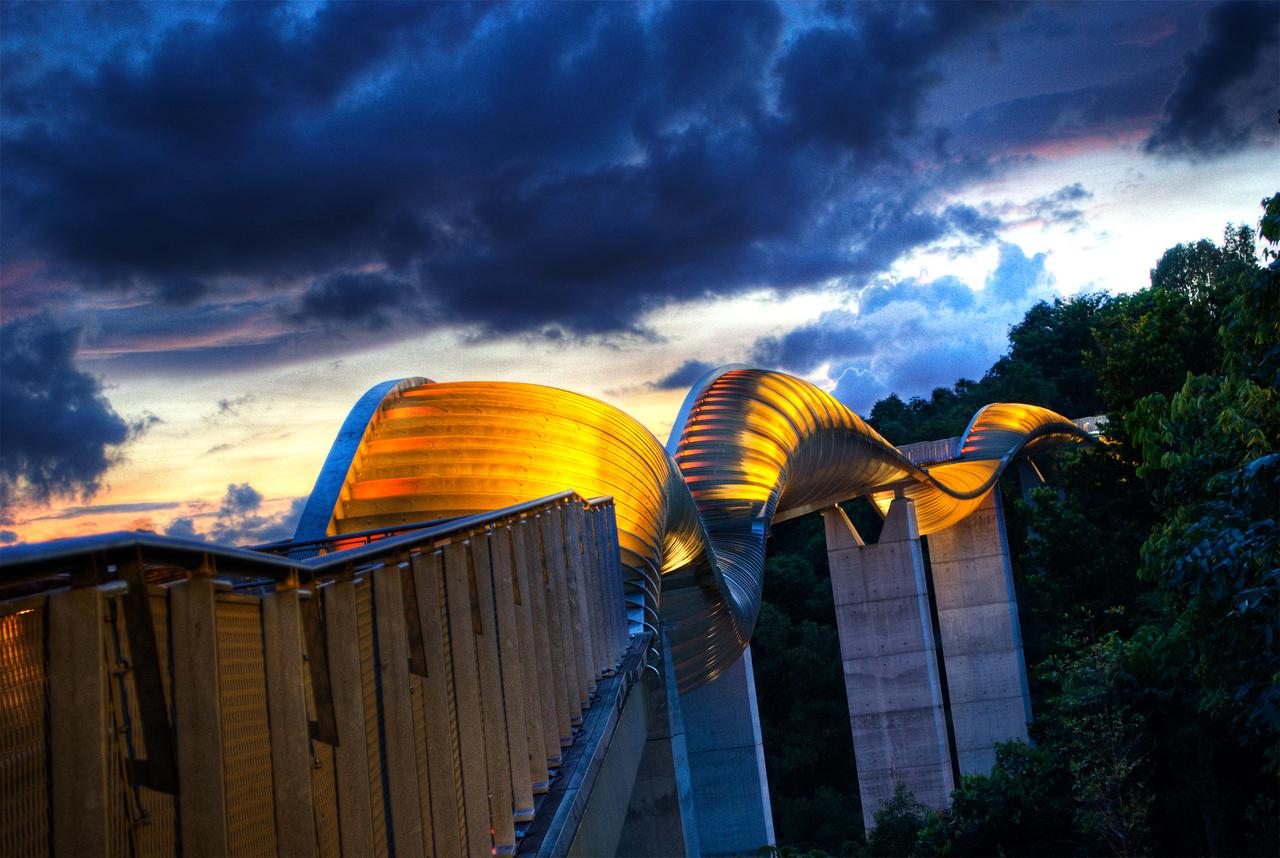
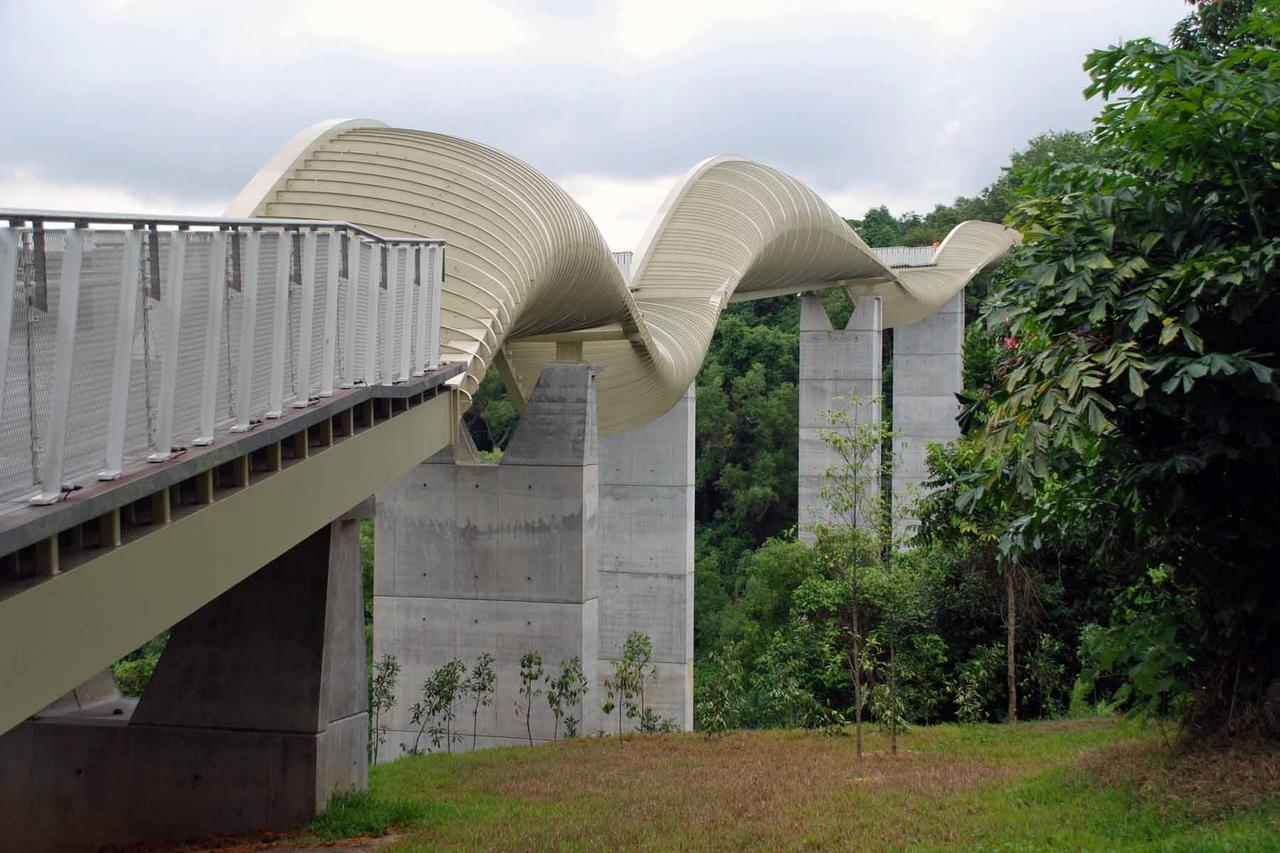
Henderson Waves Bridge is a pedestrian bridge connecting Mount Faber and Telok Blangah Hill parks in the southwest of Singapore. At 274 metres in length and 36 metres in height, it is the highest pedestrian bridge in the country. Constructed from steelandwood, the structure features a distinctive wave-like form composed of seven undulating beams. These beams provide shade and seating areas along the bridge. The bridge also links parks along the Southern Ridges walking trail, offering visitors panoramic views of natural landscapes. It is equipped with LED lighting that presents distinct visual experiences during daytime and night.
Henderson Waves Bridge (Flickr)
The Henderson Waves Bridge project was conceived as part of the Southern Ridges Identity Plan, initiated in 2002 by the Urban Redevelopment Authority (URA). The plan aimed to enhance accessibility and connectivity across a 9-kilometre chain of hilly terrain encompassing Mount Faber, Telok Blangah Hill and Kent Ridge parks. A series of pedestrian bridges were proposed to link the dispersed hilltop parks, with specific bridges planned to span Henderson Road and Alexandra Road. To ensure public input, the URA conducted a three-month public consultation process, gathering feedback through exhibitions and online platforms. Reports from expert panels consistently supported the concept of continuous hill-to-hill connections. The project aimed to develop the bridge in accordance with environmental compatibility, aesthetic quality and accessibility criteria.【1】
Henderson Waves Bridge (Flickr)
Launched in 2002, the Southern Ridges Identity Plan was an initiative by the URA to preserve the region’s natural and cultural characteristics and establish continuous connections between the hilly parks. A three-month public consultation was held during the planning phase, inviting input from visitors and online participants through surveys. Expert groups comprising professionals, representatives from relevant organizations and community members were convened to evaluate the feasibility of linking the parks and constructing the bridge. Over 90 per cent of survey respondents supported the concept of continuous hill-to-hill connections, thereby securing public backing for the project’s design process.【2】
In 2003, the URA launched an international design competition for bridges over Henderson Road and Alexandra Road. Five proposals received merit awards. The design submitted by the partnership of IJP Corporation, based in England, and RSP Architects and Planners & Engineers PTE Ltd., both based in Singapore, was selected for the Henderson Waves Bridge. For the Alexandra Arch, the design by LOOK Architects and ECAS-EJ Consultants, both based in Singapore, was chosen. Monthly meetings were held with the design teams throughout the selection process to ensure the bridges harmonized with the natural landscape of the Southern Ridges, respected environmental and topographical features, and provided functional user experiences. The final decision was made to ensure aesthetic and structural coherence for both bridges.【3】
Henderson Waves Bridge (Flickr)
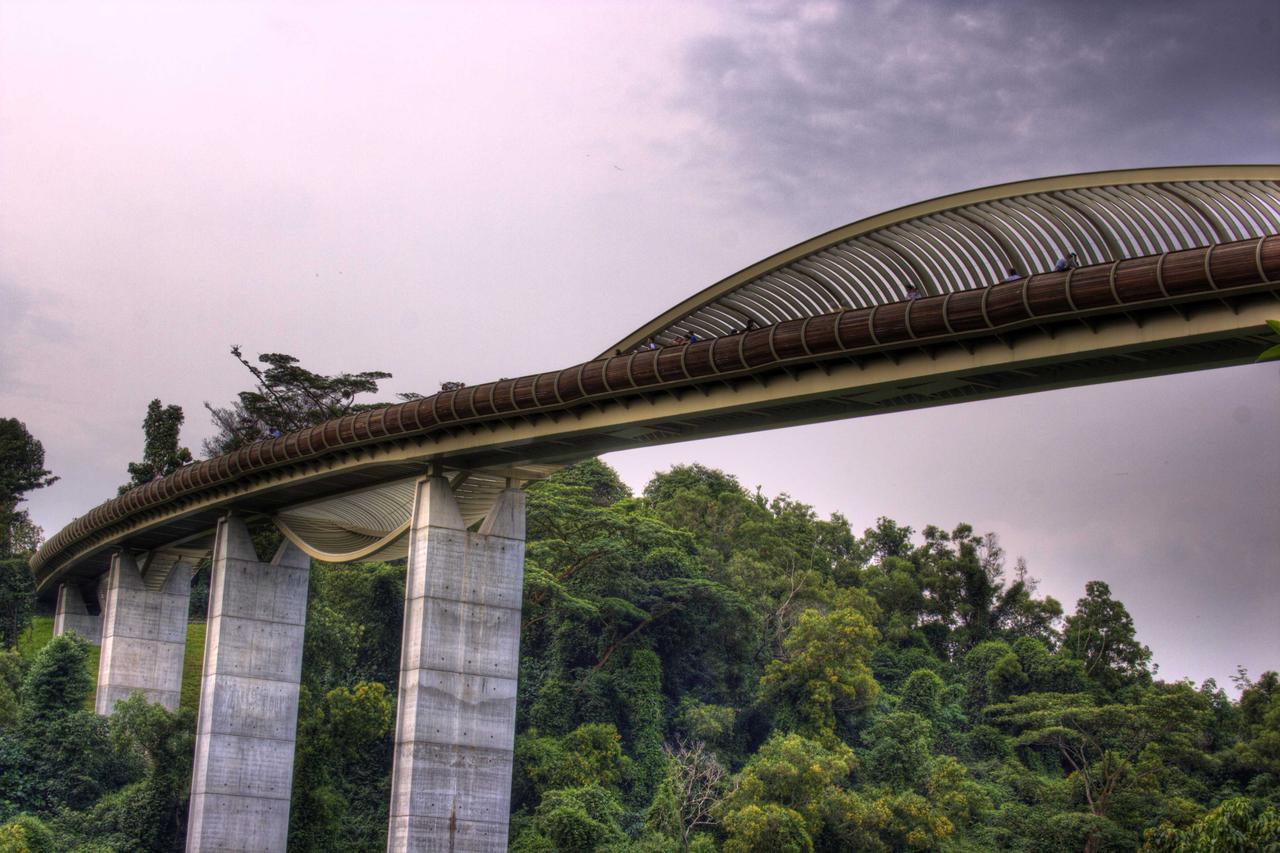
Construction of the Henderson Waves Bridge began in 2006, with the structure positioned to span the 284-metre distance between Mount Faber and Telok Blangah Hill. The bridge’s highest point rises 36 metres above the six-lane highway beneath Henderson Road.【4】 Typical spans of 24 metres were prefabricated, welded, galvanized and painted before being lifted into place by crane. The largest span was assembled on a platform and then positioned using a hydraulic lifting system. For the foundations, large reinforced concrete pad foundations were placed on top of dense soil layers, connected to concrete piles designed to support the bridge’s vertical loads.【5】
Structural stability in the lateral direction was provided by column frames, while longitudinal balance was achieved by connecting the underside elements. Wooden decking panels were installed sequentially. The 1,500 square metre deck was positioned to conform to the bridge’s central curved form. The timber used, yellow balau, was selected to ensure legal traceability and adapted by local craftsmen through handwork. This process was completed to preserve the bridge’s aesthetic integrity and functionality.【6】
Henderson Waves Bridge (Flickr)
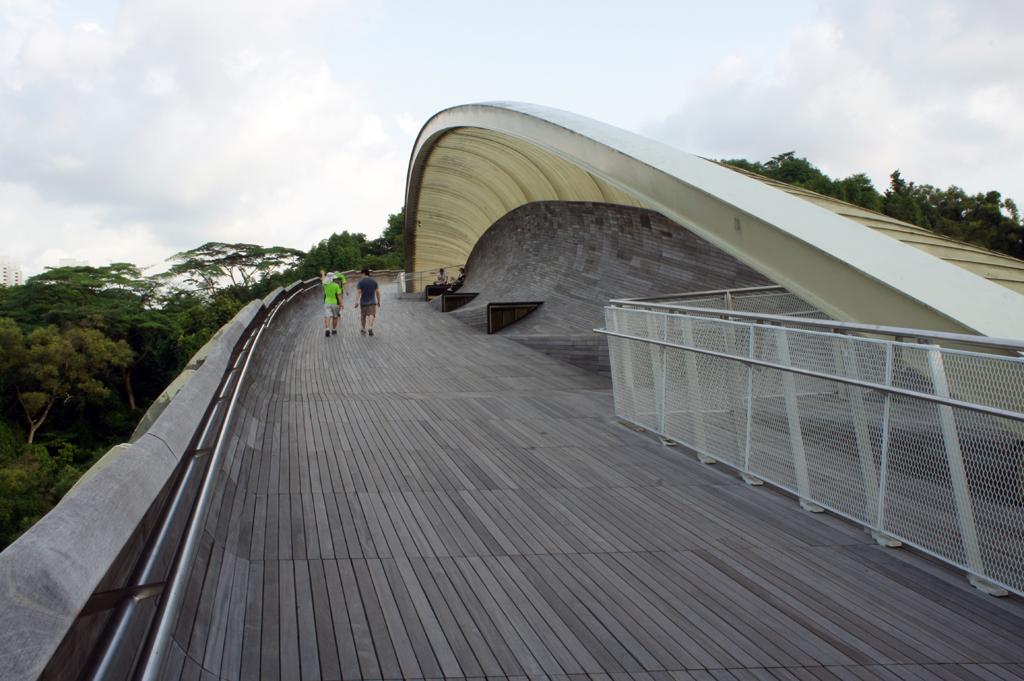
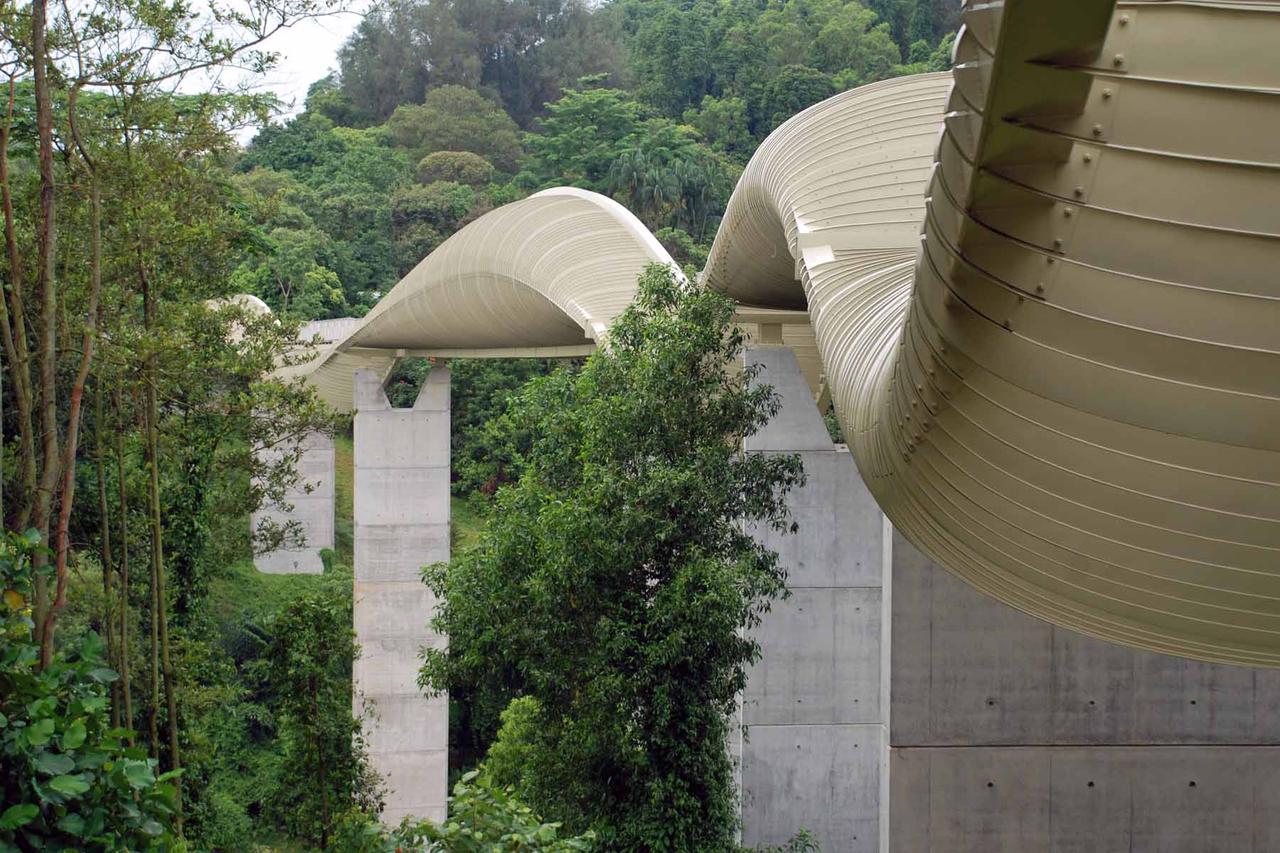
The Henderson Waves Bridge integrates structural function and visual rhythm through its undulating form composed of a series of inclined steel elements. The bridge surface consists of steel and wood materials, with the steel structural system providing strength and the wooden decking offering a natural aesthetic. The bridge is positioned to harmonize with the sloping terrain between Mount Faber and Telok Blangah Hill and is designed for pedestrian and bicycle use. The central and lateral structural elements create the bridge’s wave-like form, generating both seating areas and sheltered spaces. Additionally, the bridge was shaped to integrate seamlessly with the surrounding natural landscape, using three-dimensional mathematical formulations to ensure a continuous transition between the terrain and the bridge’s upper level.
The Henderson Waves Bridge is supported by inclined steel members and reinforced concrete piers. Positioned to conform to the slope of the terrain, the steel elements are designed to carry both vertical and horizontal loads. The bridge consists of seven sections: six sections feature elements 3.5 metres high and 24 metres long, while the seventh section is 6 metres high, 57 metres long and weighs approximately 250 tonnes. The upper sections provide users with spaces for seating, rest and viewing the surroundings, while the lower sections are inaccessible and serve only to maintain structural integrity. The steel members unify the primary structural components and lateral connections, providing stability and long-term durability.【7】
Dynamic loads and environmental influences were considered in the bridge’s design. Vibrations generated by pedestrians and cyclists were controlled through the bridge’s geometry and connection points to limit movement and ensure comfortable usage. Concrete piers were positioned to adapt to varying soil layers and designed to distribute the bridge’s weight evenly. The bridge’s sloping and undulating form was optimized using three-dimensional mathematical modelling, creating an integrated system that is both aesthetically and engineered cohesive.
Henderson Waves Bridge (Flickr)
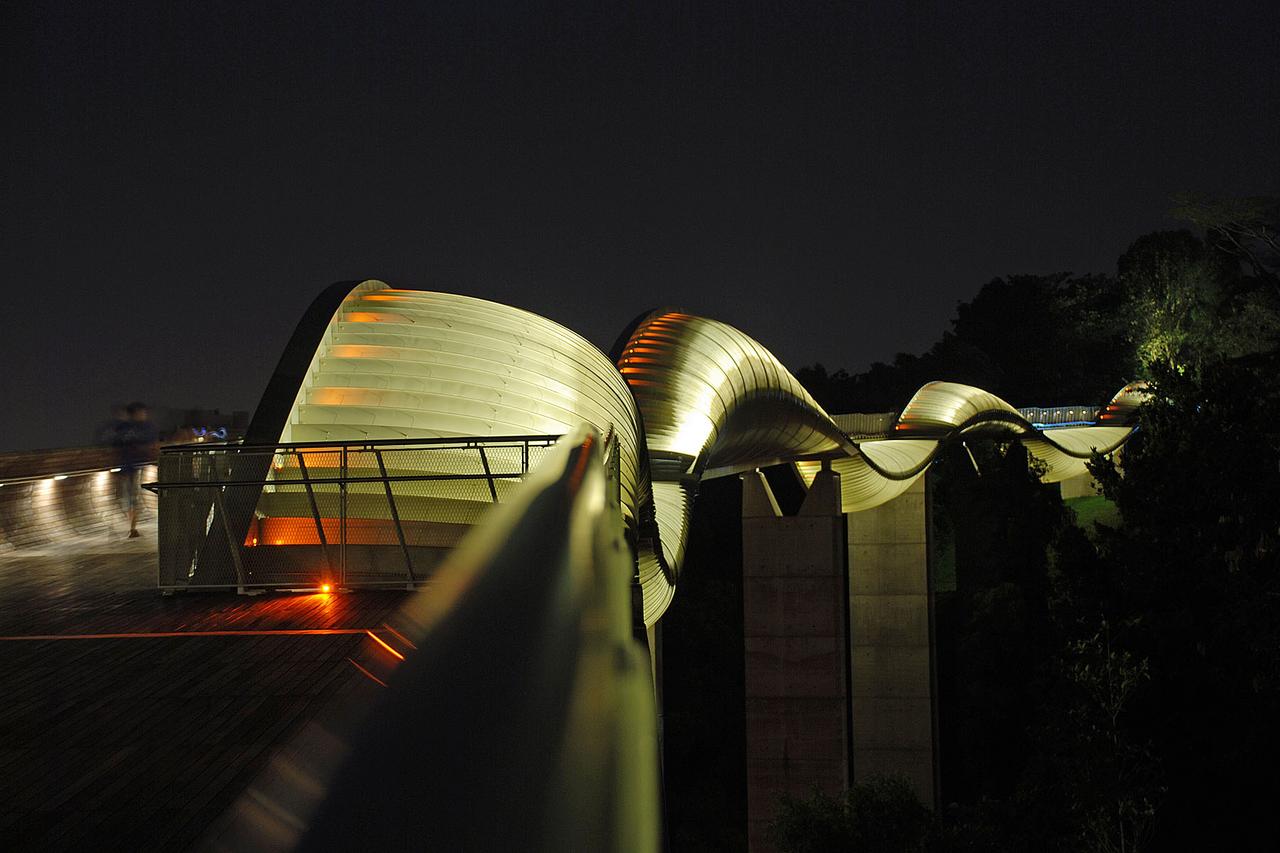
The Henderson Waves Bridge was designed to harmonize with the natural environment through its sloping and undulating form. Its surface is clad in yellow balau wood, offering a cohesive visual experience integrated with seating areas and walkways. The inclined elements along the bridge are arranged to provide both shade and privacy for users. At night, the bridge is illuminated by LED lighting, highlighting its form and contextual setting. The lighting not only ensures safety but also enables the bridge’s curved structure to be viewed from multiple perspectives, enriching its nighttime appearance alongside its daytime aesthetic. This design was planned to deliver both functional and aesthetic visual experiences for pedestrians and cyclists.
Together with the Alexandra Arch bridge and HortPark, the Henderson Waves Bridge creates a new recreational and social interaction space for both local residents and visitors within the Southern Ridges area. These structures contribute to preserving environmental and aesthetic values by integrating the natural landscape with the urban environment. The bridge and park offer opportunities for walking, cycling and interaction with nature, while emphasizing the region’s unique character and visual identity. This area functions as a platform showcasing innovations in landscape and architecture, encouraging public engagement with nature. Furthermore, the sharing of memories and experiences related to the park and bridges enriches the region’s cultural memory and strengthens the connection between urban life and the natural environment.
A Singapore Government Agency. “Henderson Waves Bridge.” A Singapore GovernmentAgency Resmi Website. December 4, 2022. Accessed April 8, 2026. https://www.sg101.gov.sg/resources/archives/heritage-henderson-waves-bridge/
Alantankenghoe. “Henderson Waves.” Flickr. Accessed April 8, 2026. https://www.flickr.com/photos/digitaljourney/5966898298/
Arslan, Ayça. “Bridges as City Landmarks: A Critical Review on Iconic Structures.” *Journal of Design Studio* 2, no. 2 (2020): 85–99. Accessed April 8, 2026. https://dergipark.org.tr/tr/download/article-file/1302255
Chew, Valerie. “Henderson Waves and Alexandra Arch.” National Library Board Singapore. Accessed April 8, 2026. https://www.nlb.gov.sg/main/article-detail?cmsuuid=b00c850d-dd67-47ea-b17b-1102c375ad36
Kustura, Mladen, Goran Šunjić, and Brigita Šunjić. “Pedestrian Bridges and Load Testing.” *e‑Zbornik* 19. (2020): 88-102. Accessed April 8, 2026. https://www.researchgate.net/publication/342898316_Pedestrian_bridges_and_load_testing
Lin, Michael. “Henderson Wave.” Flickr. Accessed April 8, 2026. https://www.flickr.com/photos/maikcol/2547869499/
Scott, Paul. “Walking on Waves.” *Ingenia.*, no. 38. March 2009. Accessed April 8, 2026. https://www.ingenia.org.uk/articles/walking-on-waves/
Shing, Choo Yut. “Henderson Waves.” Flickr. Accessed April 8, 2026. https://www.flickr.com/photos/25802865@N08/2647888683/
Shing, Choo Yut. “Pedestrian Bridge.” Flickr. Accessed April 8, 2026. https://www.flickr.com/photos/25802865@N08/2480404526/
Shing, Choo Yut. “Pedestrian Bridge.” Flickr. Accessed April 8, 2026. https://www.flickr.com/photos/25802865@N08/2480404528/
Travel Oriented. “Singapore | Henderson Waves Bridge.” Flickr. Accessed April 8, 2026. https://www.flickr.com/photos/traveloriented/16201375086/
Urban Redevelopment Authority. “PM Lee Hsien Loong Officially Opens Two Pedestrian Bridges and HortPark – the Gardening Hub at the Southern Ridges.” Urban Redevelopment Authority. May 10, 2008. Accessed April 8, 2026. https://www.ura.gov.sg/Corporate/Media-Room/Media-Releases/pr08-51
Yeoh, Erik. “Henderson Waves.” Flickr. Accessed April 8, 2026. https://www.flickr.com/photos/erikyeoh/3613177845/
[1]
Valerie Chew, “Henderson Waves and Alexandra Arch,” National Library Board Singapore, Last Accessed: 8 April 2026, https://www.nlb.gov.sg/main/article-detail?cmsuuid=b00c850d-dd67-47ea-b17b-1102c375ad36
[2]
A.e.,
[3]
A.e.,
[4]
A.e.,
[5]
Paul Scott, “Walking on Waves,” Ingenia, no. 38, March 2009, Last Accessed: 8 April 2026, https://www.ingenia.org.uk/articles/walking-on-waves/
[6]
A.e.,
[7]
A.e.,

Henüz Tartışma Girilmemiştir
"Henderson Waves Bridge" maddesi için tartışma başlatın
History
Identity Plan and Public Participation
Design Competition and Selection Process
Construction Process
Architectural Design
Structural Features and Engineering
Lighting and Visual Features
Cultural Significance