


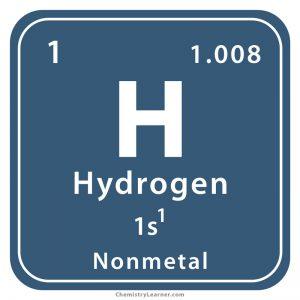
Hydrogen
Atomic Number | 1 | ||||||||
|---|---|---|---|---|---|---|---|---|---|
Group | 1 | ||||||||
Period(s) | 1 | ||||||||
Block | s | ||||||||
Electron Configuration | 1s1 | ||||||||
Phase | Gas | ||||||||
Melting Point | -259.1 °C | ||||||||
Boiling Point | -252.9 °C | ||||||||
Density | 0.08988 g/l | ||||||||
Hydrogen (H) is the simplest and most abundant element in the universe. Chemically, a hydrogen atom consists of only one proton and one electron, making it extremely simple in atomic structure compared to other elements. Hydrogen does not exist freely on Earth; it is usually found in compounds such as water (H₂O) or fossil fuels (natural gas, coal, oil). Hydrogen is a colorless, odorless, and tasteless gas that exists in a gaseous state under standard conditions. However, at low temperatures, it can liquefy, allowing it to be used in various fields such as energy storage and transportation.
The discovery of hydrogen marks a significant milestone in scientific history. For centuries, different cultures and scientists conducted various experiments to understand the nature and properties of hydrogen. Here are some key developments in the history of hydrogen:
Scientists in the 16th century laid the foundations of hydrogen. However, at that time, the chemical nature and composition of hydrogen were not fully understood. Elements were generally identified based on their compounds rather than as individual substances.
The English chemist Henry Cavendish made the modern discovery of hydrogen in 1766. Cavendish identified hydrogen gas as a distinct element and was the first to describe its acidic properties and ability to produce water. This was one of the first major steps in modern chemistry regarding hydrogen.
Cavendish referred to hydrogen as "flammable air", observing that when hydrogen reacted with acidic water, it produced water. This experiment revealed that hydrogen is a combustible gas that forms water with oxygen.
French chemist Antoine Lavoisier confirmed that hydrogen is a chemical element and one of the components of water. He coined the term "hydrogen", deriving it from the Greek words "hydros" (water) and "genes" (creator) because hydrogen forms water when it combines with oxygen.
In the 19th century, hydrogen became widely used, particularly in gas lamps and balloons. At the time, it was primarily recognized for its flammability.
During the 1820s, Michael Faraday discovered that hydrogen could be separated from water through electrolysis. This breakthrough significantly contributed to the production and use of hydrogen.
One of the most important applications of hydrogen in the 20th century was its use in space exploration. Due to its high energy density, hydrogen became a crucial component of rocket fuel.
Hydrogen-fueled rockets were developed in the 1940s, and by the early 1960s, NASA successfully used liquid hydrogen to launch spacecraft. This greatly increased hydrogen’s role in space research.
In the 21st century, as environmentally friendly energy sources gained attention, hydrogen once again became a key focus. As an alternative to fossil fuels, hydrogen emerged as a zero-emission energy carrier.
Green hydrogen, produced through water electrolysis, holds great potential for sustainable energy solutions. Advances in technology have led to various applications in clean energy production.
By the early 2020s, global research on hydrogen technologies accelerated, with many governments and companies launching projects to integrate hydrogen as an energy carrier.
Scientific studies and industrial advancements suggest that by 2050, hydrogen could meet 18% of global energy demand (according to the (IEA Net Zero 2050 Scenario). Hydrogen is expected to play a significant role in carbon-intensive industries such as cement, chemicals, and aviation. Policies like the European Union’s “Hydrogen Strategy” and Japan’s “Hydrogen Society” aim to accelerate this transition.
Hydrogen’s most notable characteristic is its role as an energy carrier. While its energy density per mass is high, its energy density per volume is low, making large-scale storage and transport difficult compared to traditional fuels.
Hydrogen is the simplest element in the periodic table, consisting of one proton and one electron. However, due to varying neutron counts, it has three isotopes, each with different physical and chemical properties.
There are various methods for producing hydrogen, and the environmental impact of these methods determines whether hydrogen is classified as "clean" or "dirty." Hydrogen production can directly contribute to emissions, depending on the process used. The primary hydrogen production methods include:
Hydrogen serves as an energy carrier in various fields. Energy carriers are substances that transport energy from one place to another. Hydrogen can be obtained through water electrolysis or extracted from fossil fuels and then converted into energy. The main areas of hydrogen use include:
Hydrogen has significant potential, but its environmental impact depends on the production method. To classify hydrogen as "clean," careful selection of production processes is necessary. While green hydrogen holds the greatest promise as an environmentally friendly energy carrier, blue and gray hydrogen require additional technologies to control emissions effectively.
Chemistry Learner. "Hydrogen." Chemistry Learner, Son erişim tarihi 12 Mart 2025. https://www.chemistrylearner.com/hydrogen.html.
CIAAW. "Hydrogen." Son erişim tarihi 12 Mart 2025. https://www.ciaaw.org/hydrogen.htm.
H2 Science Coalition. Clean Hydrogen Definition. Son erişim tarihi 12 Mart 2025. https://h2sciencecoalition.com/briefings/clean-hydrogen-definition/.
Hydrogen. Alternative Fuels Data Center. Son erişim tarihi 12 Mart 2025. https://afdc.energy.gov/fuels/hydrogen.
International Energy Agency (IEA). Towards Hydrogen Definitions Based on Their Emissions Intensity. Son erişim tarihi 12 Mart 2025. https://www.iea.org/reports/towards-hydrogen-definitions-based-on-their-emissions-intensity.
International Energy Agency (IEA). "Hydrogen." Son erişim tarihi 12 Mart 2025. https://www.iea.org/energy-system/low-emission-fuels/hydrogen.
Jefferson Lab. "Hydrogen." It's Elemental, Son erişim tarihi 12 Mart 2025. https://education.jlab.org/itselemental/ele001.html.
Los Alamos National Laboratory. "Hydrogen." Periodic Table, Son erişim tarihi 12 Mart 2025. https://periodic.lanl.gov/1.shtml.
National Grid. "What Is Hydrogen?" National Grid, Son erişim tarihi 12 Mart 2025. https://www.nationalgrid.com/stories/energy-explained/what-is-hydrogen.
Royal Society of Chemistry. "Hydrogen." Periodic Table, Son erişim tarihi 12 Mart 2025. https://periodic-table.rsc.org/element/1/hydrogen.
U.S. Energy Information Administration. "Hydrogen." Son erişim tarihi 12 Mart 2025. https://www.eia.gov/energyexplained/hydrogen/.

Hydrogen
Atomic Number | 1 | ||||||||
|---|---|---|---|---|---|---|---|---|---|
Group | 1 | ||||||||
Period(s) | 1 | ||||||||
Block | s | ||||||||
Electron Configuration | 1s1 | ||||||||
Phase | Gas | ||||||||
Melting Point | -259.1 °C | ||||||||
Boiling Point | -252.9 °C | ||||||||
Density | 0.08988 g/l | ||||||||
Henüz Tartışma Girilmemiştir
"Hydrogen" maddesi için tartışma başlatın
History
1. Early Discoveries (16th Century)
2. Discovery of Hydrogen (18th Century)
3. Naming of Hydrogen (18th Century)
4. Industrial Use of Hydrogen (19th Century)
5. Hydrogen as Rocket Fuel (20th Century)
6. Hydrogen as a Green Energy Source (21st Century)
7. The Future of Hydrogen
Physical and Chemical Properties of Hydrogen
Atomic Structure and Chemical Properties
Physical Properties
Energy Content
Isotopes of Hydrogen
1. Protium (H-1)
2. Deuterium (H-2 or D)
3. Tritium (H-3 or T)
Applications
Hydrogen Production and Environmental Impact
Hydrogen Applications
Bu madde yapay zeka desteği ile üretilmiştir.