
+2 Daha


Hyperopia is a common vision disorder in which the eye has difficulty focusing on nearby objects clearly. It occurs when the eye's optical system focuses light behind the retina instead of directly on it. Hyperopia, also known as farsightedness or hypermetropia, can affect both children and adults.
Hyperopia is one of the refractive errors of the eye. In a normal eye (emmetropia), light passes through the cornea and lens and is sharply focused on the retina, creating a clear image. However, in a hyperopic eye, the front-to-back length of the eyeball may be shorter than normal, or the cornea and crystalline lens may have insufficient refractive power. As a result, light from nearby objects is focused behind the retina, causing close-up objects to appear blurry. Distant objects are generally seen more clearly, but in cases of severe hyperopia, even distant vision may become blurry.
Hyperopia is often congenital and has a genetic component; it is more common in individuals with a family history of hyperopia. Most children are born with mild hyperopia, but as the eye grows, the condition typically resolves by adolescence. In adults, the loss of lens flexibility with age (not to be confused with presbyopia) can make hyperopia more noticeable.
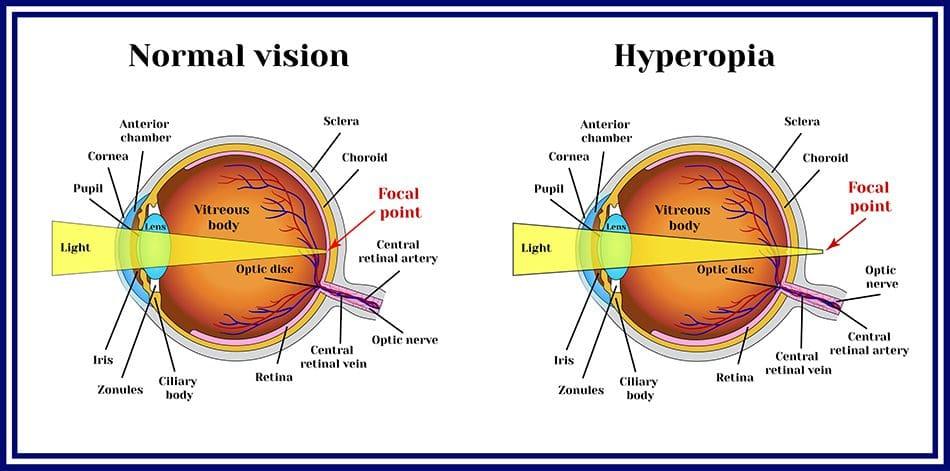
The main causes of hyperopia are related to the anatomical structure of the eye:
In children, hyperopia is often a developmental condition and usually decreases as the eye grows. In adults, it may be confused with age-related lens hardening (presbyopia), but these two conditions have different mechanisms.Hyperopia in children
The symptoms of hyperopia vary depending on the severity of the condition and the person's age. Individuals with mild hyperopia, especially young people, may not notice any symptoms due to their eye muscles' ability to accommodate. However, in more severe cases or as people age, the following symptoms may appear:
Children can compensate for hyperopia due to their flexible lenses, which may mask symptoms. However, prolonged effort to compensate may lead to eye strain or other complications over time.
Hyperopia is diagnosed through a comprehensive eye examination conducted by an ophthalmologist or optometrist. This examination may include:
Regular eye examinations are crucial for early detection of hyperopia since symptoms may not always be obvious.
Hyperopia can be corrected through various methods, depending on the person's age, lifestyle, and the severity of the condition:
Since hyperopia is primarily due to the anatomical structure of the eye, it cannot be entirely prevented. However, regular eye exams and healthy lifestyle habits (balanced diet, UV protection, limiting screen time) can help maintain good eye health. Early detection in children reduces the risk of complications.
Hyperopia is a common vision disorder affecting millions of people worldwide. This condition, often congenital, is linked to genetic factors and the physical structure of the eye. It manifests with symptoms such as blurry near vision, eye strain, and headaches, though it may remain undetected in young individuals. Easily correctable with eyeglasses, contact lenses, or surgery, hyperopia does not significantly impact the quality of life when managed with regular eye check-ups.
All About Vision. "Hyperopia (Farsightedness): Symptoms and Treatment." AllAboutVision.com. Son güncelleme Mart 4, 2019. Erişim tarihi Mart 14, 2025. https://www.allaboutvision.com/conditions/hyperopia/overview/.
Cleveland Clinic. "Hyperopia (Farsightedness)." ClevelandClinic.org. Erişim tarihi Mart 14, 2025. https://my.clevelandclinic.org/health/diseases/hyperopia-farsightedness.
Dünyagöz Hospital Editorial Board. "Hyperopia." Dunyagoz.com. Son güncelleme Haziran 2, 2023. Erişim tarihi Mart 14, 2025. https://www.dunyagoz.com/en/medical-units/laser-and-intraocular-lens/hyperopia.
ICRCat. "Hyperopia." ICRCat.com. Erişim tarihi Mart 14, 2025. https://icrcat.com/en/eye-conditions/hyperopia/.
Mayo Clinic. "Farsightedness: Symptoms & Causes." MayoClinic.org. Erişim tarihi Mart 14, 2025. https://www.mayoclinic.org/diseases-conditions/farsightedness/symptoms-causes/syc-20372495.
Moorfields Eye Hospital. "Hypermetropia (Long-Sightedness)." Moorfields.nhs.uk. Erişim tarihi Mart 14, 2025. https://www.moorfields.nhs.uk/eye-conditions/hypermetropia-long-sightedness.
Myopia Specialist Centre. "Hypermetropia." MyopiaSpecialistCentre.com. Erişim tarihi Mart 14, 2025. https://www.myopiaspecialistcentre.com/hypermetropia/.
National Eye Institute. "Farsightedness (Hyperopia)." NEI.nih.gov. Erişim tarihi Mart 14, 2025. https://www.nei.nih.gov/learn-about-eye-health/eye-conditions-and-diseases/farsightedness-hyperopia.
Nethradhama Medical Staff. "Hypermetropia (Far-Sightedness): Causes, Symptoms, Diagnosis, and Treatment." Nethradhama.org. Aralık 5, 2024. Erişim tarihi Mart 14, 2025. https://nethradhama.org/blog/hypermetropia/.
NHS. "Long-Sightedness." NHS.uk. Erişim tarihi Mart 14, 2025. https://www.nhs.uk/conditions/long-sightedness/.
Porter, Daniel. "Farsightedness: What Is Hyperopia?" American Academy of Ophthalmology. Ekim 24, 2024. Erişim tarihi Mart 14, 2025. https://www.aao.org/eye-health/diseases/hyperopia-farsightedness.

Henüz Tartışma Girilmemiştir
"Hyperopia" maddesi için tartışma başlatın
Causes of Hyperopia
Symptoms of Hyperopia
Diagnosis of Hyperopia
Treatment Options for Hyperopia
Bu madde yapay zeka desteği ile üretilmiştir.