


Bu içerik Türkçe olarak yazılmış olup yapay zeka ile otomatik olarak İngilizceye çevrilmiştir.

Humanity has long sought a scientific answer to the same fundamental question:
Is life confined only to Earth’s conditions, or can it originate under different environmental circumstances?
One of the most compelling scientific responses to this question comes from the study titled “Effect of microgravity on mammalian embryo development evaluated at the International Space Station.” This article is not merely an experimental report; it also represents a conceptual threshold that challenges our foundational assumptions about the nature of life.【1】
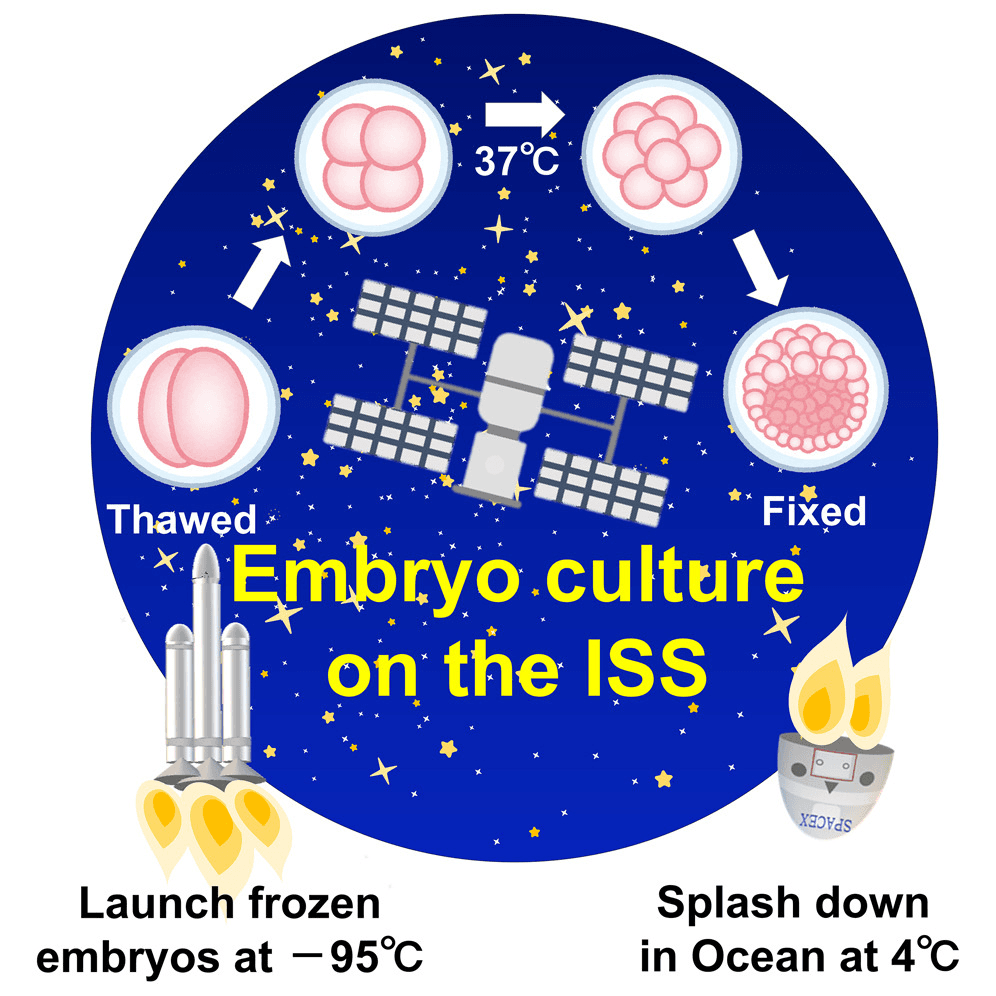
Cell Colonies in Space: Infographic of the Experiment Conducted on the ISS (iScience)
Human progress in space exploration has not only expanded our capacity for discovery but also brought critical questions about sustainable life to the forefront. Long-duration space missions and potential colonization efforts have made it essential to determine whether biological reproduction is feasible in space environments.
Although the effects of microgravity on cellular processes have been studied in various contexts, its impact on the early stages of mammalian embryonic development has been investigated only to a limited extent. Experiments conducted aboard the International Space Station (ISS) are regarded as a significant step toward filling this knowledge gap.
Early studies, particularly during the NASA and Soviet space programs, focused on understanding the effects of microgravity on living organisms.
Frogs in Space Experiments (Drew and Diane)
More recently, research has focused on cell cultures and stem cells. However, due to technical challenges, the full development of mammalian embryos from the earliest stages in space remained largely unexplored.【2】
The study was conducted aboard the International Space Station and focused primarily on the following question:
How does microgravity affect the early development of mammalian embryos?
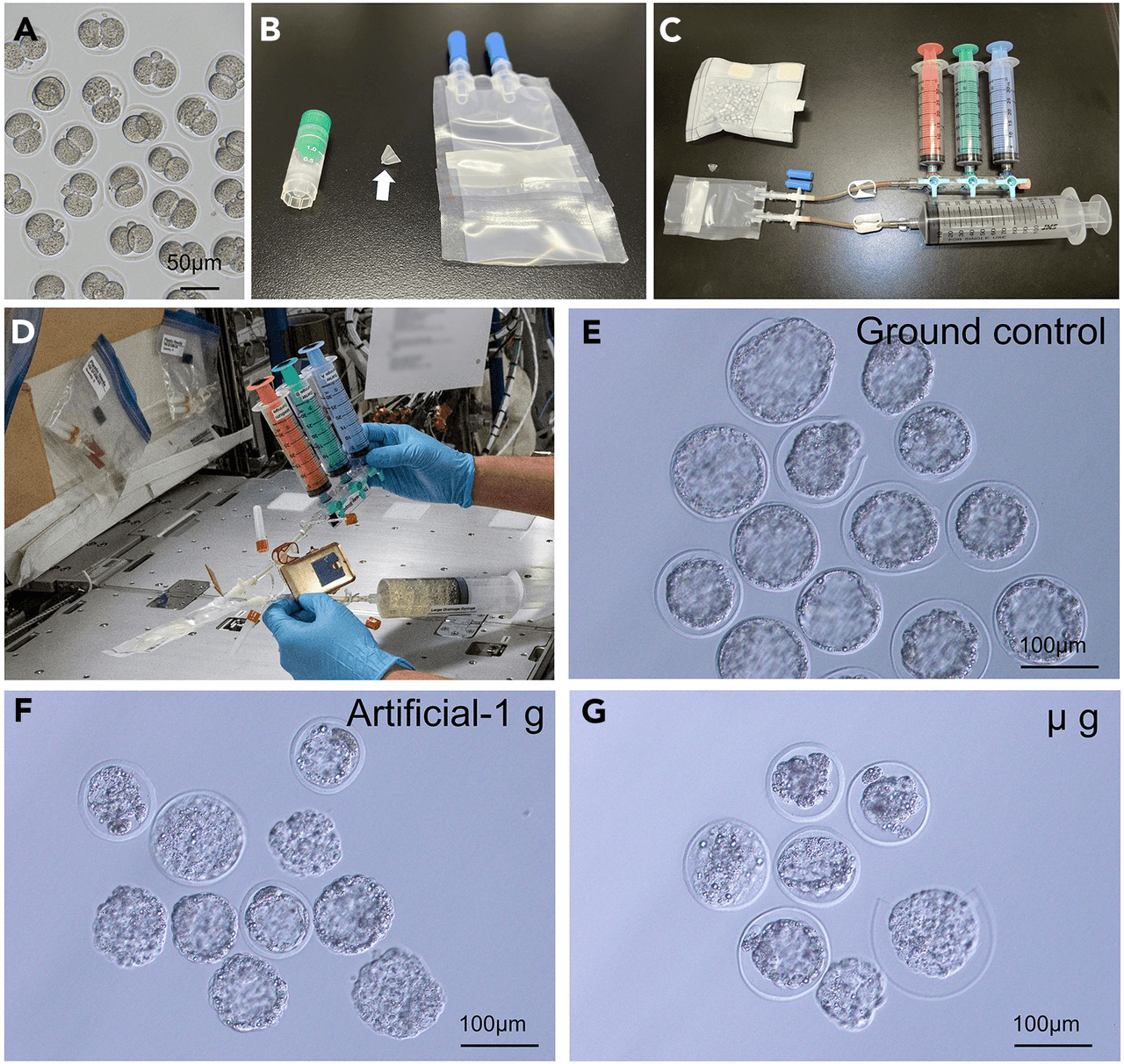
Development of Embryos to the Blastocyst Stage Under Microgravity Conditions on the International Space Station (ISS) (iScience)
The experiment involved:
The same process was replicated on Earth to enable comparative analysis.
The results of the study are clear and striking:
Additionally:
These findings indicate that microgravity does not constitute a critical barrier to the early stages of embryonic development.
Collection of Embryos from Embryo Culture Carriers (ETCs) Returned from the International Space Station (iScience)
Although the study delivers important findings, several critical questions remain unanswered:
The study sheds light only on the earliest phase of the developmental process.
This study represents a significant milestone in space biology, as it is the first to clearly demonstrate the early development of mammalian embryos in space.
It has direct implications for the following areas:
One of the most critical future challenges is interplanetary colonization.
Musculoskeletal System (Generated by Artificial Intelligence)
While the study demonstrates the possibility of early embryonic development, significant challenges remain for colonization:
In conclusion, this article does not provide a complete solution but adds a strong scientific foundation to discussions about sustainable life in space.
Though it may appear as a small step for the scientific community, it opens a door to a profoundly significant question for humanity’s future.
Alexey Kats. “Batrachospermum.” LiveJournal. Accessed March 18, 2026. https://batrachospermum.livejournal.com/42564.html.
Drew and Diane. “Frogs in Space.” YouTube. Accessed March 18, 2026. https://youtu.be/YmNtrGfRq2M
Jain, Varsha, Susana M. Chuva de Sousa Lopes, Mohammed A. Benotmane, Vittore Verratti, Rod T. Mitchell, Jan-Bernd Stukenborg, et al. “Human Development and Reproduction in Space - A European Perspective.” *npj Microgravity* 9 (2023): 24. Accessed March 18, 2026. https://doi.org/10.1038/s41526-023-00272-5
Mikhail Borisenok. “Kosmicheskaya Programma SSSR.” Histrf. Accessed March 18, 2026. https://w.histrf.ru/articles/kosmicheskaya-programma-sssr.
Wakayama, Sayaka, Yasuyuki Kikuchi, Mariko Soejima, et al. “Effect of Microgravity on Mammalian Embryo Development Evaluated at the International Space Station.” *iScience* 26, no. 11 (2023): 107723. Accessed March 18, 2026. https://www.cell.com/iscience/fulltext/S2589-0042(23)02254-X.
[1]
Sayaka Wakayama, Yasuyuki Kikuchi, Mariko Soejima, …, Atsuo Ogura, Takashi Kohda, Teruhiko Wakayama, “Effect of Microgravity on Mammalian Embryo Development Evaluated at the International Space Station,” iScience 26, no. 11 (2023): 107723, accessed 18 March 2026, https://www.cell.com/iscience/fulltext/S2589-0042(23)02254-X
[2]
Varsha Jain, Susana M. Chuva de Sousa Lopes, Mohammed A. Benotmane, Vittore Verratti, Rod T. Mitchell, Jan‑Bernd Stukenborg, et al., “Human Development and Reproduction in Space—A European Perspective,” npj Microgravity 9, article no. 24 (2023), accessed 18 March 2026, https://doi.org/10.1038/s41526-023-00272-5
Where Does Life Begin?
A Brief History of Reproduction Research in Space
Experimental Design
Key Findings
Study Limitations
Future Perspectives