

 Son Eklenen:
Bu içerik Türkçe olarak yazılmış olup yapay zeka ile otomatik olarak İngilizceye çevrilmiştir.
Islamabad Imam Bargah Suicide Attack (2026) is a suicide attack carried out on 6 February 2026 against the Shia mosque named Imambargah Khadijah-tul-Kubra located in the Tarlai Kalan / Shehzad Town area of Islamabad, the capital of Pakistan. The attack occurred during Friday prayers while congregants were inside the mosque. Thirty-six people were killed and more than 169 were injured.
Islamabad Imam Bargah suicide attack, 6 February 2026 - (Associated Press)
On 6 February 2026, a suicide attack was carried out against a mosque in Islamabad, the capital of Pakistan, during Friday prayers. The attack took place at the Shia mosque named Imambargah Khadijah-tul-Kubra in the Tarlai Kalan / Shehzad Town area in southeastern Islamabad. Authorities stated that the explosion occurred while congregants were engaged in prayer and that the attack targeted a time of peak attendance.
According to official statements, the attack is recorded as the second largest in recent months within the federal capital boundaries of Islamabad.
Pakistani security officials reported that the attacker was identified and attempted to be stopped by security personnel upon entering the mosque, whereupon he opened fire and then detonated the explosive device he was carrying.
According to official statements by Pakistani authorities, 36 people were killed and more than 169 were injured in the Islamabad suicide attack. The injured were transported by ambulances dispatched to the scene to the Pakistan Institute of Medical Sciences (PIMS), Polyclinic Hospital, and CDA Hospital. Emergency conditions were declared in hospitals across Islamabad.
It was reported that 25 ambulances were sent from Rawalpindi to support Islamabad, and surgical teams, anesthesiologists, and neurosurgeons were placed on standby.

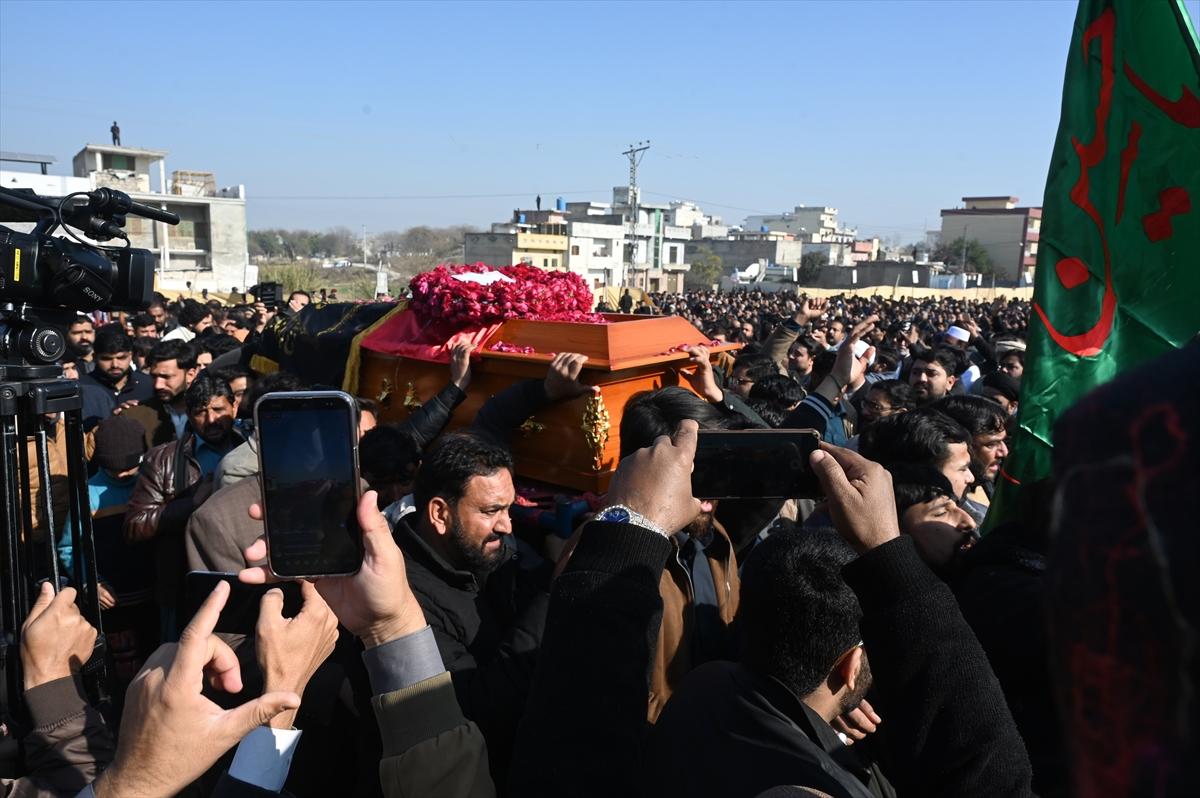
Burial of victims of the mosque attack in Pakistan, 7 February 2026 - (Anadolu Ajansı)
Following the attack, emergency response and security teams were deployed to the vicinity of Imambargah Khadijah-tul-Kubra. Authorities stated that rescue teams arrived at the scene approximately 10 to 12 minutes after the explosion and began evacuating the injured. Initial response efforts at the site were conducted simultaneously by police, medical personnel, and civil defense units.
After the explosion, the mosque and surrounding area were placed under a security cordon, with all entry and exit points controlled. The district administration confirmed that the site had been sealed and evidence collection operations had commenced. Authorities indicated that civilian movement in the vicinity was restricted to ensure the integrity of the investigation.
Authorities confirmed that the attacker was a Pakistani national and that forensic and security investigations revealed he had traveled to Afghanistan multiple times. Federal Minister for Interior Talal Chaudhry publicly stated that the attacker was not an Afghan citizen but that forensic analysis confirmed his repeated travel to Afghanistan.
Security sources indicated that the attacker conducted surveillance around the mosque prior to the attack and opened fire when security forces attempted to stop him on the day of the attack.
Technical examinations determined that the explosive device used in the attack contained approximately 4 to 6 kilograms of explosive material, was reinforced with metal ball bearings, and that the attacker fired two shots before detonating, and then fired multiple shots after entering the mosque.

Burial of victims of the mosque attack in Pakistan, 7 February 2026 - (Anadolu Ajansı)
Following the attack, Pakistani security and intelligence agencies launched a multifaceted investigation. Authorities announced coordinated nationwide operations to identify individuals linked to the attack, including raids in several cities, notably Islamabad, Rawalpindi, Peshawar, Nowshera, and Karachi.
Security sources reported that at least four “facilitators” were arrested during the investigation. Authorities assessed that these individuals assisted the attacker with accommodation, transportation, and logistical support. Among those detained were close family members of the attacker, with some suspects apprehended in the Peshawar and Nowshera regions.
During one of the operations in Nowshera, a gunfight erupted between security forces and armed individuals, resulting in the death of one police officer and injuries to several security personnel.
Pakistani authorities announced that the final investigation report would be prepared within 72 hours and submitted to the Prime Minister, and that forensic and intelligence examinations were being conducted with support from the National Database and Registration Authority (NADRA) and relevant judicial institutions.
Information emerged that a group linked to ISIS/DAESH claimed responsibility for the attack. Security sources and international news agencies reported that the group identified as DAESH’s Pakistan wing had asserted responsibility for the assault.
The Pakistani military and security agencies stated that their investigation concluded the attack was connected to the DAESH network based in Afghanistan.
On 7 February 2026, mass funeral prayers were held in Islamabad for those killed in the attack. Authorities reported that thousands attended the funeral services, with federal officials and public servants participating.
High-level security measures were implemented during the burials, with police and security forces deployed around the funeral grounds. Authorities confirmed that the funeral ceremonies concluded without any security breaches.
Following the attack, nationwide expressions of mourning and condemnation were issued. The Islamabad Bar Association condemned the attack and declared 7 February 2026 a day of mourning and strike, announcing that lawyers would not appear in court.

Burial of victims of the mosque attack in Pakistan, 7 February 2026 - (Anadolu Ajansı)
Following the attack, Pakistani President Asif Ali Zardari issued a statement offering condolences to the families of the deceased and ordered all available medical resources to be mobilized for the injured. Zardari described targeting civilians and places of worship as “a crime against humanity.”
Prime Minister Shehbaz Sharif condemned the attack and ordered a full investigation into all aspects of the incident. During a meeting with the Interior Minister, he emphasized the need to identify and bring the perpetrators to justice and insisted on personally monitoring the treatment of the injured.
Defense Minister Khawaja Muhammad Asif stated in his remarks that the attacker had previously traveled to Afghanistan, opened fire when security forces attempted to stop him, and then detonated himself. Asif argued that the attack involved organizational and transnational connections.
Following the suicide attack in Islamabad, numerous countries and international organizations issued condemnations and messages of condolence. United Nations Secretary-General Antonio Guterres strongly condemned the attack, emphasizing that assaults on civilians and places of worship are unacceptable. The UN statement underscored the need to identify and bring the perpetrators to justice.
Ministry of Foreign Affairs of the Republic of Türkiye condemned the attack in a written statement, offered condolences to the families of the deceased and wishes for swift recovery to the injured, and affirmed Türkiye’s solidarity with Pakistan in the fight against terrorism.
Under international reactions, Russian President Vladimir Putin described the attack as “barbaric” and extended condolences to the people of Pakistan. China’s Embassy in Islamabad declared its solidarity with Pakistan. Iran’s Ministry of Foreign Affairs issued a message emphasizing that combating terrorism requires regional cooperation.
In addition, Saudi Arabia, Qatar, Somalia, France, Germany, the United Kingdom, Canada, and Australia also condemned the attack and expressed solidarity with the Pakistani people and those affected. The United States diplomatic mission in Islamabad stated its support for Pakistan’s efforts toward peace and security.
Al Jazeera. “Deadly Islamabad Bombing Sharpens Focus on Cross-Border Attacks in Pakistan.” Al Jazeera. Accessed February 7, 2026. https://www.aljazeera.com/news/2026/2/7/deadly-islamabad-bombing-sharpens-focus-on-cross-border-attacks-in-pakistan
Al Jazeera. “Pakistan arrests 4 Islamabad bombing ‘facilitators’ as victims laid to rest.” Accessed February 7, 2026. https://www.aljazeera.com/news/2026/2/7/thousands-mourn-32-victims-of-islamabad-shia-mosque-bombing-in-pakistan
Anadolu Ajansı. "Deadly Explosion in Pakistani Capital Triggers Global Condemnation." Accessed February 7, 2026. https://www.aa.com.tr/en/asia-pacific/deadly-explosion-in-pakistani-capital-triggers-global-condemnation/3823053
Anadolu Ajansı. "Pakistan’da Cuma Namazı Sırasında Camide Meydana Gelen Patlamada En Az 31 Kişi Hayatını Kaybetti." Accessed February 7, 2026.
Anadolu Ajansı. “Thousands Attend Funeral of Islamabad Suicide Bombing Victims.” Accessed February 7, 2026. https://www.aa.com.tr/en/asia-pacific/thousands-attend-funeral-of-islamabad-suicide-bombing-victims/3823292
Associated Press. “Bombing at Shiite Mosque in Pakistan Kills Dozens.” YouTube video. Accessed February 7, 2026. https://www.youtube.com/watch?v=uQZxV4d9v7k
Dawn. “At least 31 killed, 169 injured in suicide bombing at Islamabad imambargah.” Dawn. Accessed February 7, 2026. https://www.dawn.com/news/print/1971418
Khyber News. “Islamabad Suicide Blast: ISIS Afghan Mastermind, Key Facilitators Arrested in Nationwide Operations.” Accessed February 7, 2026. https://khybernews.tv/islamabad-suicide-blast-isis-afghan-mastermind-key-facilitators-arrested-in-nationwide-operations/
Reuters. “Thousands mourn victims of Shi'ite mosque suicide bombing in Islamabad.” Accessed February 7, 2026. https://www.reuters.com/world/asia-pacific/thousands-islamabad-mourn-31-killed-suicide-bombing-shiite-mosque-2026-02-07/

On 6 February 2026, during Friday prayers at the Imambargah Khadijah-tul-Kubra in Islamabad, a suicide attack resulted in at least 31 deaths and over 169 injuries. It was reported that the attacker was attempted to be stopped by security personnel, but after opening fire, he detonated the explosive device he was carrying inside the place of worship. Following the incident, at least four individuals linked to the attack were taken into custody as part of a nationwide investigation, and it was stated that the attack was connected to an organization affiliated with ISIS. The attack provoked widespread condemnation within Pakistan and internationally; thousands attended the funeral ceremonies, and security measures were heightened in the capital.
Henüz Tartışma Girilmemiştir
"Islamabad Imam Bargah Suicide Attack (2026)" maddesi için tartışma başlatın
7 Şubat 2026
Course of the Attack
7 Şubat 2026
Casualties and Injuries
7 Şubat 2026
Initial Response and Security Measures at the Scene
7 Şubat 2026
Identity of the Attacker
7 Şubat 2026
Investigation and Arrests
7 Şubat 2026
Funeral Rites and Public Response
7 Şubat 2026
Statements by Pakistani Authorities
7 Şubat 2026
International Reactions and Condemnations