Bu içerik Türkçe olarak yazılmış olup yapay zeka ile otomatik olarak İngilizceye çevrilmiştir.
+2 Daha
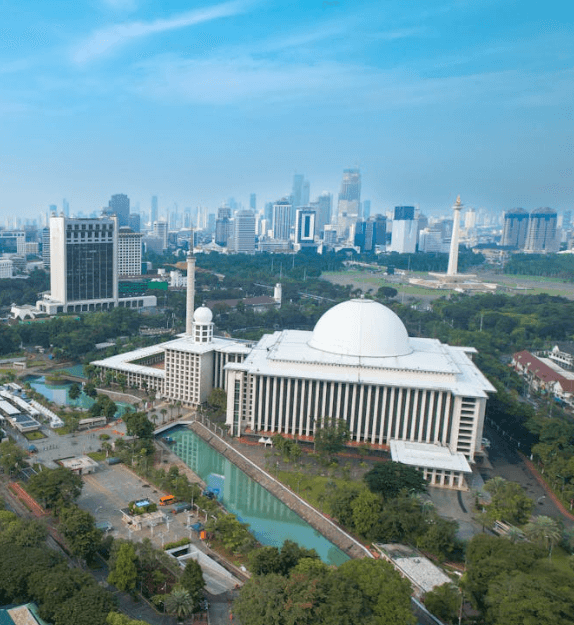
Istiqlal Mosque is a state mosque located in the National Monument (Taman Monumen Nasional) area in Indonesia’s capital, Jakarta. It derives its name from the Arabic word istiqlal, meaning “independence.” The construction of Istiqlal Mosque was publicly announced with a foundation-laying ceremony on 24 August 1961; the project commenced in 1962 and was completed in 1984.【1】
Designed according to modern architectural principles, the structure is regarded as a symbol of independence and an embodiment of national identity. The main prayer hall has a capacity of 12,000 people; the complex can accommodate approximately 120,000 worshippers during religious holidays.【2】

Istiqlal Mosque (Flickr)
The idea for constructing Istiqlal Mosque was first proposed in a 1950 meeting attended by then Minister of Religious Affairs KH. Wahid Hasyim and other religious leaders, who envisioned it as a symbolic mosque for the Republic of Indonesia.【3】
In 1955, a national architectural competition was held to select the design for the mosque. Although Friedrich Silaban did not win first place, he was commissioned to develop his second-place proposal. During the foundation-laying ceremony on 24 August 1961, Sukarno stated that the mosque would be constructed in a modern style using durable materials. The project began in 1962 and was completed in 1984.

Interior of Istiqlal Mosque (Pexels)
Istiqlal Mosque is situated in the northeast corner of Independence Square (Medan Merdeka/Taman Monumen Nasional) in central Jakarta. The National Monument (1964) stands at the center of the square, and the mosque is positioned to establish a visual and spatial relationship with this central structure. The galleries and open courtyard are arranged to orient toward the National Monument.
Independence Square has served as an urban focal point since the 17th century, known during the colonial era as Buffelsveld and Koningsplein, and as IKADA Square during the Japanese occupation. Sukarno renamed the area “Medan Merdeka” (Independence Square) following a speech on 17 August 1950.【5】
In the mosque’s layout, the prayer space is oriented toward the qibla, while connecting galleries are arranged to face the National Monument. This arrangement enables a direct visual connection between the mosque and the monument. The proximity of the mosque to the cathedral opposite it has been interpreted as a symbol of religious tolerance and social unity.【6】

Minaret of Istiqlal Mosque (Pexels)
Istiqlal Mosque was designed according to modern architectural principles. The structure is situated on a former wetland area of approximately four hectares.【7】 Unlike traditional Indonesian mosques, it features an integrated layout combining an open courtyard with covered galleries, resembling the courtyard-based plan common in Middle Eastern mosques.
The main prayer hall covers an area of 36,980 square meters and is surrounded by a five-story prayer gallery. As stipulated in the design competition brief, the structure was planned to accommodate 100,000 people. The entrance area includes a domed space of 5,000 square meters and a courtyard spanning 29,000 square meters. The architectural language follows the international style, characterized by clean white surfaces and expansive openings.【8】
The primary structural system is reinforced concrete, with marble and steel as the main building materials. The facades exhibit a regular rhythm of prominent horizontal and vertical lines. The cubic massing and repetitive facade pattern define the overall geometry of the structure.
In addition to its religious function, Istiqlal Mosque hosts educational and social activities. The complex includes a library, meeting halls, offices, exhibition spaces, and seminar rooms. In daily use, the mosque functions not only as a place of worship but also as a public space for sociocultural events.
The Istiqlal Mosque Library was established in accordance with the recommendation of the 1969 National Dakwah Seminar. Its collection and infrastructure were developed with funding from the Presidential Budget in 1973–1974.【9】 The library houses a wide range of publications, primarily Islamic sources, and includes sections and activities for children. Activities include seminars, writing competitions, and educational programs.
Within the mosque complex, formal educational units operate under the name Madrasah Istiqlal. These units cover PAUD, Madrasah Ibtidaiyah (MI), Madrasah Tsanawiyah (MTs), and Madrasah Aliyah (MA) levels. The vision of Madrasah Istiqlal is to cultivate individuals with strong moral values, high national consciousness, and the ability to compete globally. The educational program incorporates early childhood religious values, development of national culture, science and technology-based instruction, bilingual education, and character education. The curriculum is developed in accordance with national education standards; particularly at the RA level, it applies the Beyond Centers and Circle Time (BCCT) approach through seven distinct “sentra” models.【10】
Between 2019 and 2020, Istiqlal Mosque was renovated by Indonesia’s Ministry of Public Works and Housing (PUPR). Following the renovation, the structure received the EDGE (Excellence in Design for Greater Efficiencies) certification from the International Finance Corporation (IFC). It is the first place of worship to achieve this certification.【11】
The renovation implemented measures to improve energy, water, and material efficiency. Energy consumption was reduced by 23.07 percent, equivalent to an annual savings of 534.47 MWh. Annual carbon emissions decreased by 1,588.17 tons. Integrated solar panels supply approximately 13 percent of the building’s total electricity demand.【12】 LED lighting systems and energy-efficient air conditioning systems were also installed.
Water consumption was reduced by 35.99 percent, equivalent to an annual saving of 99,672.40 cubic meters.【13】 More efficient ablution faucets, dual-flush reservoir systems, and water-saving fixtures were implemented.
In terms of material efficiency, the renovation preserved existing structural and architectural elements. Embodied energy efficiency was calculated at 81.04 percent, resulting in an energy saving of 134,299.16 gigajoules through material reuse.【14】 During the renovation, existing floor beams, slabs, roof, exterior and interior walls, and window frames were reused.
Alim, Mohammed. "Interior Masjid Istiqlal Saat Waktu Sholat." Pexels. Accessed February 28, 2026. https://www.pexels.com/id-id/foto/interior-masjid-istiqlal-saat-waktu-sholat-29833372/
Aryanti, Tutin, and Amanda Achmadi. “Framing and Visualising Nationhood: Istiqlal Mosque and the Interiority of the Independence Square, Jakarta.” *Interiority*. Volume 7, no. 2 (2024): 251–272. Accessed February 26, 2026. https://scholarhub.ui.ac.id/interiority/vol7/iss2/7/
Buitenzorger. "Istiqlal Mosque, Jakarta." Flickr. Accessed February 28, 2026. https://www.flickr.com/photos/buitenzorger/8050210192
Chandra, Rio. "Minaret of Istiqlal Mosque in Jakarta." Pexels. Accessed February 28, 2026. https://www.pexels.com/photo/minaret-of-istiqlal-mosque-in-jakarta-26633801/
Fakhri, R. M. “Kajian Konsep Arsitektur Kubisme pada Bangunan Ibadah: Masjid Istiqlal.” *Purwarupa Jurnal Arsitektur.* Volume 8, no. 1 (2024): 45–51. Accessed February 26, 2026. https://jurnal.umj.ac.id/index.php/purwarupa/article/view/18153/pdf
Prajogo, Aris. "Jakarta Cathedral and Istiqlal Mosque in City." Pexels. Accessed February 28, 2026. https://www.pexels.com/photo/jakarta-cathedral-and-istiqlal-mosque-in-city-20739008/
Satriabhawana, M. T. “Sustainable Architecture Implementation of Mosque in Indonesia (Case Study: Mosque Istiqlal, Jakarta).” *IOP Conference Series: Earth and Environmental Science*, Volume 1404, no. 1 (2024): 012016. Accessed February 26, 2026. https://doi.org/10.1088/1755-1315/1404/1/012016
Teguhdin Hamid, Abdul Rosyid. “Model Pendidikan Masjid Integratif: Studi Kasus Masjid Istiqlal.” *Al-Ishlah*, Volume 20, no. 2 (2022): Accessed February 27, 2026. https://ejurnal.iainpare.ac.id/index.php/alislah/article/view/3084/1308
WallpaperFlare. "Great Mosque Istiqlal, Jakarta, Indonesia." Accessed February 28, 2026. https://www.wallpaperflare.com/search?wallpaper=great+mosque+istiqlal
Wiryomartono, Bagoes. “A Historical View of Mosque Architecture in Indonesia.” *The Asia Pacific Journal of Anthropology* Volume 10, no. 1 (2009): 33-45. Accessed February 26, 2026. https://www.tandfonline.com/doi/full/10.1080/14442210902758715?scroll=top&needAccess=true#d1e181
[1]
Tutin Aryanti ve Amanda Achmadi, “Framing and Visualising Nationhood: Istiqlal Mosque and the Interiority of the Independence Square, Jakarta,” Interiority Volume 7, Issue 2 (2024): 260-261, https://scholarhub.ui.ac.id/interiority/vol7/iss2/7/
[2]
Bagoes Wiryomartono, “A Historical View of Mosque Architecture in Indonesia,” The Asia Pacific Journal of Anthropology Volume 10, Issue 1 (2009): 42, https://www.tandfonline.com/doi/full/10.1080/14442210902758715?scroll=top&needAccess=true#d1e181
[3]
Reza Mushthafa Fakhri ve Anisa, “Kajian Konsep Arsitektur Kubisme pada Bangunan Ibadah: Masjid Istiqlal,” Purwarupa Jurnal Arsitektur Volume 8, Issue 1 (2024): 48, https://jurnal.umj.ac.id/index.php/purwarupa/article/view/18153/pdf
[5]
A. e., 265-257,
[6]
A.e., 262-263,
[7]
Bagoes Wiryomartono, “A Historical View of Mosque Architecture in Indonesia,” The Asia Pacific Journal of Anthropology Volume 10, Issue 1 (2009): 42, https://www.tandfonline.com/doi/full/10.1080/14442210902758715?scroll=top&needAccess=true#d1e181
[8]
Tutin Aryanti ve Amanda Achmadi, “Framing and Visualising Nationhood: Istiqlal Mosque and the Interiority of the Independence Square, Jakarta,” Interiority Volume 7, Issue 2 (2024): 262, https://scholarhub.ui.ac.id/interiority/vol7/iss2/7/
[9]
Abdul Rosyid ve Teguhdin Hamid, “Model Pendidikan Masjid Integratif: Studi Kasus Masjid Istiqlal,” Al-Ishlah Volume 20, Issue 2 (2022): 138, https://ejurnal.iainpare.ac.id/index.php/alislah/article/view/3084/1308
[10]
A.e., 139-140,
[11]
M. T. Satriabhawana, “Sustainable Architecture Implementation of Mosque in Indonesia (Case Study: Mosque Istiqlal, Jakarta),” IOP Conference Series: Earth and Environmental Science Volume 1404, Issue 1 (2024): 4, https://doi.org/10.1088/1755-1315/1404/1/012016
[12]
A. e., 4,
[13]
A. e., 5,
[14]
A. e., 6,

Henüz Tartışma Girilmemiştir
"İstiklal Camii" maddesi için tartışma başlatın
History
Urban and Symbolic Context
Architectural Features
Educational and Social Functions
Sustainable Architecture and Renovation Process