

Bu içerik Türkçe olarak yazılmış olup yapay zeka ile otomatik olarak İngilizceye çevrilmiştir.
+1 Daha
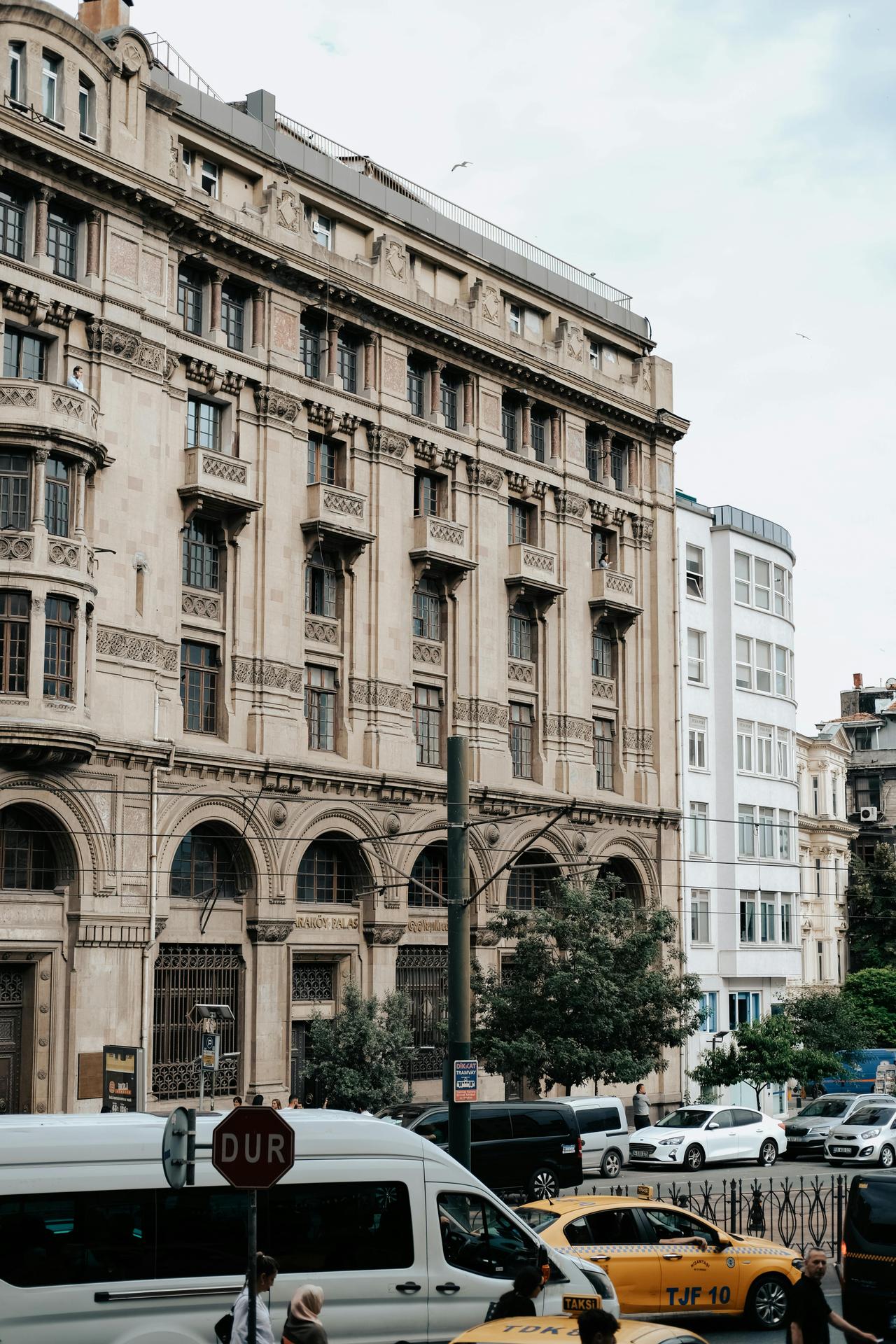
Karaköy Palas is a historical building located in the Karaköy neighborhood of Beyoğlu district in Istanbul, on Kemeraltı Street (Plot 102, Parcel 3) in the Galata area. Designed in 1920 by Giulio Mongeri, the construction process also involved Vedat Bey and Kemaleddin Bey. The building reflects the architectural trends of its time by integrating Byzantine and Turkish architectural elements with Art Nouveau and Neoclassical styles.
For many years, Karaköy Palas served as branches of Halk Bank and Yapı Kredi Bank. In 2026, it was revitalized by the Culture and Civilization Foundation (KÜME) and repurposed for culture and the arts.

Karaköy Palas (Anadolu Ajansı)
Originally designed as a four-story rectangular main volume, Karaköy Palas had a fifth story added later. The building has a symmetrical floor plan. The western facade features three entrance doors, with the central one providing access to the main foyer and the staircase leading to upper floors. Only the western facade facing the square is openly exposed; the other facades are surrounded by adjacent buildings.
The facade includes plasterwork, round arches, balcony-like projections, overhanging cornices, pilasters, and panels decorated with geometric and floral motifs. Byzantine capitals, relief decorations at arch corners, and ornamental bands are key elements defining the facade’s character. The use of horizontal and vertical lines with toothed patterns reflects Neoclassical influence, while geometric panels and decorative approaches show Art Nouveau elements. These features reflect the building’s eclectic character, combining diverse architectural styles.【1】
The interior space is characterized by a gallery layout. On the first floor, an arched gallery system is supported by square-sectioned piers at the corners and circular-sectioned columns in between. The railings surrounding the gallery feature geometric ornaments in the Art Nouveau style. Plant-based decorative elements influenced by Byzantine design are found on the capitals of columns and piers.
Karaköy Palas was constructed using stone in a load-bearing masonry system. Plaster and carton-pierre finishes were applied to ceilings, column capitals, and pier capitals within the interior.
Following a comprehensive restoration process carried out by the KÜME Foundation, Karaköy Palas is scheduled to open its doors on 25 April 2026. Located in a district surrounded by art galleries and independent creative spaces in Beyoğlu, the building aims to serve as a new platform for interaction and production for artists and audiences.

Karaköy Palas (pexels)
The building’s new functional phase has been initiated through two key projects:
Karaköy Palas will now operate as both an exhibition space and a center for scientific and artistic research contributing to Türkiye’s cultural and artistic heritage.
Afşar, Esra Naz. "Cars Driving on City Street near Old Building." Pexels. Accessed April 20, 2026. https://www.pexels.com/photo/cars-driving-on-city-street-near-old-building-17964114/
Aktemur, Ali Murat. "Karaköy’de Batı Üslubunda Yaptırılmış Sivil Mimari Örnekleri." PhD thesis, Atatürk Üniversitesi, 2006. Accessed April 20, 2026. https://eski.atauni.edu.tr/yuklemeler/0723eaa62b6a3f67a74c1d3284d51f1f.pdf
Anadolu Ajansı. “KÜME Vakfı, Karaköy Palas’ta sanata yeni bir alan açıyor.” Accessed April 20, 2026. https://www.aa.com.tr/tr/kultur/kume-vakfi-karakoy-palas-ta-sanata-yeni-bir-alan-aciyor/3906179
Karayel, Funda. "KÜME Foundation Opens Karaköy Palas as Permanent Site for Art." Daily Sabah. Accessed April 20, 2026. https://www.dailysabah.com/arts/kume-foundation-opens-karakoy-palas-as-permanent-site-for-art/news
Çankaya, Sude Naz. "Elegant Historical Building Facade at Dusk." Pexels. Accessed April 20, 2026. https://www.pexels.com/photo/elegant-historical-building-facade-at-dusk-31546408/
[1]
Ali Murat Aktemur, ''Karaköy’de Batı Üslubunda Yaptırılmış Sivil Mimari Örnekleri,'' (Doktora tezi, Atatürk Üniversitesi, 2006), 194. https://eski.atauni.edu.tr/yuklemeler/0723eaa62b6a3f67a74c1d3284d51f1f.pdf

Henüz Tartışma Girilmemiştir
"Karaköy Palas" maddesi için tartışma başlatın
Architectural Features
Interior Space
Materials and Construction Technique
Transformation and Restoration for Culture and the Arts
ArtıKÜME 2025 and ODAK Project