


Bu madde henüz onaylanmamıştır.
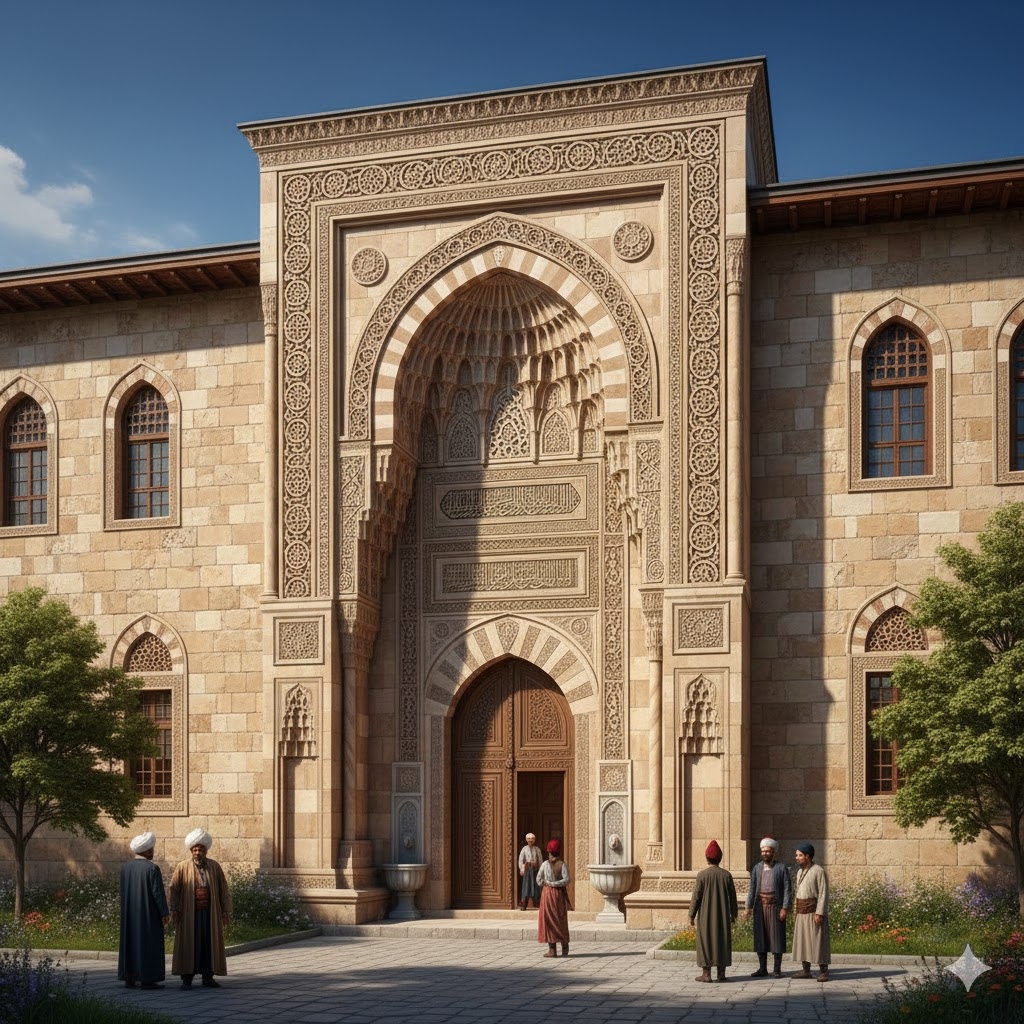
Hatuniye Madrasa (Created with artificial intelligence.)
The Karamanids were a Turkmen dynasty that ruled over the regions of Niğde, Karaman, Konya, İç province, Taş-province, and Alanya between 1256 and 1474. Historical sources trace the dynasty's lineage to the Afshar tribe of the Oghuz Turks. The fundamental social structure of the principality was formed by various clans, such as the Turgutlu, Bayburtlu, Oğuzhanlı, and Hoca Yunuslu. Following the Mongol invasion, this community migrated from the vicinity of Azerbaijan and Arran to the Sivas region. After participating in the Baba Ishak Rebellion, they settled in the Ermenek-Mut area. Karaman Bey, considered the founder of the principality, began playing an active role on the political stage after his father, Nure Sufi (Nur Sufi), handed over administration to him. The dynasty gained official status in 1261 when the Anatolian Seljuk Sultan Kilij Arslan IV granted Karaman Bey the principality and appointed his brother, Bunsuz, as the amir-i jandar (commander of the guards).

A political map showing the boundaries reached by the principality in southern and central Anatolia between the 13th and 15th centuries. (Generated by artificial intelligence.)
After the death of Karaman Bey, Shams al-Din Mehmed Bey took over the leadership. In 1277, he captured Konya, declared Alaeddin Siyavush (Cimri) the Seljuk sultan, and became his vizier. During this period, he issued a decree mandating that no language other than Turkish be used in state affairs. This edict remains the most significant historical document defining the principality's place in Turkish linguistic and cultural history.
From their inception, the Karamanids waged a struggle for independence against both the Anatolian Seljuk State and the Mongol (Ilkhanid) authority in the region. Following Mehmed Bey, the struggle against the Mongols continued under the reigns of Güneri Bey and Majd al-Din Mahmud Bey, during which the borders expanded toward Ereğli, Larende, and Alanya. In the 14th century, during the reign of Badr al-Din Ibrahim Bey, the capital was moved to Larende (Karaman), and diplomatic relations were established with the Mamluk Sultanate.
The reign of Alaeddin Bey (1361–1398), when the principality reached its widest borders, also marked the beginning of serious conflicts with the Ottoman State. Despite establishing a kinship with the Ottomans by marrying Nefise Sultan, the daughter of Murad I, Alaeddin Bey attacked Ottoman territories during their Balkan conquests. This led to the Battle of Frenkyazısı in 1386 and the Battle of Akçay in 1397. Following Alaeddin Bey’s execution in 1398 and the capture of Konya, Karamanid lands temporarily came under Ottoman rule.
After the Battle of Ankara (1402), their lands were restored by Tamerlane. Subsequently, Mehmed Bey II and Taceddin Ibrahim Bey attempted to maintain their existence by balancing relations between the Ottomans and the Mamluks. However, due to defeats against the Ottomans and internal strife, the principality was forced to accept Ottoman suzerainty in 1444. With Mehmed the Conqueror’s capture of Konya in 1468 and the eventual control of the mountainous regions in 1474, the Karamanid Principality completed its political existence.
The state organization of the Karamanid Principality was largely a continuation of Seljuk traditions. The land was considered the collective property of the dynasty; while the "Ulu Bey" (Great Bey) resided in the center (Larende), other family members administered cities like Ermenek, Mut, and Konya as fiefs (dirlik). State affairs were discussed in a council (divan) presided over by the vizier, and military matters were the responsibility of the subaşı or beylerbeyi. While the principality lacked a standing central army, its military strength primarily consisted of timariot sipahis and tribal units (especially the Turgutids).
The economic life was based on agriculture and animal husbandry. Wheat, barley, and cotton were cultivated in the vast plains, and the breeding of noble horses and the "Karaman sheep" gained great importance. The Karaman horses, produced by breeders known as "Atçeken," were held in higher regard than Arabian horses at the time. Additionally, Karaman carpets and textiles known as "Turkish velvet" were exported to centers like Cyprus, Venice, and Genoa.
The community known as the "Karamanlides," who lived within the principality's domain, represents a unique part of Turkish cultural history. This group consisted of Turkish-speaking individuals who practiced the Orthodox Christian faith. Their distinguishing feature was writing Turkish using the Greek alphabet ("Karamanli Turkish") and performing their worship in Turkish. Sources suggest their ethnic roots trace back to Turkish tribes who settled in Anatolia before the Seljuks and served in the Byzantine army. In terms of lifestyle, traditions, clothing, and culinary culture, they were nearly indistinguishable from their Muslim neighbors and remained in the region until the population exchange of 1923.

Karamanoğulları Mehmet Bey's Turkish Language Decree (Generated with AI.)
The Karamanids adopted the Seljuk legacy in Anatolian Turkish architecture, creating a rich artistic environment. Their works harmonized Seljuk traditions with Mamluk, Gothic, and—from the late 14th century onward—Ottoman influences. Key structures demonstrating the principality’s architectural maturity include:
While open-courtyard and eyvan plans were preferred for madrasas, the Lal Ağa Mosque in Mut shows parallels with early Ottoman architecture through its central dome design. Decorative arts were dominated by geometric and floral motifs; wood carving (such as the window shutters of the Ibrahim Bey Complex) and tile art reached masterpiece levels. Although the official language eventually shifted toward Persian, the importance given to the Turkish language and literature was immortalized in works like the Karamannâme, translated into Turkish by Şikârî.
Hatuniye Madrasa (Created with artificial intelligence.)
Henüz Tartışma Girilmemiştir
"Karamanids (Principality)" maddesi için tartışma başlatın
Political Development and Relations with the Ottomans
Administrative, Military, and Economic Structure
Social Diversity: The Karamanli Orthodox Turks
Cultural and Architectural Heritage
Bu madde yapay zeka desteği ile üretilmiştir.
