Bu içerik Türkçe olarak yazılmış olup yapay zeka ile otomatik olarak İngilizceye çevrilmiştir.
+2 Daha
Definition(s) | Traditional Japanese Sword | ||||||||
|---|---|---|---|---|---|---|---|---|---|
Origin(s) | Used by Samurai | ||||||||
Material(s) | Patterned and Layered Steel | ||||||||
Properties | Sharp, Hard, Durable | ||||||||
Usage | Martial Arts, Ceremonies | ||||||||
Production | Produced through Complex Heat Treatment and Layering Techniques | ||||||||
Katana is one of the most renowned and symbolic types of Japanese swords. It typically features a long, slightly curved, single-edged blade. Throughout history, it has held great significance both as a weapon of war and as a cultural symbol. During the Edo period (1603–1868) especially, the katana became the primary weapon of the samurai class and emerged as one of the most important examples of Japanese craftsmanship and aesthetic sensibility.

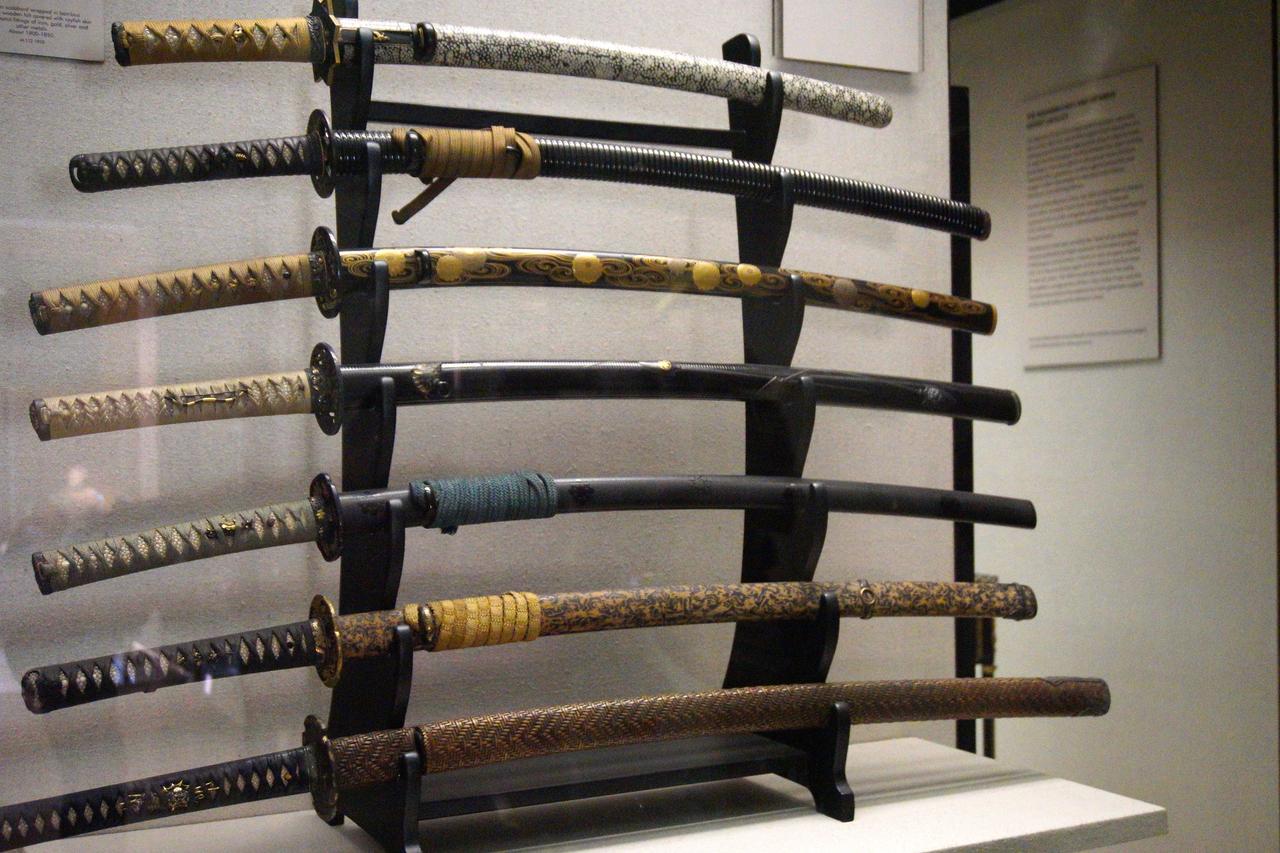
Katana and Wakizashi (World History Encyclopedia)
The earliest swords in Japan appeared during the Kofun period. Swords from this era were generally straight and double-edged, shaped by influences from China and Korea. These swords were known as chokutō and were unsuitable for mounted combat. Weapons were typically carried on the left hip with the edge facing downward.
During the Heian period, as warfare intensified and mounted combat became more common, swords became increasingly curved. These swords were called tachi and typically had blades longer than 70 cm and were quite heavy. The tachi was worn suspended from the belt with the edge facing downward, making it effective for use on horseback. This period saw significant advancements in swordmaking techniques and the emergence of distinct aesthetic characteristics in Japanese swords.
The Kamakura period is regarded as the golden age of Japanese swordmaking in both technical and aesthetic terms. With widespread warfare, sword production increased significantly, and master smiths placed great emphasis on durability and sharpness. During this time, distinct schools and techniques developed. Regions such as Sōshū and Bizen became major centers of sword production.
During the Muromachi period, changes in military tactics led to the katana emerging as an alternative to the tachi. Due to its shorter and lighter design, the katana became the preferred weapon of foot soldiers. In this period, the katana began to be worn thrust through the belt with the edge facing upward, allowing for faster drawing and striking. The katana became more practical and functional.
During this period, internal conflicts in Japan (the Sengoku period) intensified. The scale and duration of warfare spurred innovations in swordmaking techniques. New swords known as Keichō shintō achieved superior levels of durability and sharpness. At the same time, swords of various sizes and shapes were produced to meet the diverse needs of warriors.
With the establishment of the Tokugawa shogunate, a long period of peace was achieved. This reduced the practical use of swords, and the katana increasingly became a symbol of samurai social status. Sword culture flourished, but martial techniques receded into the background. Swords were now valued as art and craftsmanship. During this period, regulations and restrictions on sword carrying and use were introduced.
With the Meiji Restoration, Japan embarked on a path of modernization. Westernization and the modernization of the military led to a sharp decline in the traditional use of swords. In 1876, the Sword Abolishment Act prohibited civilians from carrying swords. Restrictions on sword production and carrying intensified. These bans significantly reduced the production and use of katanas and other traditional Japanese swords.
In the 20th century, Japanese swordmaking experienced a revival. Demand for military swords increased during World War II. However, after the war, the production and carrying of weapons were banned in Japan. Subsequently, swords were reclassified not as military tools but as works of art and cultural heritage. In 1953, legal changes permitted swordmaking and collection under specific conditions. Today, katana production continues as a tradition upheld by skilled artisans and recognized as a cultural legacy.

A Samurai and His Katana (1864–65) (Look and Learn)
The katana is classified into various types based primarily on blade length, sharpness, and intended use:
used.
The primary steel used in katana production is called tamahagane. Tamahagane is produced using Japan’s traditional tatara method of iron smelting. This process:
Tamahagane forms the foundation of Japanese swordmaking, and its varying carbon content enables the blade to achieve both hardness and flexibility.

Japanese Swordsmith (Flickr)

Katana Tip (World History Encyclopedia)
Beato, Felice. *Samurai, Yokohama*. Photograph. Look and Learn History Picture Archive. Accessed July 18, 2025. https://www.lookandlearn.com/history-images/YM0285902/Samurai-Yokohama.3/samurai-swords/.
Cheung, M. “Katana.” Flickr, March 24, 2015. Accessed July 18, 2025. https://www.flickr.com/photos/mwscheung/16841019877.
Japan National Tourism Organization. “How a Traditional Samurai Sword Is Made.” *Japan Travel*, 2024. Accessed July 18, 2025. https://www.japan.travel/en/au/story/how-traditional-samurai-sword-made/.
JapanGov. “Passing On the Artisan Spirit to Posterity.” *Tomodachi*, 2019 Fall. Accessed July 18, 2025. https://www.japan.go.jp/tomodachi/2019/autumn2019/foj_hans.html.
JapanGov. “The Swede Inheriting the Soul of Japanese Swordcraft.” *Kizuna*, March 21, 2021. Accessed July 18, 2025. https://www.japan.go.jp/kizuna/2021/03/soul_of_japanese_swordcraft.html.
Kyoto National Museum. *Introduction to Japanese Swords*. Kyoto National Museum, 2018. Accessed July 18, 2025. https://www.kyohaku.go.jp/eng/learn/assets/guides/2018_katana_intro_eng_0929.pdf.
Morimoto, Michael. *The Forging of a Japanese Katana*. Colorado: Colorado School of Mines, 2004, 8–16. Accessed July 18, 2025. https://www.mycity-military.com/uploads2/133831_1106895309_japanesesword.pdf.
Ritsumeikan University, Art Research Center. "Japanese Swords." Google Arts & Culture. Accessed July 18, 2025. https://artsandculture.google.com/story/japanese-swords-art-research-center-ritsumeikan-university/OAVBNXqTZy3eLQ?hl=en.
Simanjuntak, Mardohar Batu Bornok. “Nishida Kitaro’s Expressive Activity in Katana Sword Making as a Way to Achieve Pure Experience.” *Dekonstruksi* 9, no. 04 (2023): 111–16. Accessed July 18, 2025. https://doi.org/10.54154/dekonstruksi.v9i04.197.
Takaishi, Shogo. “The Art of Sword Making: Quality and Beauty of Japanese Swords.” *Steel Research International* 87, no. 7 (2016): 380–87. Accessed July 18, 2025. https://onlinelibrary.wiley.com/doi/abs/10.1002/srin.200100137.
Tanimura, Hiromu. “Development of the Japanese Sword.” *JOM* 32 (1980): 63–73. Accessed July 18, 2025. https://link.springer.com/article/10.1007/BF03354549.
Thoeny, Peter. “Traditional Japan: Forging a Piece of Art.” Flickr, April 15, 2023. Accessed July 18, 2025. https://www.flickr.com/photos/peterthoeny/52818945970.
Touken World. "Japon Kılıçları." *Touken World*, 2022. Accessed July 18, 2025. https://www.touken-world.jp/#sword_knowledge.
Touken World. "Katana Hakkında." Touken World, 2018. Accessed July 18, 2025. https://www.touken-world.jp/tips/98520/.
Touken World. "Katana Türleri." Touken World, 2022. Accessed July 18, 2025. https://www.touken-world.jp/tips/76859/.
Touken World. "Zaman İçindeki Değişim." Touken World, 2022. Accessed July 18, 2025. https://www.touken-world.jp/tips/changes-through-the-ages-en/.
World History Encyclopedia. "Hamon of a Samurai Katana Blade." Accessed July 18, 2025. https://www.worldhistory.org/image/10984/hamon-of-a-samurai-katana-blade/.
World History Encyclopedia. "Samurai Swords." Accessed July 18, 2025. https://www.worldhistory.org/image/1098.

Definition(s) | Traditional Japanese Sword | ||||||||
|---|---|---|---|---|---|---|---|---|---|
Origin(s) | Used by Samurai | ||||||||
Material(s) | Patterned and Layered Steel | ||||||||
Properties | Sharp, Hard, Durable | ||||||||
Usage | Martial Arts, Ceremonies | ||||||||
Production | Produced through Complex Heat Treatment and Layering Techniques | ||||||||
Henüz Tartışma Girilmemiştir
"Katana" maddesi için tartışma başlatın
History of the Katana
1. Early Period and Kofun Period (circa 3rd–7th century)
2. Heian Period and the Emergence of Curved Swords (794–1185)
3. Kamakura Period (1185–1333)
4. Muromachi Period and the Development of the Katana (1336–1573)
5. Sengoku Period and Keichō Shintō (1467–1600)
6. Edo Period and the Age of Peace (1603–1868)
7. Meiji Period and the Ban on Sword Carrying (1868–1912)
8. Modern Period (1912–Present)
Types of Katana
Steel Production: Tamahagane and Metal Preparation
Stages of Katana Production