

+2 Daha

Location | Bergama İzmir | ||||||||
|---|---|---|---|---|---|---|---|---|---|
Period(s) | Roman Empire 2nd Century AD | ||||||||
Current Status | Open-Air Museum Open to Visitors as a Cultural Site | ||||||||
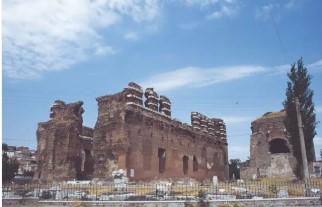
Kızılavlu is a large structure located in the city of Bergama, outside the Acropolis. It is a sacred area dedicated to Egyptian deities, particularly Serapis, who was identified with Zeus. The tripartite form of the building indicates worship not only of Serapis but also other gods such as Isis and Harpocrates. Although the exact founder of the temple is unknown, it is generally dated to the 2nd century AD, during the reign of Roman Emperor Hadrian (117–138 AD).

Kızılavlu (Türkiye Kültür Portalı)
Kızılavlu features a front courtyard approximately 260 by 110 meters in size. The temple itself is designed as a three-aisled basilica with an apse. The entire structure is built of red bricks measuring 35 by 40 centimeters with a thickness of 6 centimeters. Symmetrical round towers flank the building on both sides, and the courtyards are surrounded by colonnaded galleries. The front courtyard is situated above water tunnels built over the Selinus River.
At the front of the temple, aligned with its axis, there is a propylon (entrance gateway) and a large temple door framed with marble moldings; its large wings were covered with bronze. The sanctuary inside was illuminated only from the front by windows, while the rear part was left semi-dark.

Kızılavlu (Anadolu Ajansı)
The temple was dedicated to the cult of the Egyptian god Serapis, where water played an important symbolic role in religious ceremonies. Pools inside the temple were fed by hot and cold water pipes and are thought to have been used for ritual purification. In the rear section, two tall pedestals likely supported a colossal cult statue about 10–12 meters high. Below this statue, there were cisterns and secret passages that facilitated the priests' use during ceremonies.
During the Early Byzantine period, architectural additions were made, and the building was converted into a basilica-plan church. It became one of the seven early churches in Anatolia. The round tower structure on the north side was used as a mosque during the Ottoman period and today serves as the Kurtuluş Mosque.
Anadolu Ajansı. "Bergama'da yaklaşık 1800 yıllık geometrik desenli mozaik bulundu." Accessed June 18, 2025. https://www.aa.com.tr/tr/kultur-sanat/bergamada-yaklasik-1800-yillik-geometrik-desenli-mozaik-bulundu/2600318.
Anadolu Ajansı. "Kızılavlu Photograph." Anadolu Images. Accessed June 18, 2025. https://www.google.com/imgres?imgurl=https://cdnuploads.aa.com.tr/uploads/PhotoGallery/2022/10/18/thumbs_b2_f6d8c4d5f3224195984f8f9d612b95ac.jpg&tbnid=IqrJ8dbqd6RLFM&vet=1&imgrefurl=https://www.aa.com.tr/tr/kultur/bergama-antik-kentindeki-2-bin-yillik-eserlere-usta-dokunusu/2714232&docid=ppOEX4FJe5jZHM&w=1024&h=683&source=sh/x/im/m1/1&kgs=25d062ff377c8510
Anadolu Ajansı. "Türkiye'nin antik kentleri ziyaretçilerini bekliyor." Accessed June 18, 2025. https://www.aa.com.tr/tr/pg/foto-galeri/turkiyenin-antik-kentleri-ziyaretcilerini-bekliyor.
Bergama Belediyesi. "Serapion Temple (Kızıl Avlu)." Accessed June 18, 2025. https://bergama.bel.tr/serapion-tapinagi-kizil-avlu/.
Demirel, Nilgün. "Kızılavlu." Türkiye Turizm Ansiklopedisi, 2019. Accessed June 18, 2025. https://turkiyeturizmansiklopedisi.com/kizilavlu.
Türkiye Kültür Portalı. "Kızıl Avlu (Serapeion) (Bergama)." Accessed June 18, 2025. https://www.kulturportali.gov.tr.
Türkiye Kültür Portalı. "Bergama Kızıl Avlu." Accessed June 18, 2025. https://www.kulturportali.gov.tr/portal/bergama-kizil-avlu#:~:text=Bergama%20BaBERGAMA%20KIZIL%20AVLUilikas%C4%B1%2C%20kent%20merkezinde%2C%20K%C4%B1n%C4%B1k,y%C3%BCzy%C4%B1lda%20yapt%C4%B1rd%C4%B1%C4%9F%C4%B1%20Serapis%20Tap%C4%B1na%C4%9F%C4%B1'd%C4%B1r.

Location | Bergama İzmir | ||||||||
|---|---|---|---|---|---|---|---|---|---|
Period(s) | Roman Empire 2nd Century AD | ||||||||
Current Status | Open-Air Museum Open to Visitors as a Cultural Site | ||||||||
Henüz Tartışma Girilmemiştir
"Kızılavlu (Serapion) Archaeological Site " maddesi için tartışma başlatın
Architectural Features
Religious Function and Use
Byzantine Period and Later
Bu madde yapay zeka desteği ile üretilmiştir.