

Bu içerik Türkçe olarak yazılmış olup yapay zeka ile otomatik olarak İngilizceye çevrilmiştir.
+2 Daha
Scientific Name(s) | Ruscus aculeatus L. | ||||||||
|---|---|---|---|---|---|---|---|---|---|
Family | Asparagaceae (Asparagus family) | ||||||||
Specie(s) | Plant | ||||||||
Life Form | Geophyte, Perennial | ||||||||
Plant Form | Evergreen, Shrub-like | ||||||||
Local / Common Names | Kokina, Rabbit's breast, Broom shrub | ||||||||
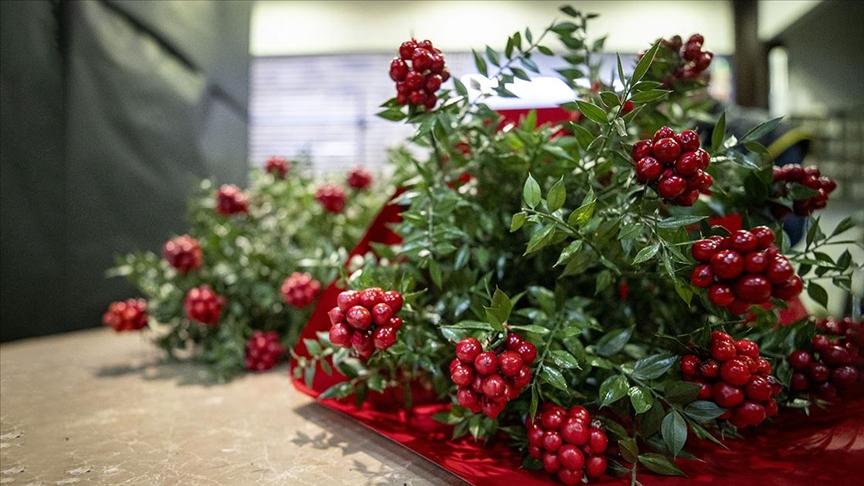
Kokina is a term used for bouquets sold primarily during the Christmas season, especially by florists. These bouquets are composed of the red fruits of Smilax excelsa and the spiny green shoots of a plant known as silcan or sincan, also referred to as rabbit's ear (Ruscus aculeatus L.). These components are assembled and then marketed under the name “kokina”.

Image Related to Kokina Sales (Pexels)
The plant referred to as “tavşanmemesi” in this context is scientifically known as Ruscus aculeatus L. Although its classification has varied across different taxonomic systems, in current systematic arrangements it is placed within the Asparagaceae family (Asparagaceae). Species of Ruscus are perennial evergreen shrub-like plants with rhizomes beneath the soil; they develop flat photosynthetic structures called cladodes, on which small flowers and subsequent orange-red fruits form. Four Ruscus species are known to occur naturally; R. aculeatus is found in various regions including the Black Sea Mediterranean and Aegean areas. Common folk names for the species and genus include “tavşanmemesi”, “tavşan kirazı”, and “silcan”.
The plant most commonly used in the production of “kokina” bouquets sold during the Christmas season is Ruscus aculeatus L., distinguished by its green spiny shoot structures resembling leaves. In modern classification, the species is classified within the genus Ruscus, which belongs to the Asparagaceae family. It is defined as a monocotyledonous plant whose distinguishing feature is that the function of classical leaves has largely been taken over by flattened green photosynthetic shoots known as cladodes. Consequently, the structures that appear leaf-like in Ruscus are botanically modified shoots rather than true leaves.

Kokinis Prepared for Christmas (Anadolu Agency)
In terms of life form, R. aculeatus exhibits an evergreen, multi-stemmed appearance above ground while forming thick creeping rhizomes beneath the soil, establishing a long-lived structure. These rhizomes serve as storage organs and play a decisive role in the plant’s survival under adverse conditions and in producing new shoots annually. Due to these characteristics, the species is also described as a geophyte, based on the underground location of its storage organs.
The renewal of shoots from buds on the rhizome and vegetative spread constitute an important mechanism for population continuity. In R. aculeatus, cladodes are not limited to photosynthesis; flowering and fruiting also predominantly occur on these structures. Small flowers may develop at the center of the cladodes, followed by orange-red fruits. It is known that the species can adapt to shade and partial shade conditions, with the storage capacity provided by the rhizomes contributing significantly to its water balance.
The red fruit component in “kokina” bouquets is most commonly associated with Smilax excelsa L. This species is a climbing plant belonging to the Smilacaceae family, with thorny stems that can grow up to 20 meters in length. Its leaves are typically heart-shaped and its fruits are spherical. In practice, the fruits of Smilax excelsa are attached to the shoots of Ruscus aculeatus to form the red component of kokina bouquets.
Ruscus aculeatus (rabbitbrush / broom shrub) is an evergreen plant that produces multiple shoots from its rhizome and exhibits a shrub-like appearance. Its height typically ranges from 25 to 80 cm, though it can approach 100 cm under favorable conditions. The structures that appear leaf-like in this species are largely cladodes—flattened, photosynthetic shoots—while true leaves are reduced to small, scale-like, membranous structures. Cladodes are usually dark green, firm in texture, and terminate in a spine-like tip; this firmness and spine-like apex are prominent morphological features used to identify the species.
The flowers are small and develop on a tiny structure located at the center of the upper surface of the cladodes; the perianth may appear greenish-white, and purplish tones have also been recorded in male flowers. Since the species is mostly dioecious (with separate male and female individuals), fruiting occurs only on female plants. The fruit is a spherical berry borne on the cladode, varying in color from orange-red to bright red, with a diameter reported in sources as approximately 5–14 mm.

Image of Ruscus aculeatus L. (Flickr)
The timing of flowering and fruiting varies according to region and climatic conditions; flowers may open from late autumn through spring, and in some areas this period extends into early summer. In practice, the bright red fruits seen in “kokina” bouquets sold during the Christmas season are often not those of Ruscus aculeatus but are instead the fruits of Smilax excelsa attached to Ruscus shoots. Consequently, the commercial appearance of the bouquet can be mistaken for the natural fruiting characteristics of Ruscus.
The red fruits used in the bouquet are spherical fruits produced on the climbing stems of Smilax excelsa. The characteristic “red-spotted” appearance of kokina bouquets results from attaching these fruits to Ruscus shoots.
Kokina is not botanically the product of a single habitat; its constituent components are selected from two distinct plant species that grow under different ecological conditions in nature.
In Türkiye, the term “kokina” refers not to a single botanical species but to a specific bouquet arrangement marketed during the Christmas season. This arrangement combines the green skeletal shoots of “tavşanmemesi” (Ruscus aculeatus) with the red fruit component known as “silcan” or “sincan”. The public visibility of kokina has increased significantly throughout December via florist stalls, Christmas markets, and street vendors. The bouquet’s red color and seasonal nature have endowed it with the status of a “New Year ornament”; in folk narratives it is associated with themes of “abundance, luck, and fortune”. Some traditions hold that if kokina retains its freshness throughout the year, wishes will be granted or a home will be acquired; thus, through these beliefs, kokina has acquired a symbolic function linked to the ideas of annual renewal and cyclical rebirth.
The cultural circulation of kokina has not been limited to consumption; the labor of preparation and the production network have also become part of popular narratives. In Istanbul-based examples, kokina is reported to have been traditionally produced within Romani communities through the transmission of knowledge and craftsmanship. Green shoots are collected weeks before New Year from nearby forested or mountainous areas, and by November the red fruits are gathered and tied together with string to form bouquets. The term “kokina” is said to derive from the Romani language and means “red”; some Romani producers have stated that their knowledge of kokina use was historically learned from Istanbul’s Greek population. Thus, kokina has taken on the form of a seasonal urban ritual object for urban populations not directly engaged in plant cultivation, representing the transformation of naturally gathered materials into crafted items through labor.
In countries such as Greece, Italy, and Türkiye, folk beliefs have been documented attributing apotropaic properties to kokina—protecting against evil. In Türkiye specifically, kokina serves as a symbolic link to nature for individuals disconnected from the natural environment; it is continually reproduced in collective memory through street vendors, Christmas markets, and media representations.

Prepared Bunches of Ruscus (Anadolu Agency)
The second dimension of the “use” aspect of kokina is linked to cut greenery and ornamental plant trade. Species of Ruscus have been widely used as cut greenery in floral arrangements, in addition to their role as outdoor landscape plants; some studies have also mentioned their use for medicinal and cosmetic purposes. The presence of Ruscus as the green component in kokina bunches indicates an intersection between this plant and the cut greenery supply chains. At the same time, it has been particularly emphasized that Ruscus species native to Türkiye’s flora can be collected unregulated from the wild and introduced into the market.
This situation has raised concerns about the potential pressure such wild harvesting, including for kokina production, may exert on natural populations; it has highlighted the ecological importance of approaches such as conservation of genetic resources, monitoring, and meeting demand through cultivation or production where possible. Within this framework, kokina has simultaneously become an object associated with Christmas in popular culture, while also serving as a clear example of how the collection methods and market circulation of plant raw materials can intersect with ecological and sustainability debates.
Ruscus aculeatus, also known as butcher’s broom, has been subject to conservation assessments; it is listed in the IUCN (2011) Red List as “Least Concern.” However, the species has been subjected to overharvesting in certain regions, and this intensive collection has been linked to local population declines in parts of Eastern Europe. In response, some countries have developed specific protection or regulatory measures for the species; for example, harvesting is legally controlled in Bulgaria, while in Romania the species is legally protected under the status of “natural monument.” The IUCN assessment notes that climate change and invasive species may pose future negative impacts, but currently the species is not considered under serious threat at a global scale.
In the context of Türkiye, the practice associated with kokina involves the seasonal wild harvesting of shoots, particularly during the Christmas period, combined with the attachment of red berries or fruits from Smilax to create bundled products for sale. This usage pattern demonstrates that the species is embedded in a seasonal supply chain tied to urban consumption. Therefore, variables such as the quantity of wild-harvested shoots and the continuity of harvesting sites may be considered among the key factors requiring monitoring of local population status and evaluation of harvesting practices against principles of sustainability.
"Bolluk ve şansın simgesi kokinaya ilgi yılbaşı yaklaştıkça artıyor." *Anadolu Ajansı*, December 24, 2023. Accessed December 31, 2025. https://www.aa.com.tr/tr/yasam/bolluk-ve-sansin-simgesi-kokinaya-ilgi-yilbasi-yaklastikca-artiyor/3090520.
"Il pungitopo, simbolo natalizio." *Lo Scarpone*, December 22, 2021. Accessed December 31, 2025. https://www.loscarpone.cai.it/dettaglio/il-pungitopo-simbolo-natalizio/
Accessed November 26, 2025.
Akbağ, H. İ. 2022. "Silvopastoral Keçi Üretim Sistemleri için Önem Taşıyan Bazı Çalı ve Ağaç Yapraklarının Besin Madde Bileşimleri." Türk Tarım ve Doğa Bilimleri Dergisi 9 (4): 943–950.
Başaran, Dilek et al. "Investigation of Some Biological Activities of Ruscus aculeatus L. Extracts." Anadolu 33, no. 2 (2023): 263-272. Accessed December 31, 2025. https://dergipark.org.tr/en/pub/anadolu/article/1403976.
Başer, Mina. *Kırmızı Meyveli Bitki*. Photograph. Pexels. Accessed December 31, 2025. https://www.pexels.com/tr-tr/fotograf/35405781/.
European Environment Agency. n.d. "Ruscus aculeatus." EUNIS – European Nature Information System. Accessed December 30, 2025.
Gómez-Aparicio, Luis, and Christopher J. Lortie. 2014. "Advancing Plant Ecology with Meta-Analyses." Journal of Ecology 102: 823–827.
Kebeli, Fatih, and Fisun Gürsel Çelikel. 2024. "Türkiye’de Yayılış Alan Ruscus Türleri." ANADOLU: Ege Tarımsal Araştırma Enstitüsü Dergisi 34 (Özel Sayı): 68–76.
Kebeli, Fatih, Çelikel, Fisun Gürsel. “Ruscus Species Distributed in Türkiye”. ANADOLU Journal of Aegean Agricultural Research Institute 34, no. Özel Sayı (May 2024): 68-76. Accessed December 31, 2025. https://doi.org/10.18615/anadolu.1403976.
Pacuła, Wiktoria, Ireneusz Sowa, Marcin Feldo, Filip Graczyk, Rafał Patryn, and Magdalena Wójciak. 2025. "Current Insights into the Phytochemistry and Pharmacological Properties of Ruscus aculeatus." Molecules 30 (22): 4417.
Rodrigues, Joana P. B., Ângela Fernandes, Maria Inês Dias, Carla Pereira, Tânia C. S. P. Pires, Ricardo C. Calhelha, Ana Maria Carvalho, Isabel C. F. R. Ferreira, and Lillian Barros. 2021. "Phenolic Compounds and Bioactive Properties of Ruscus aculeatus L. (Asparagaceae): The Pharmacological Potential of an Underexploited Subshrub." Molecules 26 (7): 1882.

Scientific Name(s) | Ruscus aculeatus L. | ||||||||
|---|---|---|---|---|---|---|---|---|---|
Family | Asparagaceae (Asparagus family) | ||||||||
Specie(s) | Plant | ||||||||
Life Form | Geophyte, Perennial | ||||||||
Plant Form | Evergreen, Shrub-like | ||||||||
Local / Common Names | Kokina, Rabbit's breast, Broom shrub | ||||||||
Henüz Tartışma Girilmemiştir
"Kokina (Ruscus aculeatus L.)" maddesi için tartışma başlatın
Taxonomy and Life Form
Ruscus aculeatus
Smilax excelsa
Morphology
Ruscus Shoots
Smilax Fruits
Habitat and Ecology
Place and Use in Popular Culture
Conservation Status