

Bu içerik Türkçe olarak yazılmış olup yapay zeka ile otomatik olarak İngilizceye çevrilmiştir.
+2 Daha
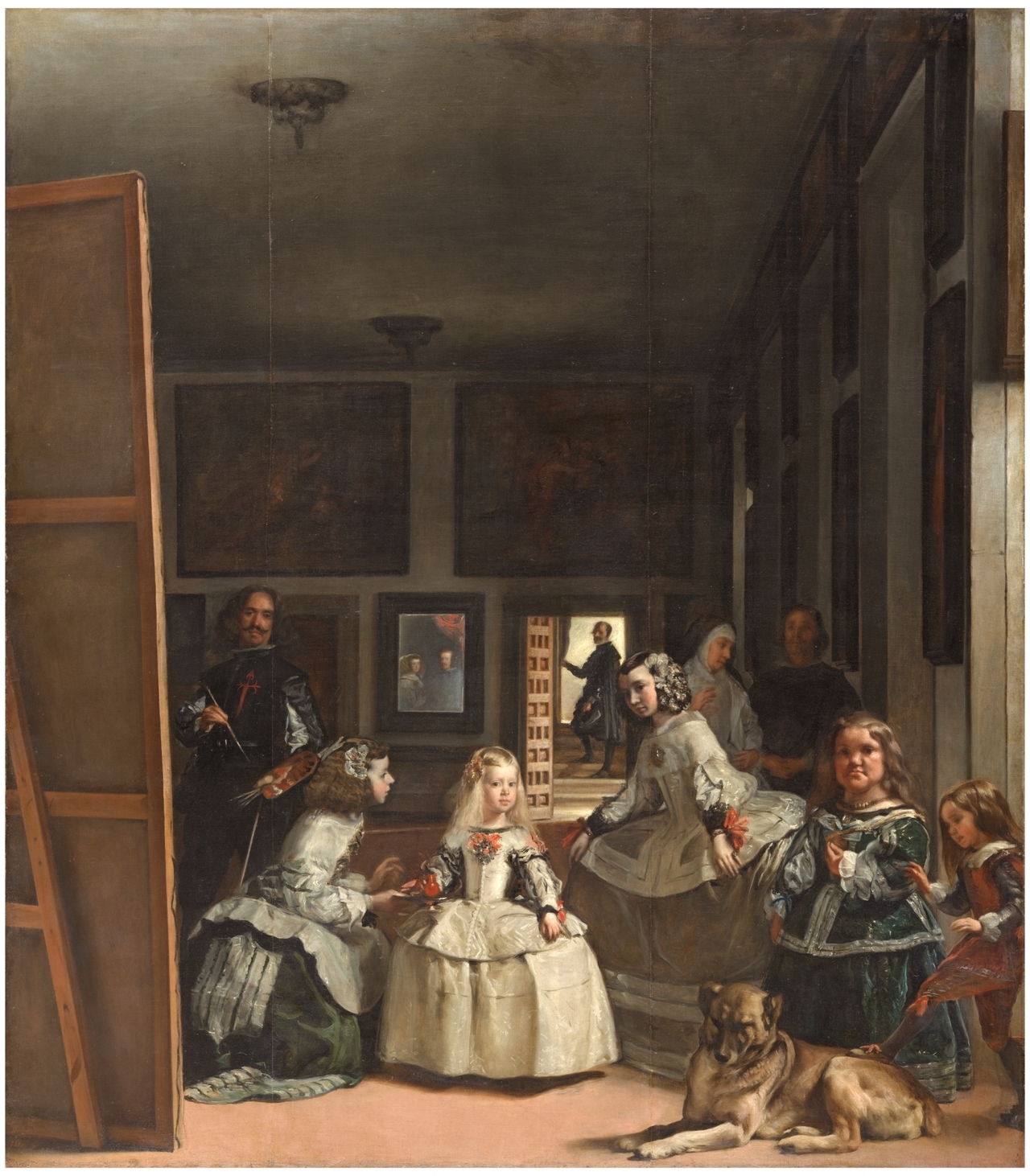
Las Meninas (The Maids of Honor), painted in 1656 by Diego Rodríguez de Silva y Velázquez. The oil on canvas measures 320.3 x 279.1 cm and is currently on display in Room 012 at the Prado Museum in Madrid. The work is one of Velázquez’s most comprehensive achievements, not only in technical mastery but also in conceptual depth. Las Meninas, one of the paintings to which Velázquez devoted the greatest effort during his lifetime, is also regarded as a representation of his thoughts on the art of painting.
The scene depicted in the painting takes place in a room within the Alcázar Palace in Madrid, designated for Prince Baltasar Carlos. The work was painted in 1656 in the section of the palace known as the “Cuarto del Príncipe.” All the figures in the painting are members of the Spanish royal family and court staff of the period.

Las Meninas (Museo del Prado)
At the center of the painting is Infanta Margarita Teresa, the five-year-old daughter of King Philip IV of Spain and Queen Mariana. To her right, kneeling on the floor, is Doña María Agustina Sarmiento; to her left, standing, is Doña Isabel de Velasco. These two figures are the “meninas” after whom the painting is named. Beside them are the court dwarf Mari Bárbola and the page Nicolasico Pertusato, who is resting his foot on a dog. In the background, Doña Marcela de Ulloa and an unidentified “guardadamas” are visible, while at the farthest door, the royal chamberlain José Nieto Velázquez can be seen. The painter himself is depicted on the left, standing before a large canvas, actively painting.
In the mirror on the back wall, the silhouettes of King Philip IV and Queen Mariana are reflected. This indicates that the royal couple are present in the room and that the gaze of all the figures is directed not at the viewer but at them. The use of the mirror constructs a conceptual framework that guides the viewer’s visual perception and invites reflection on the relationship between representation and reality.
The two large paintings on the back wall are reproductions by Juan Bautista Martinez del Mazo after works by Peter Paul Rubens. The left painting is “Pallas and Arachne”; the right one is “The Contest of Pan and Apollo.” These paintings serve as secondary artworks within the composition, alluding to classical mythology and the history of art.
Las Meninas is constructed according to the classical rules of single-point perspective. The vanishing point is not geometrically centered but located deeper within the painting, aligned with the mirror. Researchers such as Joel Snyder and Ted Cohen have demonstrated that the composition follows a mathematically accurate geometric perspective. Additionally, atmospheric perspective is employed: natural light entering through the window reflects with varying intensity on the figures’ skin, fabrics, and objects. This distribution of light is a typical example of the dramatic lighting characteristic of the Baroque period.
Michel Foucault described the work as “the representation of classical representation” and emphasized its lack of a central focus. Interpretations influenced by Roland Barthes’s deconstructive theories argue that Las Meninas has no fixed center, possesses multiple points of view, and allows each viewer to interpret it according to their own perception. For this reason, the painting is also analyzed within the framework of post-structuralist approaches.
Velázquez appears in the painting not merely as a painter but as a figure within the court. The keyring on his belt symbolizes his authority to open all doors of the palace. The cross of the Order of Santiago, added later to the figure’s garment in the lower left corner of the painting, documents his posthumous recognition with this honorific distinction. This detail reveals that the painting conveys messages not only about art but also about social status.
Las Meninas is more than a group portrait; it raises questions about the status of painting as a representational object, visual perception, and the identity of the artist. By placing the viewer beyond the role of passive observer and incorporating them into the scene, it seeks to dissolve the boundary between spectator and spectacle—a hallmark of Baroque art. The work is regarded as one of the rare examples in which the artist created not merely a portrait but a “painting within a painting” with historical significance.
Diego Velázquez, Las Meninas.SmartHistory

Henüz Tartışma Girilmemiştir
"Las Meninas (Painting)" maddesi için tartışma başlatın
Space and Time
Composition and Figures
The Mirror, Reflection, and the Royal Couple
Background Artworks
Perspective and Light Usage
Representation and Layers of Meaning
The Artist’s Social Status and Symbolic Elements
Art Theory and the Viewer Relationship