

Bu içerik Türkçe olarak yazılmış olup yapay zeka ile otomatik olarak İngilizceye çevrilmiştir.
+2 Daha
Liber Abaci is a foundational mathematical work written by Italian mathematician Leonardo Fibonacci in 1202 and revised in 1228. Written in Latin, this book is regarded as one of the turning points in modern European mathematics due to its critical role in introducing the Hindu-Arabic numeral system to Europe. Liber Abaci had a profound impact not only on theoretical mathematics but also on commercial calculations and everyday practical applications.
The primary aim of Liber Abaci is to introduce the Hindu-Arabic numeral system (0–9) and demonstrate that it is far more practical than Roman numerals. In the book, Fibonacci presents numerous practical examples applicable to trade, banking, accounting, and economic computations.
Liber Abaci became a seminal reference that profoundly influenced the level of mathematical knowledge in Europe. Thanks to this book, the adoption of the decimal system and Hindu-Arabic numerals accelerated, making calculations significantly easier and faster.
The book provided significant convenience to merchants in medieval Europe for managing debt, currency exchange, and interest calculations. In this regard, it also contributed to the development of modern accounting techniques.

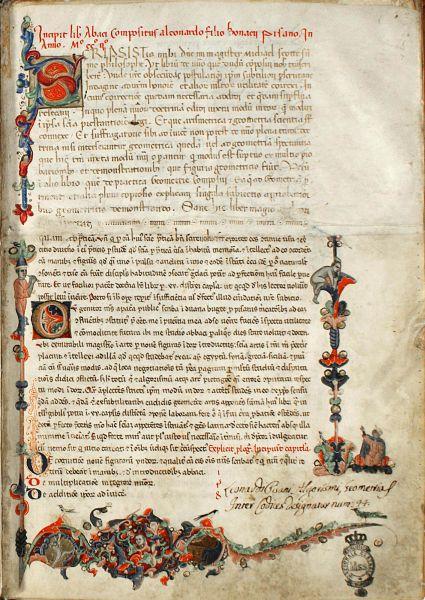
Pisalı Leonardo's Liber Abaci (Mathematical Association of America)
The work consists of fifteen chapters, each addressing a specific mathematical or commercial topic, including:
The most famous section of Liber Abaci is the problem concerning the breeding of rabbits. The sequence derived from this problem progresses as follows:
0, 1, 1, 2, 3, 5, 8, 13, 21…
Each number is the sum of the two preceding numbers. This sequence has since been associated with numerous natural and aesthetic structures, including:
Liber Abaci accelerated the acceptance of the Hindu-Arabic numeral system in Europe and significantly reduced the use of Roman numerals. This transition laid the groundwork for the scientific and mathematical advancements of the Renaissance and enabled the modernization of European mathematics.
Liber Abaci is a seminal reference work that played a decisive role in the development of mathematical applications in Europe. By highlighting the practical advantages of the Hindu-Arabic numeral system, it facilitated the more systematic use of trade, calculation methods, and basic arithmetic. The problems and techniques presented in the book were instrumental in shaping the medieval European understanding of mathematics and served as a model for later arithmetic texts.
Accessed November 26, 2025.
Devlin, Keith. Finding Fibonacci: The Quest to Rediscover the Forgotten Mathematical Genius Who Changed the World. Princeton University Press, 2017. Accessed December 11, 2025.
Dunham, William. Journey Through Genius: The Great Theorems of Mathematics. Wiley, 1990. Accessed December 11, 2025.
Fibonacci, Leonardo. Liber Abaci. Translated by Laurence E. Sigler. Springer, 2002. Accessed December 11, 2025.
Katz, Victor J. A History of Mathematics: An Introduction. Pearson Education, 2007. Accessed December 11, 2025.
Museo Galileo. "Liber Abaci – Dijital Nüsha." Bibdig Dijital Kütüphane. Accessed December 11, 2025.
Swetz, Frank J. "Mathematical Treasure: Liber Abaci of Leonardo of Pisa." Convergence (MAA), March 2019.
Swetz, Frank J. Capitalism and Arithmetic: The New Math of the 15th Century. Open Court Publishing, 1987. Accessed December 11, 2025.

Henüz Tartışma Girilmemiştir
"Liber Abaci" maddesi için tartışma başlatın
Purpose and Content
Main Topics Covered in the Book
Historical and Cultural Significance
Fibonacci’s Innovations
Commercial Impact
Structure of Liber Abaci
Fibonacci Sequence and the Rabbit Problem
Dissemination of the Work
Historical Impact