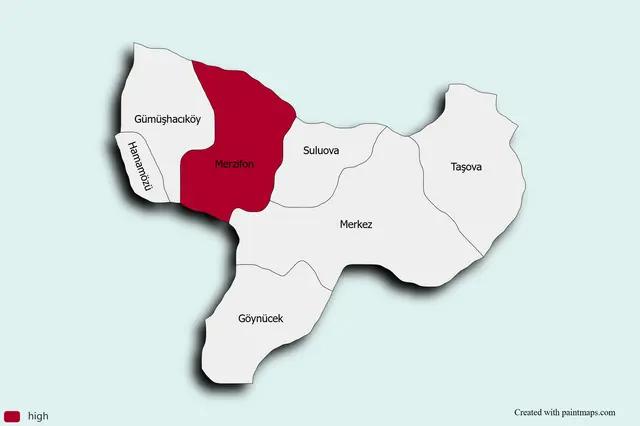


Merzifon (District)
Province(s) | Amasya | ||||||||
|---|---|---|---|---|---|---|---|---|---|
Area(s) | Black Sea | ||||||||
Altitude | 740 meters | ||||||||
Population (2024) | 76,854 | ||||||||
Mayor(s) | Alp Kargı | ||||||||
District Governor | Ahmet Karaaslan | ||||||||
Postal Code | 05300 | ||||||||
Climate(s) | Semi-arid – semi-humid transitional climate | ||||||||
Merzifon is a district of Amasya province where agriculture and industry thrive together. The district is home to historical buildings and natural areas.

Merzifon (Amasya Provincial Directorate of Culture and Tourism)
Merzifon's settlement history begins with mounds dating back to the Chalcolithic Age (5500 BC). Situated on the flat plain, which Strabo described as "A Thousand Villages," the settlements were organized around a castle that served as a border post during the Hittite period (1700–1200 BC). The region, which passed from Phrygian rule (8th century BC) to Persian rule and then to the Pontic Kingdom in 47 BC, was revitalized with temple repairs and new structures as part of the Roman Empire's reconstruction policies. Incorporated into the Eastern Roman (Byzantine) borders in 395, Merzifon experienced Umayyad raids in the 8th century, transitioned to Danishmend rule in the 11th century, Seljuk rule in the 12th century, and the Ilkhanate and Eratna Principality in the 14th century. After Taşanoğulları between 1353 and 1396, the district came under Ottoman rule in 1393 during the reign of Yıldırım Bayezid, and was included in the Ottoman administrative division with the order re-established by Çelebi Sultan Mehmet in 1402.
The Ottoman period is embodied in Merzifon's educational, commercial, and architectural structures. The Çelebi Mehmet (Sultaniye) Madrasa, dating from 817 AH (1414–1415), was built as one of the five oldest madrassas in Anatolia and was repaired in 820 AH (1418–1419). The covered bazaar and stone bazaar built within the Kara Mustafa Pasha Complex in the 17th century reinforced Merzifon's economic importance as a junction point for caravan routes. Completed in 1666, the Kara Mustafa Pasha Mosque, with its rectangular main prayer hall and eight-armed dome, exemplifies classical Ottoman mosque architecture of the period.
Following World War I, Merzifon came under British occupation on March 15, 1919. The rally and public reaction held on June 16, 1919, led to the withdrawal of the occupying forces on September 27, 1919. With the transition to the Republican Period, the district was reorganized as an administrative unit affiliated with Amasya.
Merzifon is located in the inland area of the Central Black Sea Region, the second largest settlement after Amasya province. Surrounded by Suluova to the east, Amasya and Çorum to the south, Gümüşhacıköy to the west, and Samsun to the north, the district encompasses 70 villages. Located in the transition zone between the Black Sea and Central Anatolian climates, Merzifon experiences dry and dry summers, rainy winters and springs, and average annual precipitation is 350 kg/m².
Geologically, the Merzifon Fault, located in a first-degree earthquake zone on the North Anatolian Fault, produced earthquakes measuring M 5.6 on August 4, 1996, and M 4.8 on February 28, 1997, with no loss of life in either event. According to 2005 State Planning Organization (DPT) data, the district ranks first in Amasya and 151st in Türkiye in terms of development index.
The total population of Merzifon district was 69,093 in 2007 and increased to 76,854 according to 2024 data. The highest annual increases during this period were recorded as 1,810 in the 2015–2016 period, 1,572 in the 2019–2020 period, and 920 in the 2022–2023 period, with smaller increases and decreases observed in other years. As of 2024, the male population was 38,031 (49.48%) and the female population was 38,823 (50.52%), with the gender gap generally remaining at a few hundred. Annual population changes have followed a fluctuating course, which can be explained by factors such as local registry updates, internal migration movements, and natural demographic dynamics.
Merzifon, located at the intersection of Ottoman-era caravan routes, served as a regional trade center through its covered bazaar and tashan structures. With its four-sided monumental gates and nine-domed interior, the covered bazaar offers tangible evidence of Ottoman economic history. The Tashan, with its entrance supported by curved consoles and its cut stonework with brick girders, is a distinguished example of 17th-century Ottoman caravanserai architecture.
Today, the district's economy is shaped around agriculture, livestock, and service sectors. Merzifon's geographical location provides direct access to transportation networks, supporting commercial dynamism. Its development level, ranked 151st in Türkiye according to the State Planning Organization's 2005 index, highlights the importance of planning to increase economic potential.
At the center of the tourist and cultural heritage are the Sultaniye Madrasa, Bedesten, Taşhan and Kara Mustafa Pasha Mosque.
Merzifon's cuisine, bearing the traces of cultural diversity, is considered the product of historical processes in which different religious and ethnic groups harmonized. This culinary culture, accumulated over centuries, encompasses a wide variety of flavors prepared for both daily and ritual purposes.
Paintmaps. “Turkey Provinces Map – Highlighting Merzifon , Amasya.” Erişim tarihi: 15 Nisan 2025. https://paintmaps.com.
Republic of Turkey Ministry of Culture and Tourism. “Merzifon Bedesten.” Culture Portal. Access date: May 4, 2025. https://www.kulturportali.gov.tr/turkiye/amasya/gezilecekyer/merzfon-bedesten
Republic of Turkey Ministry of Culture and Tourism Amasya Provincial Directorate of Culture and Tourism. “Merzifon.” Amasya Provincial Directorate of Culture and Tourism. Access date: May 4, 2025. https://amasya.ktb.gov.tr/TR-59480/merzifon.html
TC Amasya Governorship. “Merzifon.” Amasya Governorship. Access date: May 4, 2025. http://www.amasya.gov.tr/merzifon
TC Merzifon Municipality. “Discover Merzifon.” Merzifon Municipality. Access date: May 4, 2025. https://merzifon.bel.tr/merzifonu-kesfedin
TC Merzifon District Governorship. “Bedesten.” Merzifon District Governorship. Access date: May 4, 2025. http://www.merzifon.gov.tr/bedeten
TC Merzifon District Governorship. “Geography.” Merzifon District Governorship. Access date: May 4, 2025. http://www.merzifon.gov.tr/cografya
TC Merzifon District Governorship. “Our District.” Merzifon District Governorship. Access date: May 4, 2025. http://www.merzifon.gov.tr/ilcemiz
TC Merzifon District Governorship. “Kara Mustafa Pasha Mosque.” Merzifon District Governorship. Access date: May 4, 2025. http://www.merzifon.gov.tr/kara-mustafa-pasa-camii
TC Merzifon District Governorship. “Girls’ School.” Merzifon District Governorship. Access date: May 4, 2025. http://www.merzifon.gov.tr/kizlar-mektebi
TC Merzifon District Governorship. “Merzifon Cuisine.” Merzifon District Governorship. Access date: May 4, 2025. http://www.merzifon.gov.tr/merzifon-mutfagi
TC Merzifon District Governorship. “History.” Merzifon District Governorship. Access date: May 4, 2025. http://www.merzifon.gov.tr/tarihi
Turkish Statistical Institute (TurkStat). Address Based Population Registration System Results, 2024. Access date: April 20, 2025. https://data.tuik.gov.tr/Bulten/Index?p=Adrese-Dayali-Nufus-Kayit-Sistemi-Sonuclari-2024-53783

Merzifon (District)
Province(s) | Amasya | ||||||||
|---|---|---|---|---|---|---|---|---|---|
Area(s) | Black Sea | ||||||||
Altitude | 740 meters | ||||||||
Population (2024) | 76,854 | ||||||||
Mayor(s) | Alp Kargı | ||||||||
District Governor | Ahmet Karaaslan | ||||||||
Postal Code | 05300 | ||||||||
Climate(s) | Semi-arid – semi-humid transitional climate | ||||||||
Henüz Tartışma Girilmemiştir
"Merzifon (District)" maddesi için tartışma başlatın
History
Geography and Climate
Population and Demography
Economy
Tourism – Culture – Cuisine
Bu madde yapay zeka desteği ile üretilmiştir.