

Bu içerik Türkçe olarak yazılmış olup yapay zeka ile otomatik olarak İngilizceye çevrilmiştir.
Messier 5 (M5) is a globular star cluster located in the halo of the Milky Way Galaxy, consisting of numerous stars bound together by gravity. This cluster, situated in the constellation Serpens, lies approximately 24,500–26,000 light-years from Earth and contains hundreds of thousands of stars within a region about 165 light-years in diameter.【1】 With an apparent magnitude of approximately 5.6, Messier 5 is considered one of the brightest globular clusters in the sky and one of the oldest globular star clusters. Most of its stars formed about 11.5–13 billion years ago, making it an important astronomical object for studying the early stellar populations of the Milky Way.
Messier 5 was first observed on the night of 5 May 1702 by German astronomer Gottfried Kirch and his wife Maria Margarethe Kirch during a comet observation. The object was described as a “fuzzy star.” Later, French astronomer Charles Messier independently observed the cluster on 23 May 1764 and added it as the fifth object to his famous catalog of nebulae and star clusters. In his observations, Messier described the object as a round, starless nebula.
In 1791, English astronomer William Herschel, using a large reflecting telescope, resolved Messier 5 into individual stars and counted approximately 200 stars within the cluster. Herschel’s observations contributed significantly to understanding the true nature of the object and confirmed it as a globular star cluster.
Messier 5 is a large stellar system approximately 165 light-years in diameter and is estimated to contain hundreds of thousands of stars. Its apparent angular diameter is about 23 arcminutes, featuring a dense central core and an extended stellar halo. The core region is highly concentrated and spans a region of about 6 light-years in diameter. The cluster’s half-mass radius is estimated at approximately 15 light-years.
The cluster is not perfectly spherical; it exhibits an elliptical elongation of about 10 percent, with its major axis inclined at an angle of approximately 50 degrees.【2】 The total mass of the cluster is estimated at approximately 392,000 solar masses. Its average radial velocity is about 52–53 km/s, indicating that it is moving away from Earth.
The majority of Messier 5’s stars formed in the same star-forming region and have evolved together. The cluster’s age is estimated at approximately 11.5–13 billion years. As a result, most of its stars are old and low-mass. As a consequence of stellar evolution, some of these stars have entered the red giant phase, while others have become blue horizontal branch stars.
However, a number of unexpectedly young-looking blue straggler stars have also been detected in the cluster. Astronomers believe these stars formed through stellar collisions or mass transfer in binary star systems. The dense structure of globular clusters facilitates such stellar interactions.
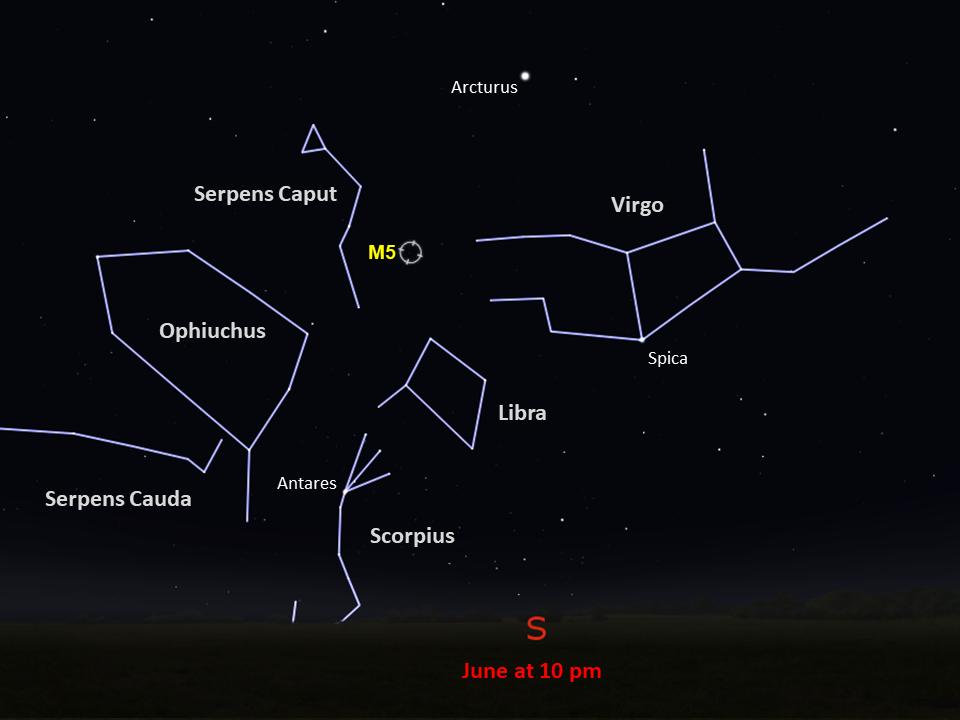
M5 Star Chart (NASA)
Messier 5 is notable for its large number of variable stars. The first variable stars were detected in 1890 by A. A. Common. Later, S. I. Bailey identified numerous RR Lyrae-type variable stars within the cluster. As of 2015, a total of 181 variable stars had been detected in the cluster, with 154 confirmed as genuine variables. These include RR Lyrae stars, semi-regular variables, eclipsing binary stars, and other types of variable stars.
Millisecond pulsars have also been detected in the cluster. The majority of these are found in binary systems, while one is observed as a solitary object.
Under suitable observing conditions, Messier 5 appears as a small, fuzzy patch of light through binoculars. In small telescopes, it presents a round, nebulous appearance with increasing concentration toward the center. With larger telescopes, thousands of individual stars can be resolved in the outer regions of the cluster.
The cluster is located approximately 20 arcminutes northwest of the star 5 Serpentis. Under excellent observing conditions, it is barely visible to the naked eye. May and June are the best months for observing the cluster, as it reaches its highest point near midnight.
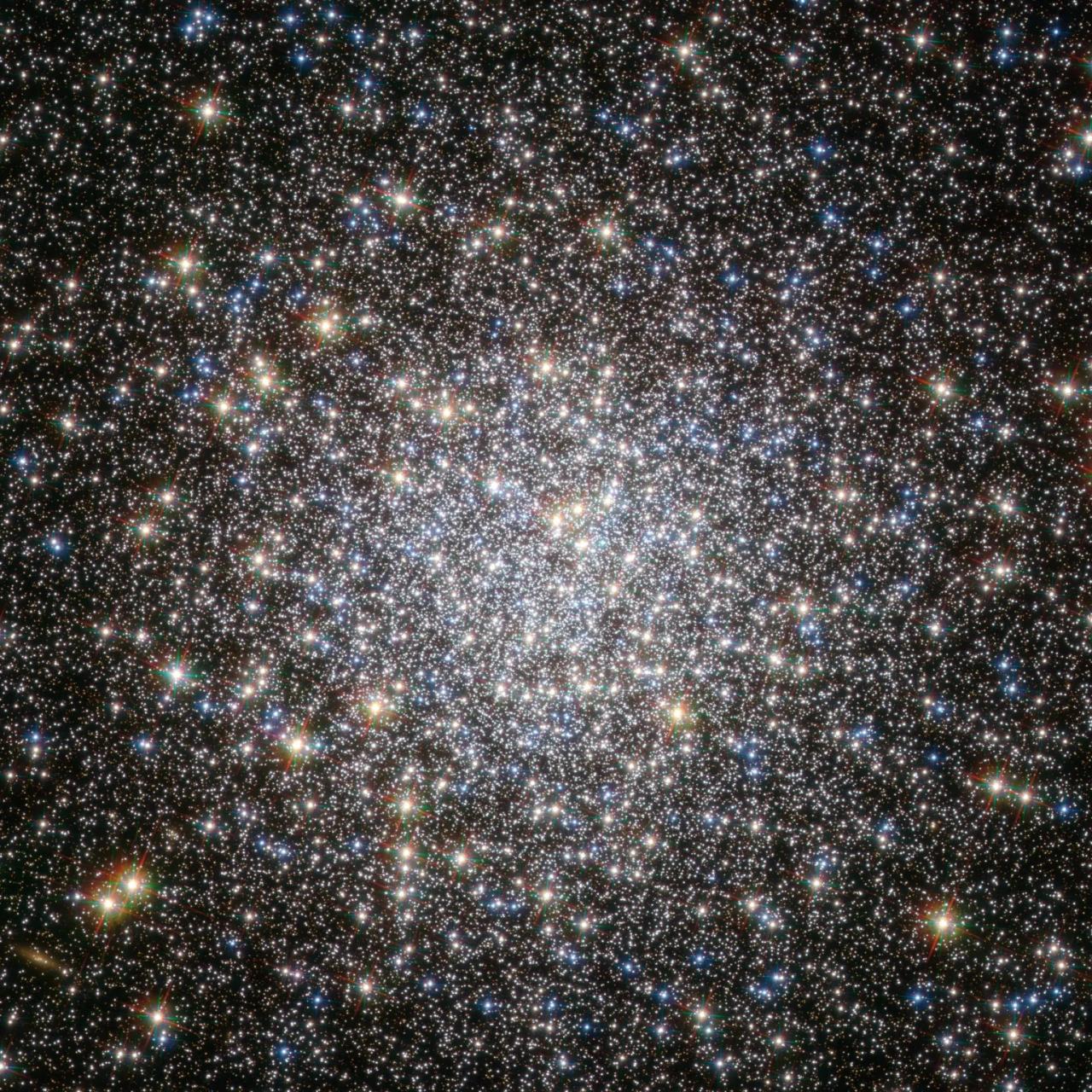
NASA/ESA Hubble Space Telescope has imaged the central region of Messier 5 in great detail. Images obtained using the Wide Field Channel of the Advanced Camera for Surveys resolve the dense core and stars at different evolutionary stages with high resolution. These images were created using blue (F435W), red (F625W), and near-infrared (F814W) filters.
These observations revealed that individual stars can be distinguished even in the cluster’s central regions and have clarified the distribution of different stellar types, including red giants, blue horizontal branch stars, and blue stragglers.
[1]
AstroCamp, “Messier 5,” AstroCamp, Accessed 8 March 2026, https://astrocamp.eu/en/messier-5-2/
[2]
George C Mallen, “Messier 5 (M5),” SEDS Messier Database, Accessed 8 March 2026, http://www.messier.seds.org/m/m005.html

Henüz Tartışma Girilmemiştir
"Messier 5" maddesi için tartışma başlatın
Discovery and Observational History
Physical Characteristics
Stellar Population
Variable Stars and Other Objects
Observational Characteristics
Hubble Space Telescope Observations