

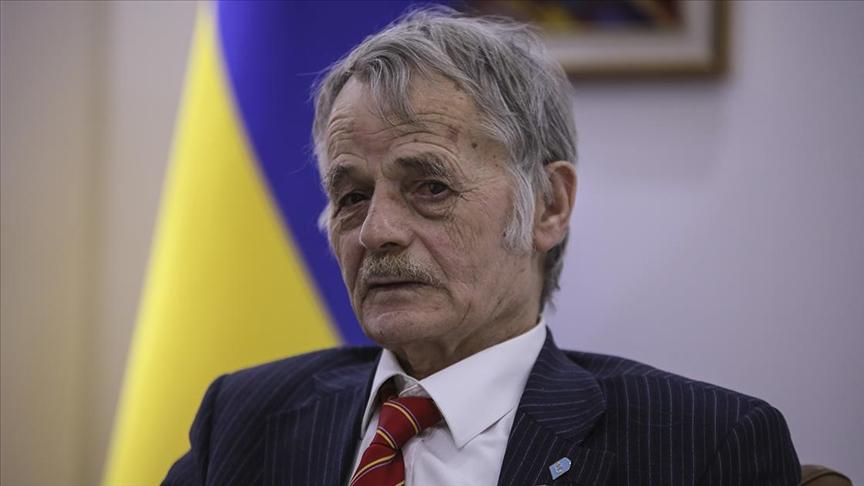
Mustafa Abdülcemil Kırımoğlu (Crimean Tatar: Mustafa Abdülcemil Cemilev; Russian transliteration: Dzhemilev) was born on 13 November 1943 in the village of Moon-Serez (Bozköy), in the Sudak region of Crimea. He dedicated his entire life to the struggle for the return of the Crimean Tatar people to their ancestral lands, lost through deportation, and for the recognition of their fundamental human rights.
Mustafa Abdülcemil’s family belonged to the ancient domestic clans of the Crimean Tatars. During the Second World World War, he experienced his first trauma when, on 18 May 1944, the Stalinist regime deported the entire Crimean Tatar population under the false accusation of collaborating with the Germans. Approximately 200,000 Crimean Tatars were loaded into freight cars and transported to Central Asia Asia; during the seven- to eight-day-day train journey, thousands perished from starvation or disease.
During the deportation process, Mustafa Abdülcemil and his family were resettled in the Andican region of Uzbekistan. Growing up and spending his early youth in exile, Kırımoğlu made concerted efforts through his family to preserve Crimean Tatar identity and homeland consciousness amid Soviet policies of identity erosion. In the 1950s and 1960s, even in rural areas, the very mention of Crimea was forbidden; it was during this oppressive atmosphere that Mustafa Abdülcemil developed his first conscious awareness of resistance.
Kırımoğlu began his studies at the Tashkent Institute of Irrigation and Mechanization; however, his student years there were cut short. His expressions of views on Crimean Tatar history led to accusations of “nationalism,” resulting in his expulsion from the institution. He subsequently enrolled at the Moscow State University Institute of East Languages, but faced renewed pressure due to his ideas and was forced to abandon his studies before completion.
In 1961, at the age of 18, he became one of the founding members of the Crimean Tatar Youth Organization. Beginning in 1966, he was imprisoned for the first time in the Soviet Union on charges of “anti-Soviet propaganda to do” activities. In subsequent years, he was arrested numerous times, tried six times, and spent more than 15 years in prisons and internal exile.
Mustafa Abdülcemil Kırımoğlu’s 303-day hunger strike while imprisoned in 1975 generated widespread international attention on human rights platforms. His designation as a “prisoner of conscience” by Amnesty International during this period prompted global scrutiny of the Soviet regime’s practices.
In 1989, following the Soviet Union’s period of liberalization, Kırımoğlu entered Crimea for the first time in 45 years. At the Second Crimean Tatar National Kurultai convened in 1991, the Crimean Tatar National Mejlis (KTMM) was established, and Kırımoğlu was elected its first chairman. He served as chairman until 2013, maintaining diplomatic relations with the Ukraine government while persistently advocating for the recognition of Crimean Tatars’ rights to citizenship, soil land, and language.
In 1998, Kırımoğlu was elected as a member of the Ukrainian Parliament (Verkhovna Rada). He held this position until 2014 under various political parties. Within Ukrainian domestic politics, he played a significant role in advancing legislation concerning minority rights, human rights law, and regulations related to Crimea.
Following Russia’s annexation of Crimea in 2014, Kırımoğlu was banned from entering Crimea. On 2 May 2014, while attempting to enter Crimea by road, he was stopped at the border and forced to turn back. This event incident received extensive coverage in national and international media, providing new evidence of Russia’s human rights violations.
Kırımoğlu’s struggle was closely followed by public opinion in Türkiye. Especially during the 1980s, it was supported through various academic and civil society initiatives. Turkish institutions actively worked to bring the Crimean issue to international platforms.
Mustafa Abdülcemil Kırımoğlu, remembered for the words, “We We did not fear the Soviet regime; are we now to fear Putin’s Russia?”, has been a leading figure in the Crimean Tatars’ struggle for independence. For this reason, Russia has banned his entry into Crimea until 2034.
Anadolu Ajansı. "Mustafa Abdülcemil Kırımoğlu: İşgalciler tarafından en çok baskı Kırım Tatar Türklerine oldu." Accessed April 11, 2025. https://www.youtube.com/watch?v=uj5f7gCFzl4
Anadolu Ajansı. "Ukrayna'dan Kırımoğlu'nun Kırım'a giriş yasağını 2034'e kadar uzatan Rusya'ya tepki." Accessed April 11, 2025. https://www.aa.com.tr/tr/dunya/ukraynadan-kirimoglunun-kirima-giris-yasagini-2034e-kadar-uzatan-rusyaya-tepki/2166259
Engin, Muhammed Furkan. Mustafa Abdülcemil Kırımoğlu (Cemiloğlu): Hayatı ve Fikirleri. Master's thesis, Marmara Üniversitesi, 2014.
Erdemir, İrem. The Awakening of the Crimean Tatar Nationalist Movement under the Leadership of Kirimoglu. Master's thesis, Ankara Yıldırım Beyazıt Üniversitesi, 2019.
TRT Avaz. "Kırım Türkleri'nin Lideri Kırımoğlu Konuğumuz - Dünya Gündemi." Accessed April 11, 2025. https://www.youtube.com/watch?v=DPNgFiKiEVU
TRT Avaz. "Mustafa Cemiloğlu'nun Hayatı - Türk Dünyasının Enleri." Accessed April 11, 2025. https://www.youtube.com/watch?v=xQt8x3DtFUU

Henüz Tartışma Girilmemiştir
"Mustafa Abdülcemil Kırımoğlu" maddesi için tartışma başlatın
Family Origins and Childhood
Educational Journey
National Awakening and Political Activism
Crimean Tatar National Mejlis and Leadership Period
Ukrainian Parliament and Modern Political Activities
The 2014 Russian Occupation and Its Aftermath
Relations with Türkiye and the Turkic World