
OKR (Objectives and Key Results) is a management system used in corporate goal setting and performance management. It aims to concretize goals with measurable outcomes. The method helps individuals, teams, and organizations align around shared objectives, track progress, and evaluate performance objectively. OKR is highly compatible with both strategic planning and agile working models. It is effectively applied in many sectors, particularly in technology companies.
The OKR system was first developed in the 1970s by Andrew Grove, the founder and CEO of Intel. Grove elaborated on his views on performance management in his 1983 book High Output Management, and the model was adopted as Intel’s corporate management tool. However, it gained global recognition when investor John Doerr introduced the OKR system to Google in 1999. Larry Page and Sergey Brin integrated OKR into Google’s founding philosophy, and it quickly became the company’s main management mechanism during its rapid growth.
Today, the OKR model is a standard practice in leading companies of the digital era such as Amazon, Spotify, LinkedIn, Twitter, Airbnb, and Netflix. Additionally, it is being adopted and customized by educational institutions, public organizations, and non-governmental organizations.
The OKR structure consists of a concise and focused objective along with several numerical criteria that measure progress toward that objective. Generally, each objective is accompanied by 2 to 5 key results.
An objective is a clear and motivating statement that defines what an individual or organization wants to achieve within a specific time frame. These statements are typically qualitative and conceptual, such as “increase customer satisfaction,” “become a market leader,” or “strengthen team culture.”
Key results are measurable, concrete, and verifiable criteria used to evaluate the level of success in achieving the objective. Each key result is based on a metric and is scored between 0.0 and 1.0 based on its attainability. For example:
– Increase NPS score from 30% to 50%
– Reduce customer complaints by 20%
– Raise the number of daily active users to 10,000
OKRs are typically defined on a quarterly basis and are reviewed at the end of each year in alignment with the strategic plan. At the end of each cycle, OKR scores are evaluated, and new objectives are set. Achieving 100% of a goal is rarely expected; 70–80% success is generally considered a strong performance.
OKRs are often confused with KPIs (Key Performance Indicators). Although both systems serve to measure performance, there are key differences between them. These distinctions are detailed in the following table.
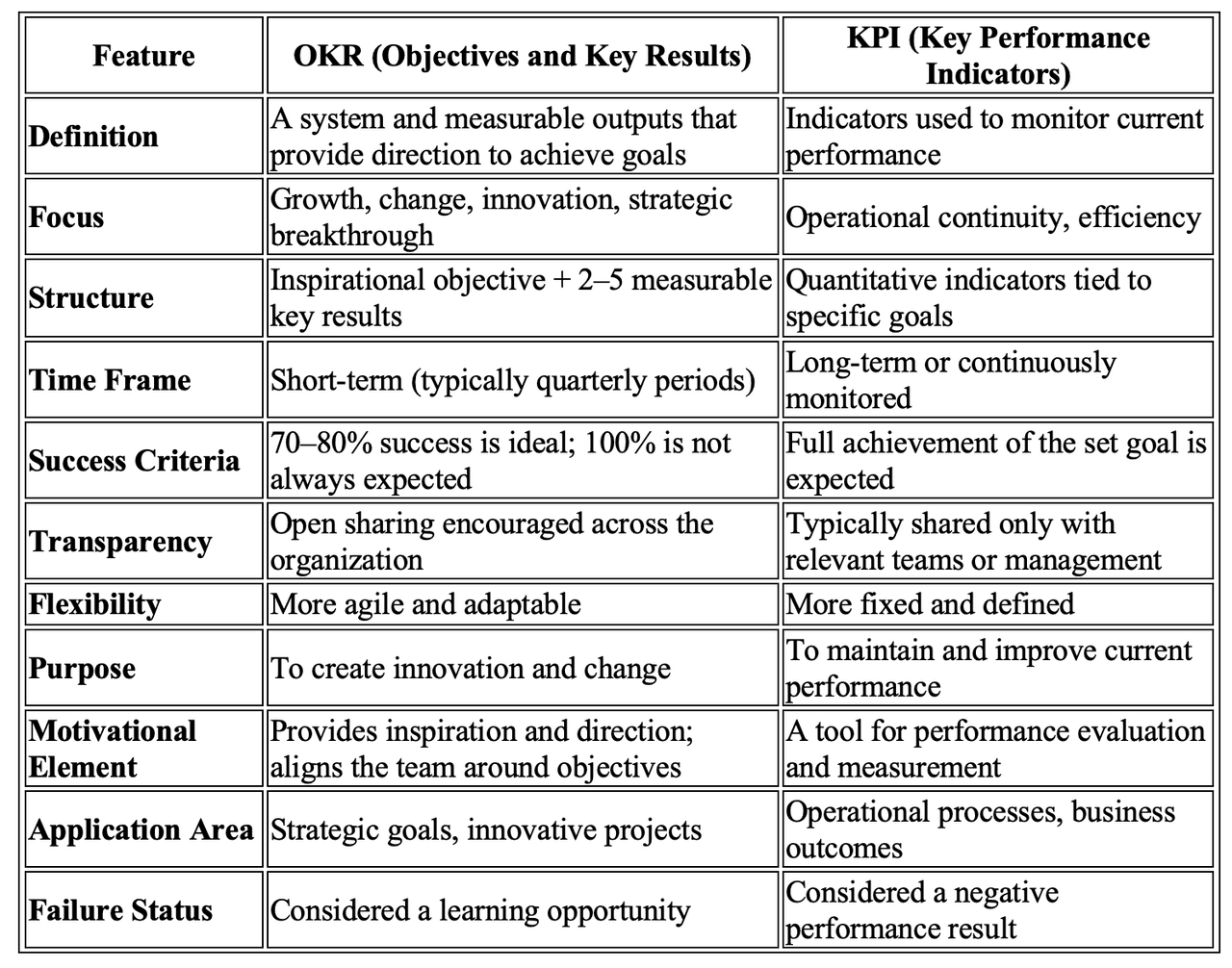
Table 1. Dıfferences between OKR and KPI
Implementation of OKRs at Corporate and Individual Levels
OKR systems can be implemented hierarchically at three levels as follows:
Implementation Challenges and Critical Factors
Although the OKR system appears to be simple and effective, there are several structural and cultural challenges that may arise during implementation. These can be summarized as follows:
Use of OKRs in the Public and Nonprofit Sectors
In recent years, the OKR system has been increasingly adopted not only by the private sector but also by public institutions, universities, and nonprofit organizations. For institutions that prioritize transparency, measurability, and accountability, OKRs have become a powerful tool in project and program management. OKR structures have also started to be used in European Union–funded projects and in frameworks for social impact reporting.

Henüz Tartışma Girilmemiştir
"Objectives and Key Results" maddesi için tartışma başlatın
Historical Background and Development Process
Structure of the OKR System
Objective
Key Results
Implementation Periods
Differences Between OKR and KPI
Bu madde yapay zeka desteği ile üretilmiştir.