


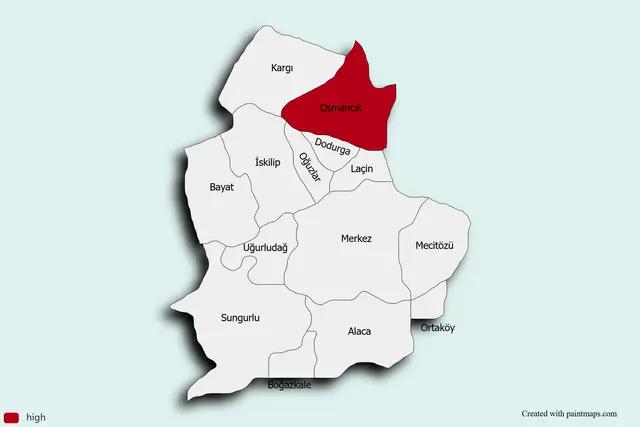
Osmancık (District)
Province(s) | Corum | ||||||||
|---|---|---|---|---|---|---|---|---|---|
Area(s) | Black Sea | ||||||||
Altitude | 430 meters | ||||||||
Postal Code | 19500 | ||||||||
Mayor(s) | Ahmet Gelgor | ||||||||
District Governor | Furkan Duman | ||||||||
Climate(s) | Continental climate | ||||||||
Osmancık is located at the transition between the Central Anatolia and Black Sea regions. The Kızılırmak River flows through the district center, influencing the settlement's physical structure. Because it is located on the transportation network, various highways pass through the district. Its population largely makes its living through agriculture and small-scale trade.

Osmancık (Çorum Provincial Directorate of Culture and Tourism)
The district of Osmancık has a history that is said to date back to the Hittite period and is one of the oldest settlements in Çorum. Known as "Pimolisene" in ancient Roman and Byzantine times, Osmancık became an important center thanks to its strategic location. During this period, the city, situated on the banks of the Kızılırmak River, served as a fortified position controlling east-west trade routes. Osmancık Castle (locally known as Kandiber Castle), built on steep cliffs along the riverbank, was used to monitor caravan routes passing through the region and ensure tax security. The walls surrounding the castle were approximately 250 meters long and 30 meters high, and it has been determined that it contained hidden river channels and the remains of ancient structures carved into the rocks. The presence of Roman rock tombs within the castle suggests that its initial construction may have been during the Roman Empire. However, some sources attribute the castle's origins to the Hittites, while other accounts suggest it was built during the Byzantine raids of the Umayyads, although this view is not definitive.
The district came under Seljuk rule in 1075 and became a Turkish homeland. Following the victory at Manzikert, the Turkish presence in the region led to the appointment of Şerafettin Osman Gazi, the bey of the Sorgun tribe of the Alayuntlu clan of the Oghuz Turks, as emir of Osmancık and its surrounding area. After establishing authority in the region, Şerafettin Osman Gazi named the city after his own tribe, changing its former name from Eflanos to "Sorgun." Osman Gazi's influence in the region grew so much that he resided in Osmancık for an extended period, governing the İskilip, Hacıhamza, and Çorum regions from there. Over time, the name Osmancık, meaning "Osman's little city," became widespread among the locals, and the city became known by this name.
With the collapse of the Danishmend Principality in the region in 1177, Osmancık was incorporated into the Anatolian Seljuk State. Subsequently, at the end of the 14th century, in 1389, it was conquered by Ottoman Sultan Bayezid I and came under Ottoman rule. During the Ottoman period, Osmancık maintained its commercial and strategic importance thanks to its location on the Silk Road. Indeed, when Evliya Çelebi visited Osmancık in the 17th century, he spoke highly of the place, noting that the Koyunbaba Dervish Lodge was one of the most respected places of pilgrimage of the period, that the castle was a sturdy structure with a perimeter of 800 steps, and that the city, as a police station, was a vibrant commercial center.
Within the Ottoman administrative organization, Osmancık's affiliation status changed over time. The district was annexed to the Amasya Sanjak in 1423 and to the Çorum Sanjak in 1596, before being re-incorporated into Amasya in 1864. Shortly after the founding of the Republic, it was annexed to the province of Çorum as a district in 1924, achieving its current administrative status. Traveler W.J. Ainsworth, who toured the region in the mid-19th century, noted approximately 200 houses within the city walls of Osmancık, 80 outside the city walls, and five small mosques, a caravanserai, and bathhouses. This information demonstrates that Osmancık played a significant role as a regional administrative, military, and commercial center throughout history. Consequently, Osmancık, with its rich historical heritage, has survived to the present day, preserving its cultural fabric from antiquity to the Ottoman era.
The district of Osmancık is located north of Çorum province, at the intersection of the Central and Western Black Sea regions of the Black Sea Region. It is located at the intersection of roads connecting the Central Anatolia Region and the Black Sea to the west (towards Istanbul). The district center is approximately 59-60 km from Çorum city center. Osmancık borders Samsun province (specifically the district of Vezirköprü) to the northeast, Amasya province (Gümüşhacıköy and Hamamözü districts to the southeast) to the east, Dodurga and Laçin districts of Çorum to the south, İskilip district to the southwest, Kargı district of Çorum to the west, and Sinop province (Saraydüzü district) to the northwest. This location places Osmancık at a strategic point where important east-west and north-south transit routes intersect.
The district is located in the northern basin of the Kızılırmak River, Türkiye's longest river. The Kızılırmak flows through Osmancık, providing life to the region, and its length within the district is approximately 80 km. Due to the alluviums carried along its course, the water is red and murky in places; this is the source of the "red" color that gives Kızılırmak its name. The main streams that join the Kızılırmak River within the district are Kavşak Stream, İncesu Stream, Karalar Stream, and Yukarızeytin Stream. The district's most important plain is the Kızılırmak Valley, which boasts fertile agricultural land. Hills of all sizes and mountain ranges run parallel to the river throughout the valley. The highest of the mountains surrounding Osmancık is İnegöl Mountain, at 1,864 meters. The Çal Mountains (the highest point of which is Büyük Çal Hill, 1,750 m) and Ada Mountains (the highest point of which is Dedeçal Hill, 1,770 m) are also located within the district's borders in the west of the province. While this topography gives Osmancık a rugged terrain, it also provides significant flat agricultural land in the valleys and along rivers.
The district's total area is approximately 1,200 km² (1,202,500 acres). A large portion of this area consists of forests and mountainous terrain. Indeed, approximately 65% of Osmancık's land (783,000 acres) is covered by forests; dense forests of pine, oak, and juniper trees are particularly prevalent in the mountainous areas. Of the land outside of forested areas, 21% (254,000 acres) is agriculturally cultivated, 8% pastures and meadows, 3% rocky areas, and 2% water surfaces. Settlement areas cover approximately 1% of the total land area (approximately 10,000 acres). Forest cover thins out on the plains and valley floors, and steppe vegetation begins to dominate in these areas. This diversity enriches Osmancık's geography in terms of both forest and steppe ecosystems.
In terms of climate, Osmancık exhibits a transitional climate between the Black Sea climate and the Central Anatolian continental climate. The district generally experiences a temperate climate. Summers are relatively hot and dry, while winters are mild and rainy. Spring and autumn are long, with distinct seasonal transitions. Rainfall is highest in the spring months. The average annual rainfall is approximately 368 mm, which is considered moderate for a semi-arid region. Extreme cold temperatures are rare due to the relatively low altitude (the district center is approximately 420-430 meters above sea level) and the prevailing air currents through the valleys connected to the Black Sea. These climatic conditions facilitate agriculture in the region and support a diversity of forests and vegetation.
In terms of population and settlement, Osmancık is a developed district with both urban and rural populations. According to 2023 data from the Turkish Statistical Institute, the total population is 43,388. Approximately 29,757 of this population live in the district center (city), while the remainder reside in towns and villages. Osmancık has 18 neighborhoods and 55 villages within the district. Because a significant portion of the population is concentrated in the district center, administrative, commercial, and social services are concentrated in the city center. In rural areas, the population is dispersed among village communities engaged in agricultural production. Osmancık's transportation advantages and fertile lands have ensured a consistent population presence in the region today, as they have throughout history.
The population of Osmancık district, which was 45,730 in 2007, fluctuated over the years, declining to 43,056 in 2024. A general decrease was observed between 2008 and 2015, with increases and decreases at varying rates between 2015 and 2021, and a mostly slight decrease between 2021 and 2024. As of 2024, the male population was 21,212 (49.27%) and the female population was 21,844 (50.73%); the gender gap generally remained at a few hundred throughout the period. Annual population changes can be associated with factors such as migration movements, birth-death balances, and administrative record updates.
The Osmancık district's economy is largely based on agricultural activities. Rice (paddy) farming, which has become a symbol of the district, is the first economic activity that comes to mind when Osmancık is mentioned. High-quality rice is produced in the vast paddy fields spread across the fertile Kızılırmak Valley. The variety of rice known throughout Türkiye as "Osmancık rice" is renowned for its high yield and delicious flavor. Thanks to the mild climate and the water resources provided by the river, rice cultivation in Osmancık has been a tradition that has endured for centuries. The rice harvest season provides a vital boost to the district's economy; producers contribute not only to the local market but also to the nationwide demand for rice. In addition to rice, the valley's wet and alluvial agricultural lands also grow grains and industrial crops such as wheat, barley, corn, sugar beets, as well as various vegetables and fruits. As agricultural lands cover one-fifth of the total land area, agricultural production is the primary source of income for Osmancık's economy. However, productivity continues to increase with the use of modern agricultural techniques and the development of irrigation projects.
Another natural resource of the district is its rich forests. Forested areas, which constitute 65% of the land, offer potential for wood and timber production, resin collection, and forestry-based sub-industries. People living in forest villages contribute to the economy through activities such as controlled forest felling, wood product processing, and in-forest agriculture. Forestry also supports beekeeping, and small-scale initiatives such as organic honey production are common in Osmancık and the surrounding area. The presence of pastures and meadows allows for the continuation of traditional animal husbandry activities (small and large cattle raising). In rural areas, families engage in livestock farming for their own needs or for limited commercial purposes, in addition to agriculture, producing meat and dairy products.
Osmancık district also possesses a significant resource in terms of underground resources: lignite (hard coal) deposits. Rich reserves of lignite coal have been discovered within the district borders, particularly around the villages of Yaylabaşı and Kumbaba. Geological surveys indicate that the carbon content in the coal seams is up to 5%, demonstrating the high quality of these lignite deposits. These lignite reserves are operated by the private sector, and mining activities contribute to the district's economy in terms of employment and income. These mining activities make Osmancık important for meeting the region's fuel needs and providing industrial raw materials. Furthermore, the district also possesses natural resources such as clay, sand, and gravel, which can be used as construction materials, and these resources are being utilized locally.
Transportation and trade also play a significant role in the district's economic life. Osmancık, due to its geographical location, has historically been a hub for transit trade routes, and this advantage continues today. The D-100 Highway (formerly the E5 Highway) passes through Osmancık, one of the most important arteries connecting the Black Sea and Eastern Anatolia to Istanbul. This road is an approximately 1,800 km international route, starting from Gürbulak on the country's eastern border and extending west to Kapıkule, the gateway to Europe. Osmancık is located near the center of this long route, with the distance between Kapıkule and Osmancık being approximately 815 km. Thanks to this strategic location, tens of thousands of vehicles transit through the district daily. According to official data, an average of approximately 14,000 vehicles pass through Osmancık daily. This is reflected in the district's economy through the service sector along the route: numerous gas stations, rest stops, restaurants, hotels, and businesses operate along the highway and in the district center. Because Osmancık is a key stopover and rest stop for long-distance drivers and passengers, small-scale commercial and service businesses generate significant revenue. Roadside sales of local products (rice, molasses, tarhana, etc.) can be considered both a revenue-generating activity and a contribution to Osmancık's promotion.
While the industrial sector in Osmancık is limited, it offers potential for development. The district boasts rice mills, flour mills, and food processing facilities dedicated to processing agricultural products. Rice sifting and packaging facilities, in particular, play a significant role in supplying Osmancık rice, a local product, to the national market. Additionally, small-scale woodworking workshops (based on forest products) and construction material production businesses also support the economy. In recent years, cultural and nature tourism has also been a prominent source of income in the district's economy. Efforts to attract local tourists through the restoration of historical monuments and the promotion of natural beauty have begun to revitalize the economy. In short, Osmancık's economic structure is shaped by traditional sectors based on agriculture and natural resources, as well as trade and small-scale industry, which are driven by transportation advantages.
Osmancık boasts remarkable cultural and tourism assets thanks to its rich history and geographical beauty. The district boasts numerous significant historical sites and monuments, representing significant cultural heritage. Ottoman-era structures, along with traces of Seljuk and earlier civilizations, make Osmancık an open-air museum. The main historical sites in and around the district center can be summarized as follows:
In addition to the monuments listed above, Osmancık boasts many other cultural assets worth seeing. Other Ottoman-era mosques, such as the Şeyh Hasan Mosque and Beyler Çelebi Mosque, the Ulu Mosque and its mausoleums, along with ancient inscriptions and tombstones scattered throughout the district, complement the historic atmosphere. The Town Square project in the district center aims to make this cultural heritage more visible and accessible to the public through landscaping.
Osmancık also offers a wealth of natural beauty and recreational opportunities. Located near the district, the Adatepe Picnic Area, with its lush greenery and river views, has been designed as an area suitable for picnics and daily recreation. Hiking trails line the Kızılırmak River and through the forest. Indeed, Osmancık is home to important stops on the Kızılırmak Basin Gastronomy and Hiking Trail. Four of the designated hiking trails are located within Osmancık: the 5-kilometer trail from the Olive Fire Watchtower to Lake Gölbel and the trail from Lake Gölbel to Karalargüney Village are popular among nature lovers. Lake Gölbel, a natural lake at the higher elevations of the district, is surrounded by fir and pine forests, making it suitable for camping and hiking. Başpınar Karaca Plateau, with its clean air and panoramic views, is a cool plateau where the tradition of transhumance continues in the summer months. Here, you can encounter different colors of vegetation in every season. Also known as the Kunduz Forests, the extensive forested area of pine, beech, and oak trees attracts photography enthusiasts with its riot of color in autumn, snowy landscapes in winter, and vibrant spring landscapes. For adventure seekers, Baldıran Canyon, a pristine area in the northern part of the district, offers opportunities for rock climbing and nature walks with its steep, rocky valleys. While not yet widely known, this canyon is ripe for nature tourism.
Osmancık's cultural richness isn't limited to tangible heritage; spiritual and folkloric values also hold significant significance. Narratives and anecdotes about saints such as Yunus Emre, Hacı Bektaş-ı Veli, and Koyunbaba live on in the local folk culture. Carpet and kilim weaving, wood carving, and carved stonework, traditional handicrafts, once flourished in the district but are now fading into obscurity. However, recent efforts have been made to revive these handicrafts and produce tourist items. Annual local festivals and fairs are events that stimulate Osmancık's cultural and tourism potential. Festivities held after the rice harvest and the Koyunbaba commemoration days, in particular, contribute to the district's promotion and attract visitors from abroad.
The local culinary culture in Osmancık is shaped by agricultural production and blends the flavors of surrounding regions. Osmancık rice, a product renowned nationwide, is a staple in the cuisine. The rice grown locally is particularly popular for pilaf, and Osmancık-style buttered rice pilaf is a staple. Rice is used not only in pilaf but also in desserts like rice pudding, fillings for stuffed vegetables, and soups, further diversifying the region. Osmancık cuisine generally reflects a cross between the grain-based dishes of Central Anatolia and the vegetable and legume dishes of the Black Sea region. For example, dishes from neighboring regions, such as wheat-based keşkek, yarma soup, corn-flour mıhlama, and evelik dolma, also find a place on Osmancık tables. Meat dishes based on livestock are also common in the district; dishes like traditional tandır kebab, lamb stew, and meat pide are favorites at family gatherings, weddings, and holiday feasts. Roasted chickpeas (leblebi), also famous throughout Çorum, are a popular snack in Osmancık, perfect for tea conversations. Traditional Anatolian cuisine, such as molasses, jams, and marmalades made with local fruits, stuffed vine leaves, bulgur stuffed meatballs, and tarhana soup, are all kept alive in Osmancık.
Ilimiz.net. “Osmancık District of Çorum Province.” Ilimiz.net. Access date: May 4, 2025. https://www.ilimiz.net/ilce/19/319-corum-ilimizin-osmancik-ilcesi.html
Paintmaps. “Turkey Provinces Map – Highlighting Osmancık , Çorum .” Access date: April 15, 2025. https://paintmaps.com .
Republic of Turkey Ministry of Culture and Tourism, Çorum Provincial Directorate of Culture and Tourism. “Osmancık.” Çorum Provincial Directorate of Culture and Tourism. Access date: May 4, 2025. https://corum.ktb.gov.tr/TR-58703/osmancik.html
TC Çorum Governorship. “Osmancık.” Çorum Governorship. Access date: May 4, 2025. http://www.corum.gov.tr/osmancik
TC Osmancık Municipality. “Akşemsettin Mosque Madrasa.” Osmancık Municipality. Access date: May 4, 2025. https://osmancik.bel.tr/aksemsettin-cami-medresa
TC Osmancık Municipality. “Geographic Information.” Osmancık Municipality. Access date: May 4, 2025. https://osmancik.bel.tr/cografi
TC Osmancık Municipality. “Imaret Mosque.” Osmancık Municipality. Access date: May 4, 2025. https://osmancik.bel.tr/imaret-cami
TC Osmancık Municipality. “Village Father Bridge.” Osmancık Municipality. Access date: May 4, 2025. https://osmancik.bel.tr/koyunbaba-koprusu
TC Osmancık Municipality. “Population.” Osmancık Municipality. Access date: May 4, 2025. https://osmancik.bel.tr/nufus
TC Osmancık Municipality. “History.” Osmancık Municipality. Access date: May 4, 2025. https://osmancik.bel.tr/tarihce
TC Osmancık Municipality. “Transportation.” Osmancık Municipality. Access date: May 4, 2025. https://osmancik.bel.tr/ulasim
TC Osmancık District Governorship. “Beyler Çelebi Mosque.” Osmancık District Governorship. Access date: May 4, 2025. http://www.osmancik.gov.tr/beyler-celebi-camii
TC Osmancık District Governorship. “Paddy Fields.” Osmancık District Governorship. Access date: May 4, 2025. http://www.osmancik.gov.tr/celtik-tarlalari
TC Osmancık District Governorship. “Imaret Mosque.” Osmancık District Governorship. Access date: May 4, 2025. http://www.osmancik.gov.tr/imaret-camii
TC Osmancık District Governorship. “City Square.” Osmancık District Governorship. Access date: May 4, 2025. http://www.osmancik.gov.tr/kent-meydani
TC Osmancık District Governorship. “General View of Osmancık.” Osmancık District Governorship. Access date: May 4, 2025. http://www.osmancik.gov.tr/osmancik-genel-gorunum
TC Osmancık District Governorship. “Our History.” Osmancık District Governorship. Access date: May 4, 2025. http://www.osmancik.gov.tr/tarihcemiz
Turkish Statistical Institute (TurkStat). Address Based Population Registration System Results, 2024. Access date: April 20, 2025. https://data.tuik.gov.tr/Bulten/Index?p=Adrese-Dayali-Nufus-Kayit-Sistemi-Sonuclari-2024-53783

Osmancık (District)
Province(s) | Corum | ||||||||
|---|---|---|---|---|---|---|---|---|---|
Area(s) | Black Sea | ||||||||
Altitude | 430 meters | ||||||||
Postal Code | 19500 | ||||||||
Mayor(s) | Ahmet Gelgor | ||||||||
District Governor | Furkan Duman | ||||||||
Climate(s) | Continental climate | ||||||||
Henüz Tartışma Girilmemiştir
"Osmancık (District)" maddesi için tartışma başlatın
History
Geography and Climate
Population and Demography
Economy
Tourism and Culture
Kitchen
Bu madde yapay zeka desteği ile üretilmiştir.