+1 Daha

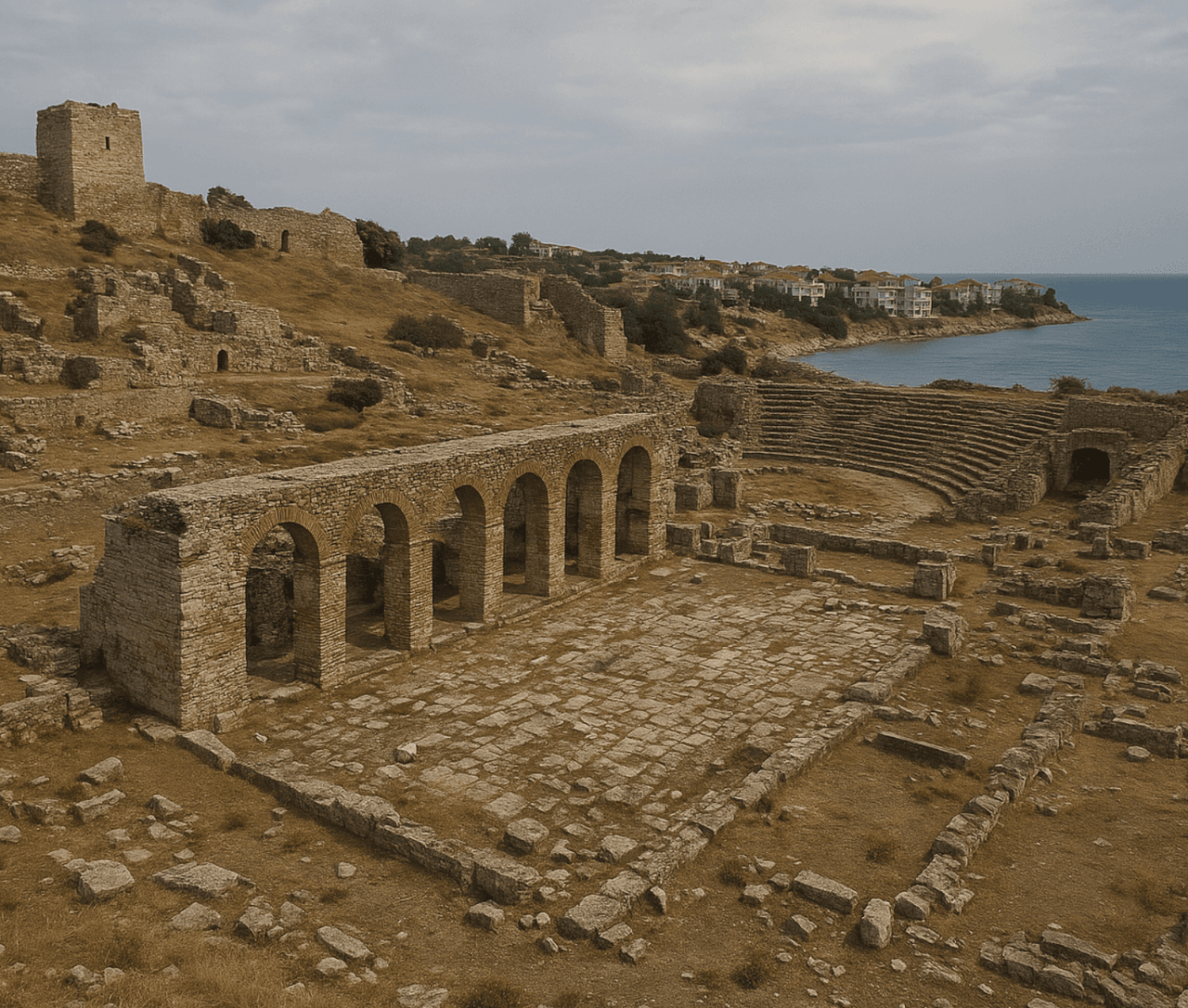
Perinthos by AI
Location | Marmara Eregli Türkiye Tekirdag province | ||||||||
|---|---|---|---|---|---|---|---|---|---|
Date of Establishment | Traditionally 602 BC (Greek colonists from Samos) | ||||||||
Historical Period(s) | Prehistoric Age Ottoman Period (taken by Suleyman Pasha in 1353) (name Herakleia in 286 AD) Byzantine Period (bishopric center) Roman Period (Capital of Thrace Province in 46 AD) Hellenistic Period Thrace and Persian Period | ||||||||
Featured Buildings | Thracian tumuli (necropolis areas) Roman period waterways (17 km long from Değirmendere) City walls (sections reaching 6–7 m in height) Constantine/Metropolitan House Basilica Stadium Temple/Church area Acropolis Theatre | ||||||||
Archaeological Excavations | Topographic plan studies and building documentation in 2022 Scientific excavations by MSGSÜ starting from 2021 Short-term surface exploration in the 1980s | ||||||||
Epigraphic and Numismatic Data | Neocoros coins from the Septimus Severus - Caracalla - Elagabalus period Possible visit by Hadrian and inclusion in the Panhellenion (AD 131–138) | ||||||||
Museums and Exhibitions | Marmara Ereğlisi Municipality Building Garden Marmara Ereğlisi Open Air Museum (Stone Garden) Tekirdag Archaeology Museum | ||||||||
The ancient city of Perinthos, located within the present-day boundaries of Marmara Ereğlisi district in Tekirdağ province, is a multi-layered settlement that was continuously inhabited from prehistoric times to the Ottoman period. Positioned on the coast of the Sea of Marmara in Eastern Thrace, the city held strategic geopolitical and geodynamic significance and served as a major political and religious center at various times throughout history.
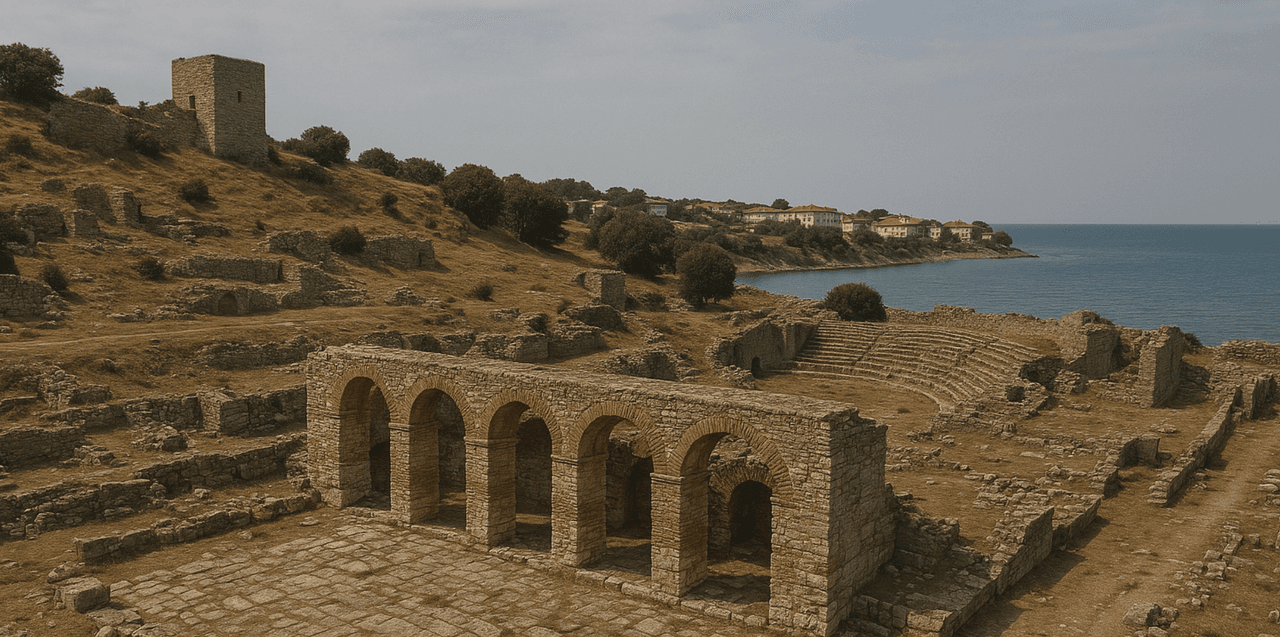
Perinthos Ancient City Reconstruction (Drawn with AI)
According to ancient sources, Perinthos was founded in 602 BCE by Greek colonists from the island of Samos. However, systematic excavations initiated in 2021 revealed prehistoric settlement layers in the acropolis area, including stone tools and ceramic fragments from earlier periods. These findings extend the city’s history back to prehistoric times, highlighting its significance beyond the Classical era.
Initially under the influence of Thracian tribes, the city later came under Persian domination and regained independence around 476–475 BCE. Although Macedonian King Philip II besieged Perinthos in 337 BCE, he failed to capture it. Subsequently, Alexander the Great minted coins bearing his name in the city. During the Roman period, Perinthos lost its former status following Rome’s victory over Byzantion but retained the privilege of hosting athletic games.
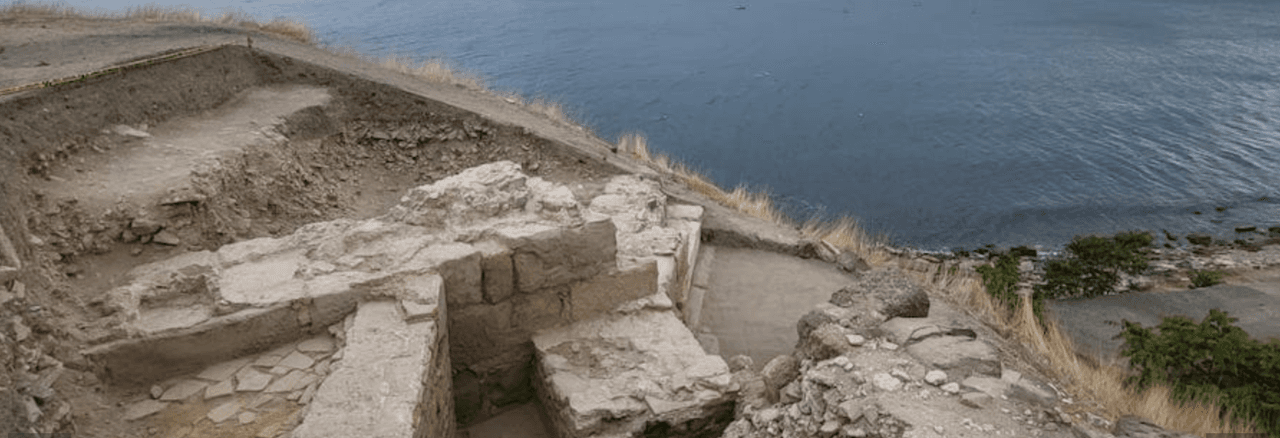
A Photo from the Ongoing Excavation Site (Source: Perinthos Excavation )
In 46 CE, Perinthos was declared the capital of the Roman province of Thrace. In 286 CE, during the reign of Emperor Diocletian, the city was renamed Herakleia, in reference to the mythological founder Herakles. In Late Antiquity, it became an episcopal center, with written sources indicating the presence of approximately 40 churches. Despite its importance, the city suffered significant destruction due to Avar and Bulgar invasions. During the Middle Ages, control over the city shifted multiple times. In 1204, it was taken by the Venetians during the Latin occupation, and finally, in 1353, it was incorporated into the Ottoman Empire under the command of Süleyman Pasha.
Perinthos is situated along the northern coast of the Sea of Marmara, approximately 90 km west of the Bosphorus, in close proximity to the North Anatolian Fault Zone. The city’s ancient core overlaps with the modern urban area of Marmara Ereğlisi. It was a tombolo-type port city, featuring two large harbors, an acropolis, necropolis areas, and a lower city, forming a complex and expansive urban layout.
The settlement stretched along an east-west axis. The acropolis was located on the highest elevation, while the lower city extended toward flatter coastal areas. The city's territory spanned a radius of about 25 kilometers, including modern neighborhoods such as Yeniçiftlik, Kamaradere, and Sultanköy, as well as parts of the Çorlu district.
The acropolis of Perinthos houses several significant architectural remains, including a theater, stadium, temple/church structures, fortification remnants, and rock-cut tombs. The theater, which overlooks the Propontis, stands out for its both functional and aesthetic design. Vaulted substructures to the west of the theater indicate multi-phase usage. The temple/church complex includes layers from both pagan and Christian periods, illustrating the city’s cultural transformation over time.
In the lower city, a basilica dating to Late Antiquity and the so-called Constantine/Metropolitan House have been identified. Additionally, numerous architectural fragments and statues from different historical phases are displayed at the Marmara Ereğlisi Open-Air Museum (Municipal Park – Stone Garden) and in the garden of the Municipal Building, providing insights into the city’s civic and domestic architecture.
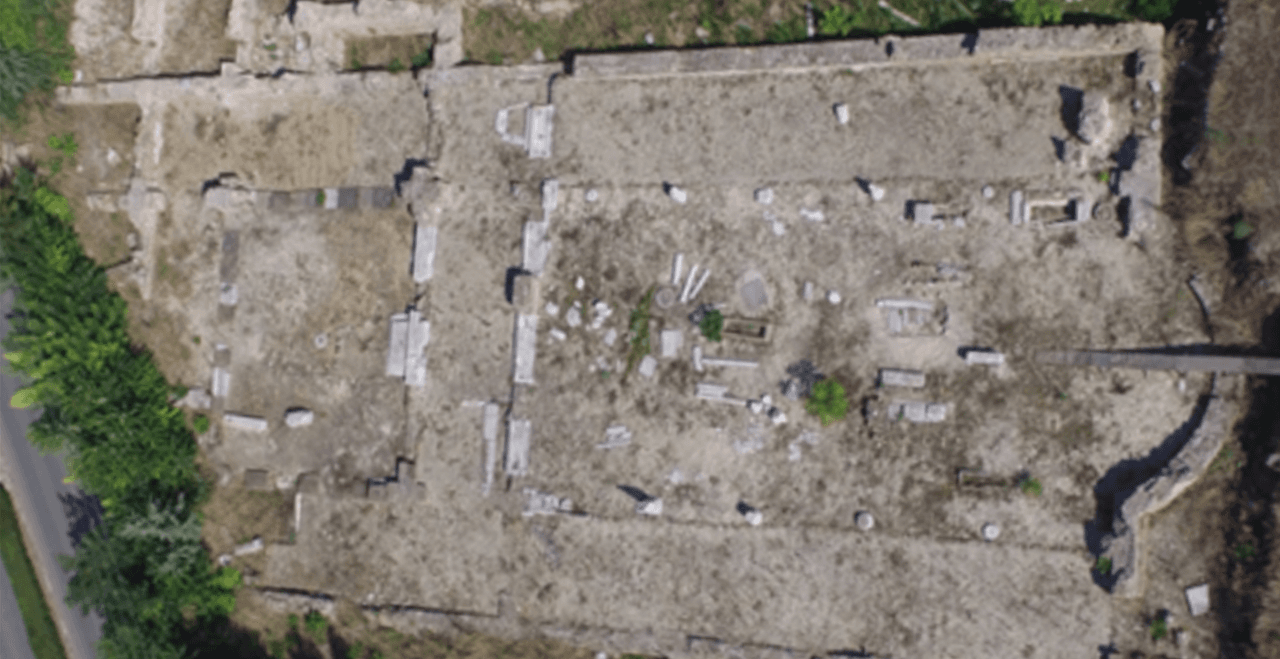
Ruins of Perinthos Basilica (Source: Perinthos Excavation )
The city’s fortification walls encompassed both the acropolis and the lower city. Notably, sections of the acropolis walls, particularly to the northwest, have been preserved up to 6–7 meters in height. During the Roman period, the city’s water supply came from Değirmendere, located 17 km away. This water system utilized terracotta pipes, exemplifying advanced ancient engineering.
Necropolis areas surrounding Perinthos feature tumulus-type monumental tombs from the Hellenistic and Roman periods. In accordance with Thracian funerary traditions, deceased individuals were sometimes buried alongside their horses, and some tumuli were constructed specifically for the horses.
Due to its proximity to the North Anatolian Fault, Perinthos experienced numerous devastating earthquakes throughout its history. Records begin with the earthquake of 427 BCE and continue into the 15th century. Notable events include those in 282 BCE (Gelibolu), 117 CE (Kapıdağ), 138 and 160 CE (Çanakkale), 170 CE (southern Marmara), and 430 CE (Istanbul). These events often necessitated the repair or reconstruction of city walls and aqueducts, especially during the reign of Justinian (527–565 CE).
The Perinthos-Herakleia 37 inscription suggests that Emperor Hadrian visited the city around 131 CE. The inscription is associated with the inclusion of Perinthos in the Panhellenion League, a pan-Hellenic institution centered in Athens. The divine titles attributed to Hadrian and the cultic references to Sabina support this interpretation. Coinage from the reigns of Septimius Severus, Caracalla, and Elagabalus further confirms Perinthos's status as a neokoros city—one designated as a center of imperial cult worship.
Excavations between 2006 and 2009 uncovered a Byzantine-era cemetery used continuously between the 9th and 13th centuries CE. A total of 109 individuals were documented. One child, aged 3–4, exhibited sagittal craniosynostosis—a congenital anomaly characterized by the premature closure of the sagittal suture, leading to a condition known as scaphocephaly. This case is among the earliest recorded examples of such an anomaly in Anatolia.
Today, the modern town of Marmara Ereğlisi is built directly over the ancient city of Perinthos. As such, archaeological remains are integrated into the urban fabric, sometimes located within private properties or public spaces. Many artifacts from the city are exhibited in the Tekirdağ Archaeological Museum, the Marmara Ereğlisi Open-Air Museum, and the garden of the municipal building. Oral history studies conducted in the area have helped trace the memory of Perinthos in the local population, contributing to a broader understanding of intangible cultural heritage through a method referred to as "oral archaeology."
Aktaş, Oya. Oral Archaeological History of Perinthos Ancient City (Tekirdağ Marmaraereğlisi) . Master's thesis, Mimar Sinan Fine Arts University, 2023.
Erel, T. Levent, Cengiz Zabcı, H. Serdar Akyüz, and Namık Çağatay. “Historical Earthquakes of the Ancient City of Perinthos (Marmara Ereğlisi) Until the 15th Century.” Turkish Geological Bulletin 51, no. 2 (2008): 77–90.
Topalilov, Ivo. “On the Perinthos-Heraklea 37.” Studia Antiqua et Archaeologica 26, no. 1 (2020): 59–68. https://www.ceeol.com/search/article-detail?id=953409 .
Koçel Erdem, Zeynep, Kenan Eren, Haldun Arda Bülbül, and Ertunç Denktaş. Perinthos (Tekirdağ Marmara Ereğlisi) Ancient City Topographic Plan Study 2022: Project Final Report . Mimar Sinan Fine Arts University, 2022. Scientific Research Projects Coordination Report, No. 2022-05.
Perinthos Excavation Official Website. “Photo Gallery – ON1617.” Accessed 13 April 2025. http://perinthoskazisi.com/fotografgaleri/on-1617/8.html .
Perinthos Excavation Official Website. “Homepage.” Accessed 13 April 2025. http://perinthoskazisi.com/ .
Perinthos Excavation Official Website. “City History.” Accessed 13 April 2025. http://perinthoskazisi.com/sayfa/kent-tarihcesi/10.html .

Perinthos by AI
Location | Marmara Eregli Türkiye Tekirdag province | ||||||||
|---|---|---|---|---|---|---|---|---|---|
Date of Establishment | Traditionally 602 BC (Greek colonists from Samos) | ||||||||
Historical Period(s) | Prehistoric Age Ottoman Period (taken by Suleyman Pasha in 1353) (name Herakleia in 286 AD) Byzantine Period (bishopric center) Roman Period (Capital of Thrace Province in 46 AD) Hellenistic Period Thrace and Persian Period | ||||||||
Featured Buildings | Thracian tumuli (necropolis areas) Roman period waterways (17 km long from Değirmendere) City walls (sections reaching 6–7 m in height) Constantine/Metropolitan House Basilica Stadium Temple/Church area Acropolis Theatre | ||||||||
Archaeological Excavations | Topographic plan studies and building documentation in 2022 Scientific excavations by MSGSÜ starting from 2021 Short-term surface exploration in the 1980s | ||||||||
Epigraphic and Numismatic Data | Neocoros coins from the Septimus Severus - Caracalla - Elagabalus period Possible visit by Hadrian and inclusion in the Panhellenion (AD 131–138) | ||||||||
Museums and Exhibitions | Marmara Ereğlisi Municipality Building Garden Marmara Ereğlisi Open Air Museum (Stone Garden) Tekirdag Archaeology Museum | ||||||||
Henüz Tartışma Girilmemiştir
"Perinthos Ancient City" maddesi için tartışma başlatın
Foundation and Historical Background
Geography and Urban Planning
Architectural Structures
Acropolis Area
Lower City and Other Areas
Fortifications and Water Structures
Necropolis and Tumuli
Historical Earthquakes
Inscriptions and Imperial Cult
Anthropological Findings
Perinthos Today
Bu madde yapay zeka desteği ile üretilmiştir.