

+2 Daha

Pipelining & Parallel Processing (Generated with AI)
Definition(s) | Techniques that improve performance by overlapping or parallelizing instruction execution | ||||||||
|---|---|---|---|---|---|---|---|---|---|
Key Concepts | Pipelining, Parallel Processing | ||||||||
Parallelism Types | ILP: Instruction-Level, DLP: Data-Level, TLP: Task-Level | ||||||||
Used In | Microprocessors, DSPs , AI Accelerators, GPUs | ||||||||
Design Impact | Reduces Critical Path Delay, Lowers Iteration Bound, Enables Real-time & High-throughput Systems | ||||||||
Pipelining and parallel processing are foundational techniques in computer architecture and digital system design, aimed at improving performance by increasing instruction throughput and computational efficiency. These techniques are essential in the design of microprocessors, digital signal processors (DSPs), and modern embedded systems.
Pipelining is a technique that divides the processing of instructions into several stages, each completing a part of the instruction. This allows multiple instructions to be processed simultaneously in a staggered fashion. For example, in a typical 5-stage instruction pipeline used in RISC processors, the stages include Instruction Fetch (IF), Instruction Decode (ID), Execute (EX), Memory Access (MEM), and Write Back (WB). While one instruction is being executed, another can be decoded, and a third can be fetched, increasing instruction throughput.
Pipelining is analogous to an assembly line in a factory where different stages of production occur simultaneously. This technique helps in reducing the instruction latency and increasing overall system performance.
Parallel processing refers to the simultaneous execution of multiple tasks or operations to achieve faster computation. It involves multiple processing units working concurrently on different data or instructions. There are several types of parallelism:
Architectures supporting parallel processing include SIMD (Single Instruction, Multiple Data), MIMD (Multiple Instruction, Multiple Data), superscalar processors, multicore systems, and GPU-based systems.
Critical Path refers to the longest delay path between the input and output in a combinational circuit. It determines the minimum clock period that the system can operate with. Reducing this path is essential to increase the clock frequency and improve system performance.
Iteration Bound, on the other hand, is a concept specific to recursive or iterative computations (such as those in DSP). It represents the minimum time required to complete one iteration, based on computation delay and the number of delays (registers) in the loop.
This bound defines the theoretical lower limit for the sample period. Techniques like retiming and pipelining are often applied to reduce the actual sample period closer to this bound. A well-optimized VLSI system aims to minimize the gap between the critical path delay and the iteration bound. When these two values converge, the design achieves near-optimal timing efficiency, ensuring that each clock cycle is effectively utilized. Techniques such as retiming, loop unrolling, and pipelining are key tools in achieving this alignment.
In VLSI digital system design, pipelining and parallel processing significantly influence architectural performance metrics such as critical path delay and iteration bound.
These optimizations are particularly important in digital signal processing (DSP) applications, where real-time constraints demand both low latency and high throughput.
In summary, pipelining reduces per-stage delay, while parallelism scales throughput. When strategically applied, these techniques allow VLSI systems to meet timing constraints efficiently without excessive resource usage.
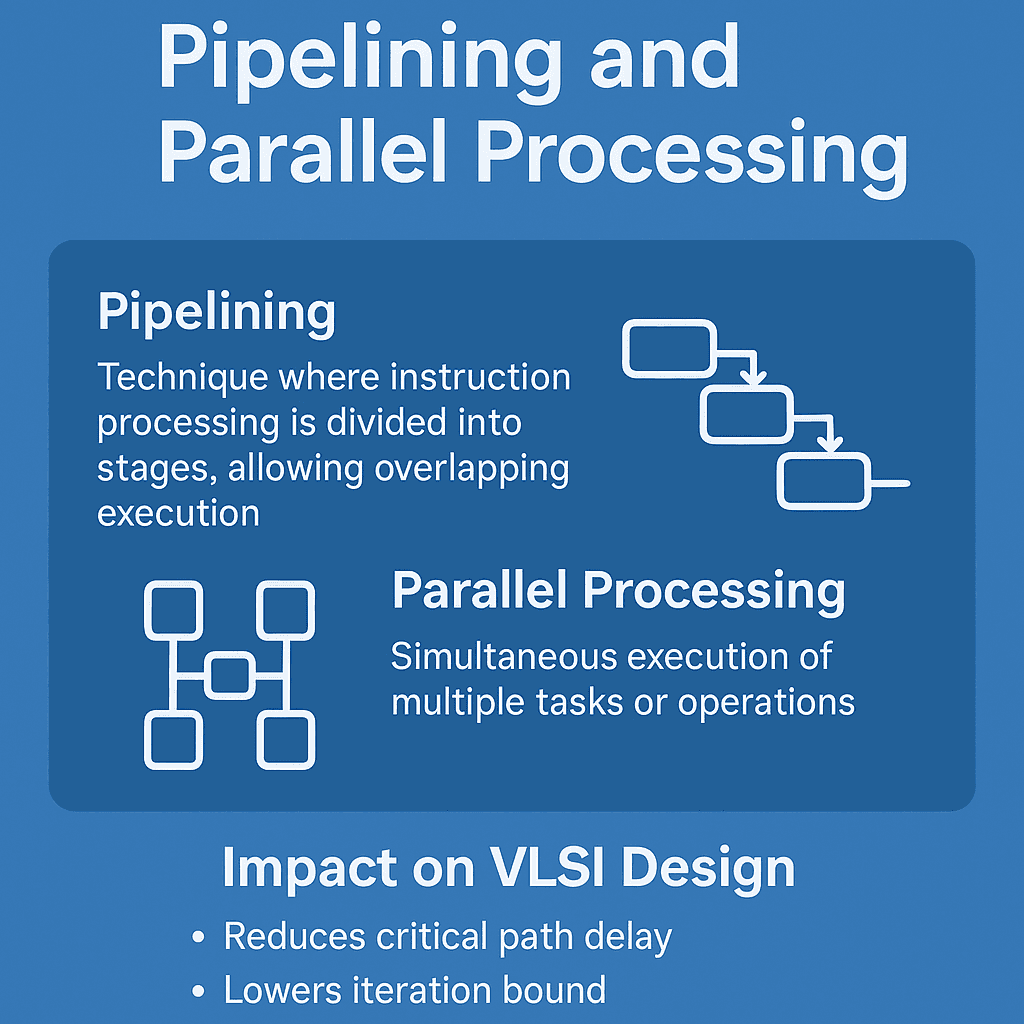
Pipelining and Parallel Processing Impact (Generated with AI)
Today’s systems often combine both pipelining and parallel processing. Modern CPUs use deep pipelines for faster instruction handling, while GPUs and accelerators employ thousands of cores for massive parallelism. The integration of these techniques is crucial in fields such as real-time signal processing, artificial intelligence, and high-performance computing.
Flynn, Michael J., and Wayne Luk. Computer System Design: System-on-Chip. Chichester: Wiley, 2011.
Hennessy, John L., and David A. Patterson. Computer Architecture: A Quantitative Approach. 6th ed. San Francisco: Morgan Kaufmann, 2019.
MIT OpenCourseWare. 6.004 Computation Structures (Spring 2017), Lecture 15: Pipelining the Beta. Massachusetts Institute of Technology. Accessed July 9, 2025. https://ocw.mit.edu/courses/6-004-computation-structures-spring-2017/pages/c15/.
MIT OpenCourseWare. 6.004 Computation Structures (Spring 2017), Lecture 21: Parallel Processing. Massachusetts Institute of Technology. Accessed July 9, 2025. https://ocw.mit.edu/courses/6-004-computation-structures-spring-2017/pages/c21/.
Parhi, Keshab K. VLSI Digital Signal Processing Systems: Design and Implementation. New York: Wiley, 1999.
Terman, Chris. MIT OpenCourseWare, “MIT 6.004 L15: Introduction to Pipelining.” Lecture video, Computation Structures, course 6.004, Spring 2017. Published on YouTube, approximately 8 Jul 2017. Accessed July 4, 2025.
Yalçın, Müştak Erhan. ELE 617 VLSI Digital Signal Processing Systems: Week 5 – Pipelining and Parallel Processing. Istanbul Technical University. Accessed July 9, 2025. https://web.itu.edu.tr/yalcinmust/ele617.html

Pipelining & Parallel Processing (Generated with AI)
Definition(s) | Techniques that improve performance by overlapping or parallelizing instruction execution | ||||||||
|---|---|---|---|---|---|---|---|---|---|
Key Concepts | Pipelining, Parallel Processing | ||||||||
Parallelism Types | ILP: Instruction-Level, DLP: Data-Level, TLP: Task-Level | ||||||||
Used In | Microprocessors, DSPs , AI Accelerators, GPUs | ||||||||
Design Impact | Reduces Critical Path Delay, Lowers Iteration Bound, Enables Real-time & High-throughput Systems | ||||||||
Henüz Tartışma Girilmemiştir
"Pipelining and Parallel Processing" maddesi için tartışma başlatın
Pipelining
Parallel Processing
Understanding Critical Path and Iteration Bound
Impact on VLSI Design: Critical Path and Iteration Bound
Applications
Advantages and Challenges
Advantages
Challenges
Modern Use and Trends
Bu madde yapay zeka desteği ile üretilmiştir.