
Bu içerik Türkçe olarak yazılmış olup yapay zeka ile otomatik olarak İngilizceye çevrilmiştir.
+1 Daha
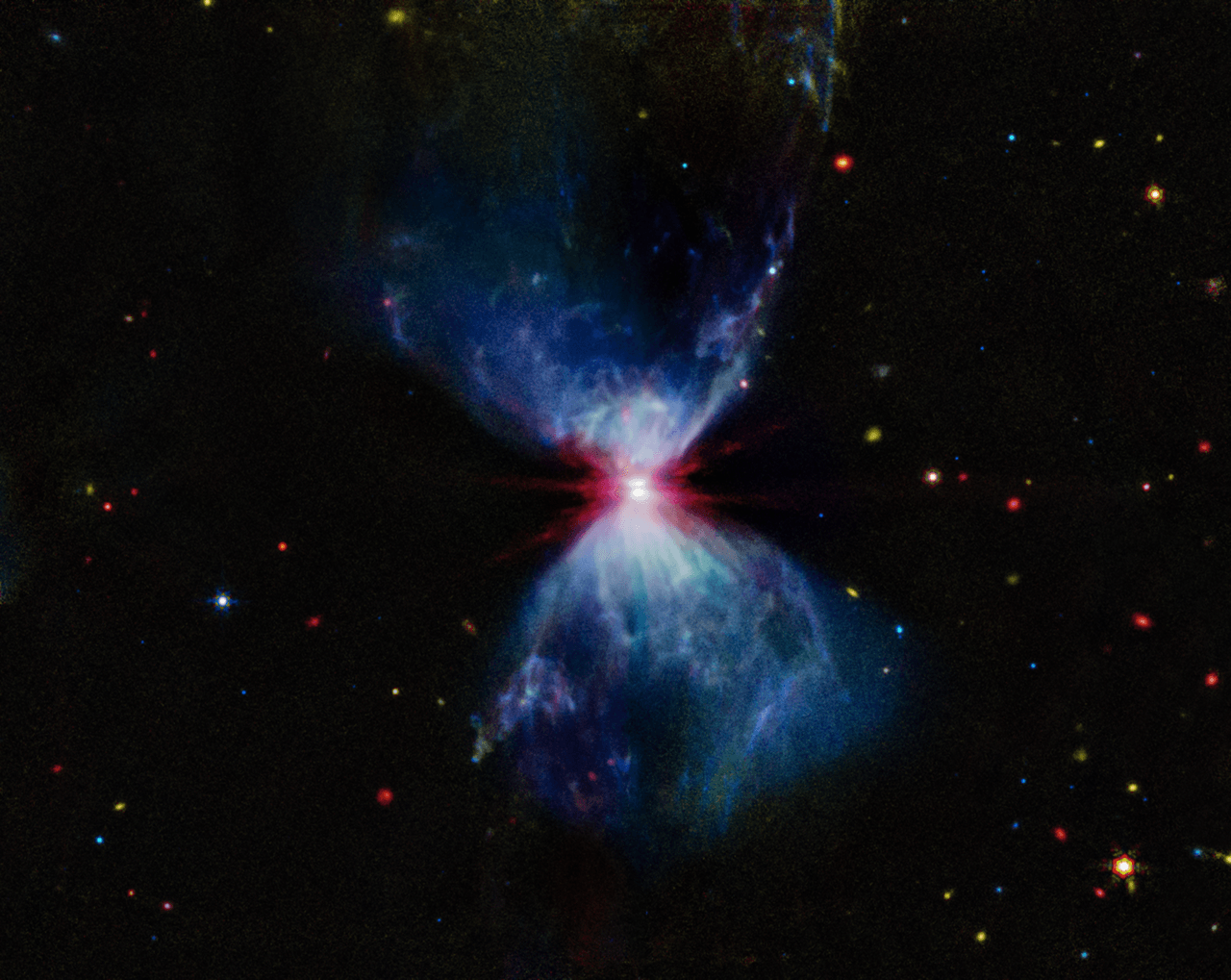
Protostar (Pre-star) is a celestial body formed by the gravitational collapse of a dense core composed of gas and dust during the early stage of star formation, in which nuclear fusion reactions have not yet begun in its center.【1】 The structure at this stage has not yet transitioned into a stable energy production process through hydrogen nuclei converting into helium; however, temperature and density continue to increase. A protostar emits energy primarily through gravitational contraction and the infall of surrounding material. Due to its location within dense molecular gas and dust clouds, direct detection in visible light is often impossible, and infrared wavelengths are the primary method of investigation.
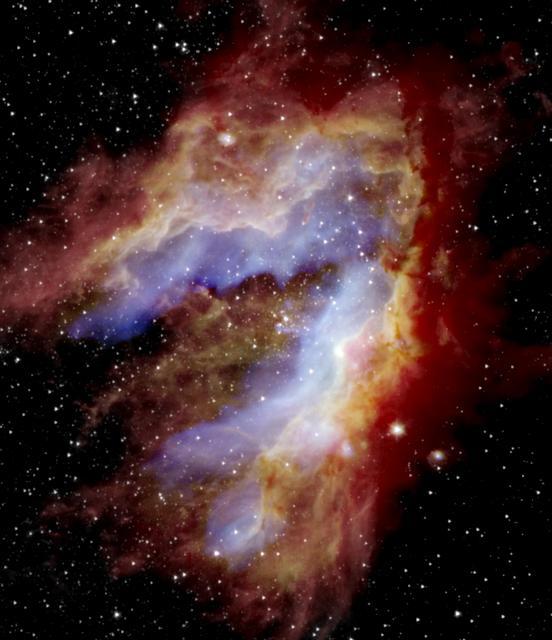
Protostar (NASA)
Star formation begins with the gravitational collapse of dense regions within vast molecular gas and dust clouds in space. During this process, matter accumulates at the cloud’s center, increasing temperature and pressure. As the collapse progresses, the condensing core enters the protostar phase.
Although the central temperature has risen during the protostar phase, nuclear fusion has not yet begun. Therefore, energy production arises not from hydrogen fusion but from the gravitational contraction of the core and the accretion of surrounding material through an accretion disk. Once fusion initiates, the celestial body transitions into the main sequence star phase.【2】
A disk structure composed of gas and dust rotating around the protostar. It forms in a planar configuration due to the conservation of angular momentum. The disk enables continuous delivery of material to the protostar and is the primary mechanism for mass increase. Scientific studies have revealed prominent disk structures supported by rotational motion in some protostar systems.
A layer of gas and dust surrounding the protostar over a broader region. Observations have shown that the envelope’s mass decreases and its distribution changes during protostar development. This evolution is considered one of the key indicators of protostar evolution.
Infrared observations have identified cavity-like regions above and below protostars. These structures become visible when outflows from the center disperse surrounding dust and allow light to escape through these channels. These cavities play a crucial role in understanding the three-dimensional structure of the system.
The total radiative power and bolometric temperature of protostars vary widely across a broad range. Analysis of spectral energy distributions has revealed distinct emission profiles among different protostar groups. These data enable comparison of evolutionary stages.
The Class 0 protostar phase is one of the earliest developmental stages. Objects in this phase are embedded within dense gas and dust envelopes and actively accrete material from their surroundings. The envelope mass is high, and observations are predominantly conducted in infrared wavelengths. This stage is critical for understanding the initial dynamics of star formation.
The primary reason protostars cannot be detected in visible light is the absorption of light by dense dust clouds surrounding them. Infrared telescopes exploit wavelengths that penetrate these dust layers to reveal the structural properties of protostars. Images obtained from space telescopes have clearly revealed details such as disk structures, dust density distributions, and patterns of light scattering.【3】
Regular or irregular brightness increases have been detected in some protostar systems. These events are associated with sudden flows of material from the accretion disk toward the core. Brightness variations indicate that mass accretion in protostars may occur intermittently and that radiative output can increase sharply over short time intervals.【4】
L1527 is an example of a protostar located within a dense molecular cloud and studied in detail through infrared observations. This system exhibits a rotationally supported disk structure and a prominent envelope. Infrared telescope images have revealed the distribution of gas and dust around the disk, the cavities opened above and below, and the manner in which light is scattered by dust. These observations confirm that L1527 is an early-stage Class 0 protostar with nuclear fusion not yet initiated in its center.

Protostar in L1527 (NASA)
HOPS 383 is a young protostar located in the Orion star-forming region and notable for its pronounced brightness variations. Infrared observations from space telescopes have shown that these brightness changes are linked to sudden flows of surrounding gas and dust toward the core. This indicates that accretion processes in protostars can experience intermittent disruptions.
Some protostar studies have detected periodic light bursts and strobe-like brightness variations. Such behavior is sometimes associated with the presence of binary star systems. Orbital interactions may cause periodic acceleration of material flows from the disk toward the stars, resulting in observable changes in radiation output. This demonstrates that the protostar phase is not only structurally complex but also dynamically intricate.
[1]
Sarıgül, Tuba, “Bir Yıldızın Doğumuna Tanıklık Etmek.” Bilim Genç (TÜBİTAK). Access Date: 6 February 2026.https://bilimgenc.tubitak.gov.tr/makale/bir-yildizin-dogumuna-taniklik-etmek
[2]
Tobin, John J., Lee Hartmann, Hsin‑Fang Chiang, David J. Wilner, Leslie W. Looney, Laurent Loinard, Nuria Calvet ve Paola D’Alessio. “A 0.2 Solar Mass Protostar with a Keplerian Disk in the Very Young L1527 IRS System (Preprint).” arXiv (Cornell University). 2012. Access Date: 6 February 2026. https://arxiv.org/abs/1212.0861
[3]
NASA, “NASA’s Webb Catches Fiery Hourglass as New Star Forms,” Access Date: 6 February 2026, https://science.nasa.gov/missions/webb/nasas-webb-catches-fiery-hourglass-as-new-star-forms/
[4]
NASA Jet Propulsion Laboratory, “NASA Satellites Catch a ‘Growth Spurt’ from a Newborn Protostar,” Access Date: 6 February 2026, https://www.jpl.nasa.gov/news/nasa-satellites-catch-a-growth-spurt-from-a-newborn-protostar/

Henüz Tartışma Girilmemiştir
"Protostar" maddesi için tartışma başlatın
Formation Process and Physical Mechanism
Molecular Cloud Collapse
Energy Production Mechanism
Structural Components
Accretion Disk
Envelope
Polar Outflows
Physical Properties and Classification
Bolometric Temperature and Emission
Class 0 Phase
Observed Characteristics
Infrared Observation Methods
Brightness Variations and Accretion Events
Example Protostar Systems
L1527 Protostar
HOPS 383 Protostar
Dynamic Behavior and Binary System Possibility