


Bu içerik Türkçe olarak yazılmış olup yapay zeka ile otomatik olarak İngilizceye çevrilmiştir.
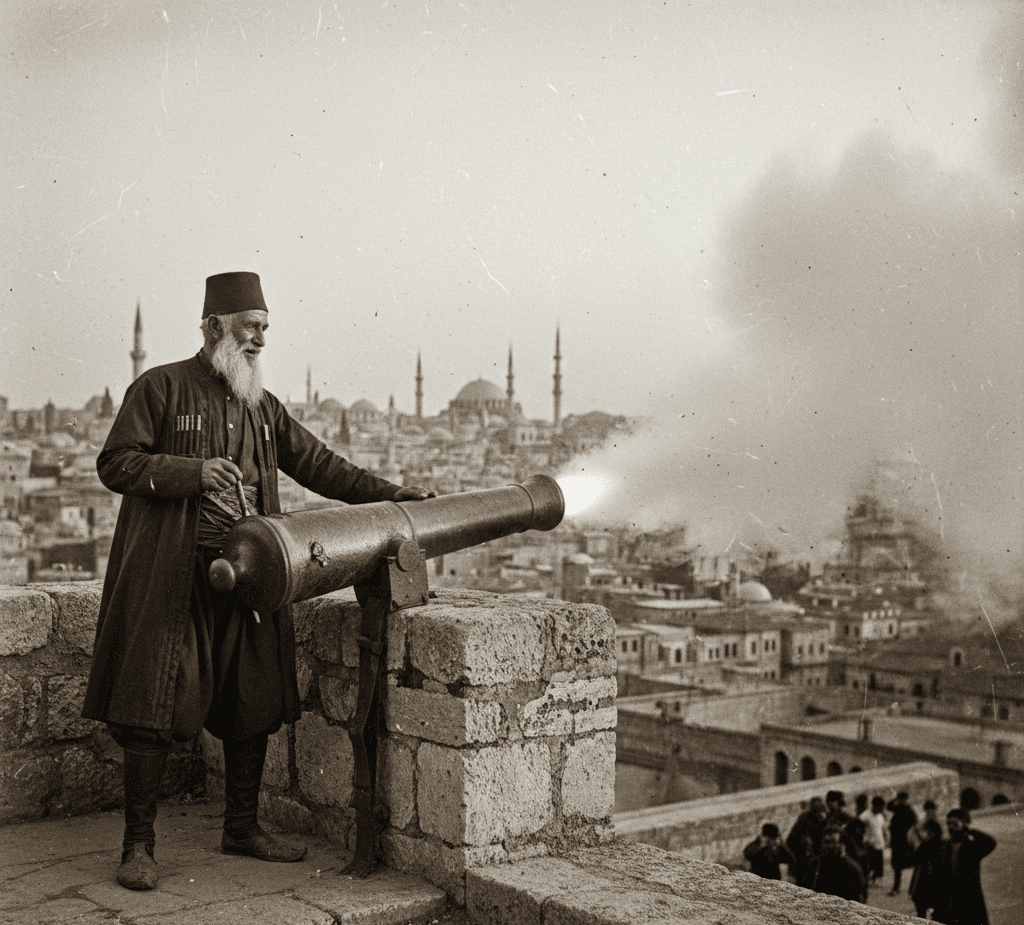
Ramazan Topu (Yapay Zeka ile Oluşturulmuştur.)
Ramadan cannon is a traditional practice of firing a cannon to announce the times of iftar and suhur to the public, especially during the month of Ramadan. In an era when clocks, city time signals, radio, and similar communication tools were not widespread, it served as a functional method to convey a precise and simultaneous time signal to large populations. Over time, it acquired a symbolic character in many countries and became an element of religious and cultural heritage.
There are various accounts regarding the origin of the Ramadan cannon. Some historians trace the practice to the period of the Mamluk ruler Sayf al-Din Huskadam in the 15th century. According to one narrative, the test firing of a newly cast cannon coincided with the time of the evening prayer; the public interpreted this as a signal for iftar, and the practice became customary.【1】
The most widely accepted account holds that the tradition began in the 19th century during the rule of Kavalalı Muhammad Ali Pasha, the Ottoman governor of Egypt and founder of modern Egypt. According to this narrative, a test firing of a cannon built for military purposes coincided with the time of iftar; the people of Cairo regarded it as an official signal for breaking the fast, and the practice was adopted.【2】

A Visual Depicting the Historical Development and Origins of the Ramadan Cannon (Generated by Artificial Intelligence)
Another account links the tradition to the late 19th century during the reign of Khedive Ismail Pasha. According to this version, after a test firing at sunset, Ismail’s daughter Fatima ordered the practice to continue; as a result, the cannon became known among the people as “Fatima’s Cannon” (al-hājja Fāṭima).【3】
In the Ottoman Empire, the regular practice of cannon firing began during the reign of Sultan Mustafa III, and was expanded during the reign of Mahmud II (1835) on the occasion of Mawlid Kandili.【4】
The Ramadan cannon practice, widely accepted as having become common in Egypt during the 19th century, extended to the Levant, Istanbul, and the Balkans. Later, it was adopted in Mecca and Medina, and subsequently in the Gulf region. Kuwait is recognized as the first Gulf country to adopt this tradition.【5】 Cannons first fired in Anatolia at Anadolu Hisarı subsequently echoed in Ankara, Maraş, and other provinces.【6】 In the capital Istanbul, cannon fire was launched from six distinct locations: Serasker Gate, Selimiye, Tophane, Baruthane, İcadiye, and the Utarit barracks ship.【7】
Today, the practice continues in various forms in many Muslim countries including Saudi Arabia, the United Arab Emirates, Qatar, Bahrain, Yemen, Jordan, Syria, Kuwait, Türkiye, Bangladesh, Malaysia, and Senegal. In Gulf countries, the practice has taken on a ceremonial character; in some places modern howitzers are used, while in others traditional muzzle-loading cannons are retained.
In Jerusalem, a 75 mm American-made howitzer gifted to local Muslim authorities in 1945 was used for many years as a Ramadan cannon; after difficulties in obtaining gunpowder, the system was replaced with pyrotechnic signals. In Sarajevo, Bosnia and Herzegovina, cannon firings from Žuta Tabija Fortress were banned during the communist era but were revived from the 1990s onward.【8】
In the Ottoman State, the use of cannon fire for religious timekeeping became systematic in the 19th century. It is recorded that the first cannon firing occurred in 1835 during the reign of Mahmud II on the occasion of Mawlid Kandili, with five shots fired at each of the five daily prayer times from evening prayer until the following afternoon.【9】
During the reign of Mustafa IV, cannon firings at iftar and suhur times were carried out at Rumeli Hisarı and Yedikule; the regular practice of cannon firing at iftar and suhur times was institutionalized during the reign of Mustafa III. It is stated that the first regular Ramadan cannon was fired at Anadolu Hisarı, after which the practice was adopted in other centers such as Ankara, Maraş, Shkodra, and Acre.【10】
Cannon firings were conducted by military units, with experienced soldiers assigned to the task and durable military cannons employed. The establishment of Tophane-i Âmire and the organization of the Artillery Regiment indicate that the practice had acquired an institutional framework.
In the capital, iftar cannons were fired from six locations: Serasker Gate, Selimiye, Tophane, Baruthane, İcadiye, and the Utarit barracks ship. As clocks were not present in homes and city clock towers were not widespread, cannon firing was preferred as a low-cost method that could be heard simultaneously by everyone.
However, accidents occasionally occurred. After a cannonball fired from a tower on the first day of a holiday killed a person in Acre, an investigation was launched; although intent was ruled out, negligence was found and those responsible were punished. Following such negative incidents, some places decided to replace cannons with rifles or fireworks.【11】

The Ramadan Cannon Tradition, Banned During the Former Yugoslavia Era in Bosnia and Herzegovina, Was Revived After the Bosnian War (1992–1995) (Anadolu Ajansı)
In an era before the widespread use of clocks and modern communication tools, the Ramadan cannon was adopted as a practical and effective method to announce iftar and suhur times simultaneously to large populations. Durable cannons from military inventories were used. Equipment varied by region; for example, British-made 25-pound howitzers are used in Dubai, while German Krupp 75 mm field guns from 1904 are preferred in Cairo.【12】
Military weapons used during the First World War or local conflicts began to be employed for timekeeping within this tradition. Although banned in certain periods for security reasons or under political pressure—for example, in communist-era Bosnia—communities resumed the practice. Especially among children, the anticipated cannon fire continues to carry symbolic meaning even today, despite advances in technology. Although in some places rifles or fireworks replaced cannons due to past accidents caused by negligence, the sound of cannon fire fired from fortress ramparts or city squares remains identified as one of the defining traditions of Ramadan.
Anadolu Ajansı. "Eski ramazanları yeniden yaşatıyor." Accessed February 17, 2026. https://www.aa.com.tr/tr/ramazan-2018/saraybosnanin-ramazan-topcusu-eski-ramazanlari-yeniden-yasatiyor/1164211
Bezci, Gül. "Osmanlı Toplumunda Ramazan Kültürü / Ramazan Culture in the Ottoman Society." Master's thesis,Dumlupınar Üniversitesi, Institute of Social Sciences, pp. 197. Accessed February 17, 2026. https://tez.yok.gov.tr/UlusalTezMerkezi/TezGoster?key=fS4sqEZr79C_n60Rk6MjFTN0W9PYFu8QDBwRZZzI8tM9wbXtKWhM3lHSZwf7jQP3
GZT. "Bir Ramazan ayı geleneği: İftar topu." GZT. Accessed February 17, 2026. https://www.gzt.com/foto-galeri/dunya/bir-ramazan-ayi-gelenegi-iftar-topu-2036903
Sayadi, Ömer. "A Brief History of the Ramadan Cannon." *Ultima Ratio Project*. Accessed February 17, 2026. https://ultimaproject.org/2020/06/05/a-brief-history-of-the-ramadan-cannon/
Çakır, Emine. "Efemera Olarak Ramazan İmsakiyeleri." 10th International Congress of Turkish Folk Culture – General Topics. General Directorate of Living Heritage and Cultural Activities, Ministry of Culture and Tourism of the Republic of Türkiye. Accessed February 17, 2026. https://www.academia.edu/126778449/EFEMERA_OLARAK_RAMAZAN_%C4%B0MSAK%C4%B0YELER%C4%B0
[1]
Ömer Sayadi, "A Brief History of the Ramadan Cannon" Ultima Ratio Project, Erişim 17 Şubat 2026, https://ultimaproject.org/2020/06/05/a-brief-history-of-the-ramadan-cannon/.
[2]
Ömer Sayadi, "A Brief History of the Ramadan Cannon" Ultima Ratio Project, Erişim 17 Şubat 2026, https://ultimaproject.org/2020/06/05/a-brief-history-of-the-ramadan-cannon/.
[3]
GZT, "Bir Ramazan ayı geleneği: İftar topu" GZT, Erişim 17 Şubat 2026, https://www.gzt.com/foto-galeri/dunya/bir-ramazan-ayi-gelenegi-iftar-topu-2036903.
[4]
Gül Bezci, "Osmanlı Toplumunda Ramazan Kültürü / Ramazan Culture in the Ottoman Society" (Yüksek Lisans Tezi, Dumlupınar Üniversitesi, Sosyal Bilimler Enstitüsü, sayfa 75, Erişim 17 Şubat 2026, https://tez.yok.gov.tr/UlusalTezMerkezi/TezGoster?key=fS4sqEZr79C_n60Rk6MjFTN0W9PYFu8QDBwRZZzI8tM9wbXtKWhM3lHSZwf7jQP3.
[5]
GZT, "Bir Ramazan ayı geleneği: İftar topu" GZT, Erişim 17 Şubat 2026, https://www.gzt.com/foto-galeri/dunya/bir-ramazan-ayi-gelenegi-iftar-topu-2036903.
[6]
Gül Bezci, "Osmanlı Toplumunda Ramazan Kültürü / Ramazan Culture in the Ottoman Society" (Yüksek Lisans Tezi, Dumlupınar Üniversitesi, Sosyal Bilimler Enstitüsü, sayfa 76, Erişim 17 Şubat 2026, https://tez.yok.gov.tr/UlusalTezMerkezi/TezGoster?key=fS4sqEZr79C_n60Rk6MjFTN0W9PYFu8QDBwRZZzI8tM9wbXtKWhM3lHSZwf7jQP3.
[7]
Gül Bezci, "Osmanlı Toplumunda Ramazan Kültürü / Ramazan Culture in the Ottoman Society" (Yüksek Lisans Tezi, Dumlupınar Üniversitesi, Sosyal Bilimler Enstitüsü, sayfa 76, Erişim 17 Şubat 2026, https://tez.yok.gov.tr/UlusalTezMerkezi/TezGoster?key=fS4sqEZr79C_n60Rk6MjFTN0W9PYFu8QDBwRZZzI8tM9wbXtKWhM3lHSZwf7jQP3.
[8]
Ömer Sayadi, "A Brief History of the Ramadan Cannon" Ultima Ratio Project, Erişim 17 Şubat 2026, https://ultimaproject.org/2020/06/05/a-brief-history-of-the-ramadan-cannon/.
[9]
Gül Bezci, "Osmanlı Toplumunda Ramazan Kültürü / Ramazan Culture in the Ottoman Society" (Yüksek Lisans Tezi, Dumlupınar Üniversitesi, Sosyal Bilimler Enstitüsü, sayfa 75, Erişim 17 Şubat 2026, https://tez.yok.gov.tr/UlusalTezMerkezi/TezGoster?key=fS4sqEZr79C_n60Rk6MjFTN0W9PYFu8QDBwRZZzI8tM9wbXtKWhM3lHSZwf7jQP3.
[10]
Gül Bezci, "Osmanlı Toplumunda Ramazan Kültürü / Ramazan Culture in the Ottoman Society" (Yüksek Lisans Tezi, Dumlupınar Üniversitesi, Sosyal Bilimler Enstitüsü, sayfa 76, Erişim 17 Şubat 2026, https://tez.yok.gov.tr/UlusalTezMerkezi/TezGoster?key=fS4sqEZr79C_n60Rk6MjFTN0W9PYFu8QDBwRZZzI8tM9wbXtKWhM3lHSZwf7jQP3.
[11]
Gül Bezci, "Osmanlı Toplumunda Ramazan Kültürü / Ramazan Culture in the Ottoman Society" (Yüksek Lisans Tezi, Dumlupınar Üniversitesi, Sosyal Bilimler Enstitüsü, sayfa 76, Erişim 17 Şubat 2026, https://tez.yok.gov.tr/UlusalTezMerkezi/TezGoster?key=fS4sqEZr79C_n60Rk6MjFTN0W9PYFu8QDBwRZZzI8tM9wbXtKWhM3lHSZwf7jQP3.
[12]
Ömer Sayadi, "A Brief History of the Ramadan Cannon" Ultima Ratio Project, Erişim 17 Şubat 2026, https://ultimaproject.org/2020/06/05/a-brief-history-of-the-ramadan-cannon/.


Ramazan Topu (Yapay Zeka ile Oluşturulmuştur.)
Henüz Tartışma Girilmemiştir
"Ramazan Topu" maddesi için tartışma başlatın
Historical Development and Origins
Spread Across the Islamic World
Ramadan Cannon in the Ottoman State
Social Function and Technical Features
Tradition and Cultural Heritage