

+2 Daha

Raspberry Pi
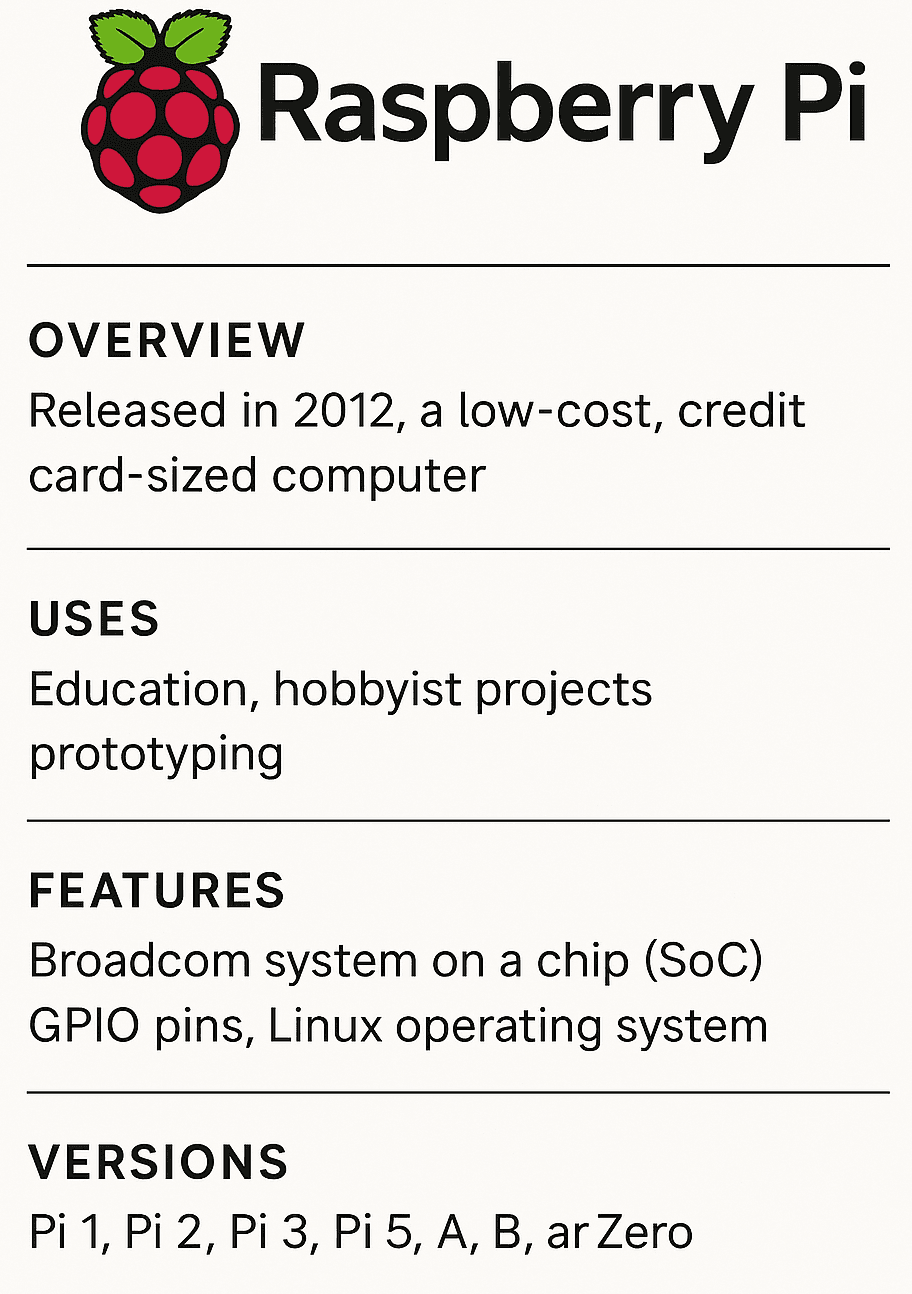
Definition(s) | Credit Card-Sized and Highly Versatile Single-Board Computer. A Low-Cost | ||||||||
|---|---|---|---|---|---|---|---|---|---|
Key Features | Compatible With Linux-Based Operating Systems USB HDMI Ethernet Ports GPIO (General Purpose Input/Output) Pins ARM-Based Processor RAM Options Ranging From 2 to 8 GB | ||||||||
Areas of Application | Facial Recognition Image Processing Automation Systems Biological Data Collection Internet of Things (IoT) Projects Computer Science Education | ||||||||
Raspberry Pi is a low-cost, compact computer platform with high potential. Developed in 2012 by the Raspberry Pi Foundation, this device offers a wide range of applications, particularly in education, research, and industry. Through its use in various projects, the device has become a practical tool for both hobbyists and professionals.
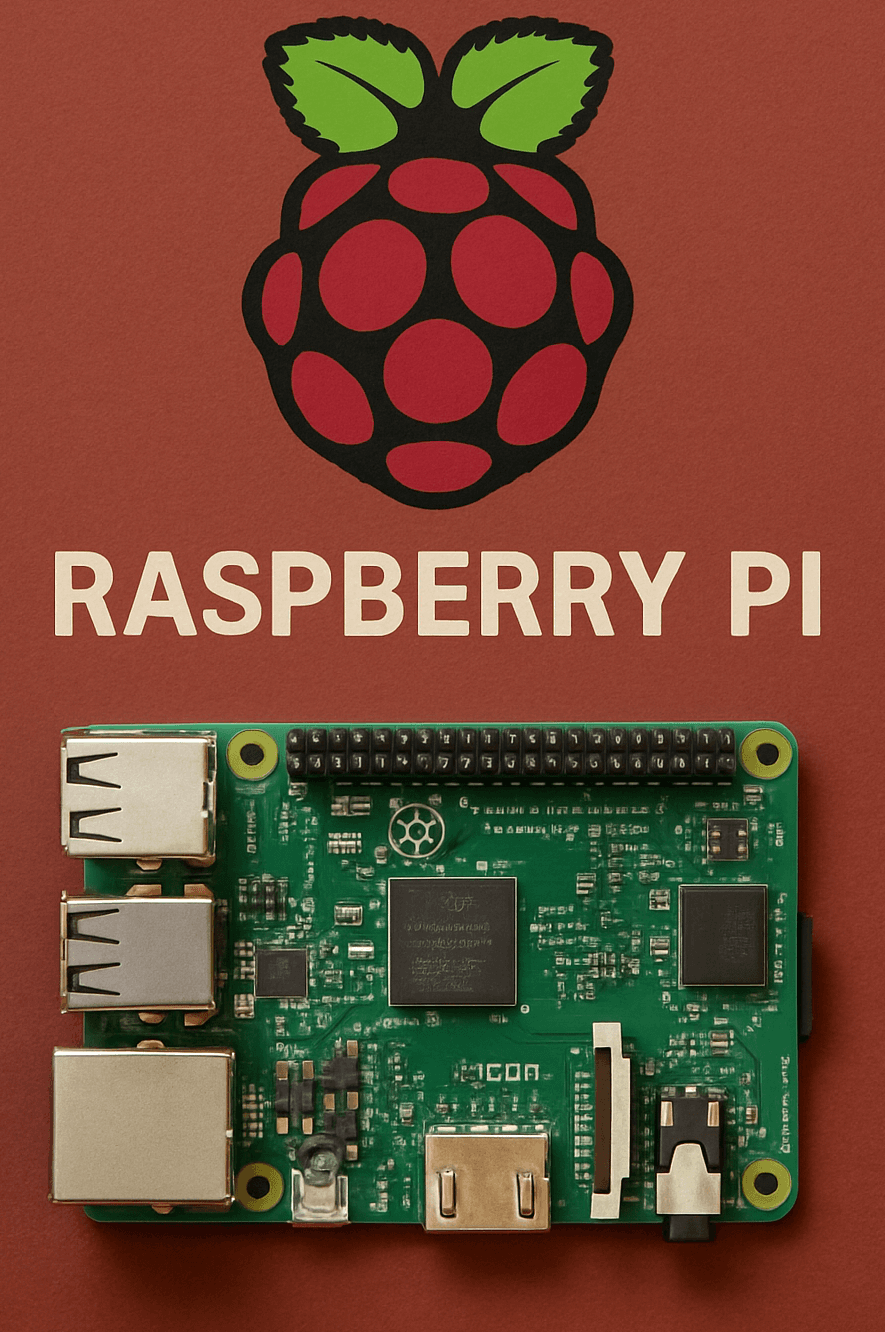
Raspberry Pi ( Generated by artificial intelligence)
The first version of the Raspberry Pi was released in 2012 and has become increasingly powerful over time. With the release of the Raspberry Pi 4 Model B in 2020, the device’s processing power improved significantly. The Raspberry Pi 4 is equipped with a quad-core ARM Cortex-A72 processor and offers different performance levels with 2GB, 4GB, or 8GB RAM options. The device is also enriched with various hardware features such as HDMI output, USB 3.0 ports, Ethernet connectivity, and GPIO pins. These features make the Raspberry Pi suitable for a wide range of applications in both software development and hardware projects.
The Raspberry Pi was originally designed as an education-oriented device, and it continues to serve this purpose. It is particularly significant as a tool for teaching programming and computer science. Şahin et al. (2020) noted that the Raspberry Pi provides an effective means of introducing young students to software development and hardware integration. Its affordability, ease of access to learning materials, and compatibility with open-source software make it a preferred tool in educational contexts. Additionally, its internet connectivity and multiple input/output pins enable educators to engage students through creative, project-based learning activities.
The applications of the Raspberry Pi extend beyond the educational sphere and into industrial contexts. For instance, Cox (2012) highlighted the use of Raspberry Pi in supercomputing projects by integrating it with Lego components, demonstrating its flexibility and cost-effective hardware capabilities. Moreover, the Raspberry Pi is widely employed in Internet of Things (IoT) projects. Hosny et al. (2023) reported that the device is used in tasks such as collecting sensor data, connecting to networks, and transmitting information between devices. Its low power consumption and portability make it particularly well-suited for field applications.
Raspberry Pi also holds significant potential in the fields of biotechnology and healthcare. Jolles (2023) indicated that the device is utilized in biological research, especially in laboratory testing and data collection systems. This demonstrates its practicality and affordability as a tool in biotechnology. Furthermore, the integration of Raspberry Pi with various sensors enables its use in healthcare projects such as environmental monitoring and patient tracking. These capabilities show that the device offers not only educational value but also practical effectiveness in real-world applications.
The future of the Raspberry Pi presents numerous possibilities. It is anticipated that upcoming models will feature increased processing power, expanded memory options, and enhanced software support. However, the Raspberry Pi still faces limitations in applications that demand high computational performance. To address these challenges, greater integration with advanced parallel processing and cloud-based solutions is expected. Additionally, as the device becomes more prevalent, especially in IoT contexts, ensuring its security has become increasingly important. Efforts are being made to enhance its security features to mitigate vulnerabilities associated with widespread deployment.
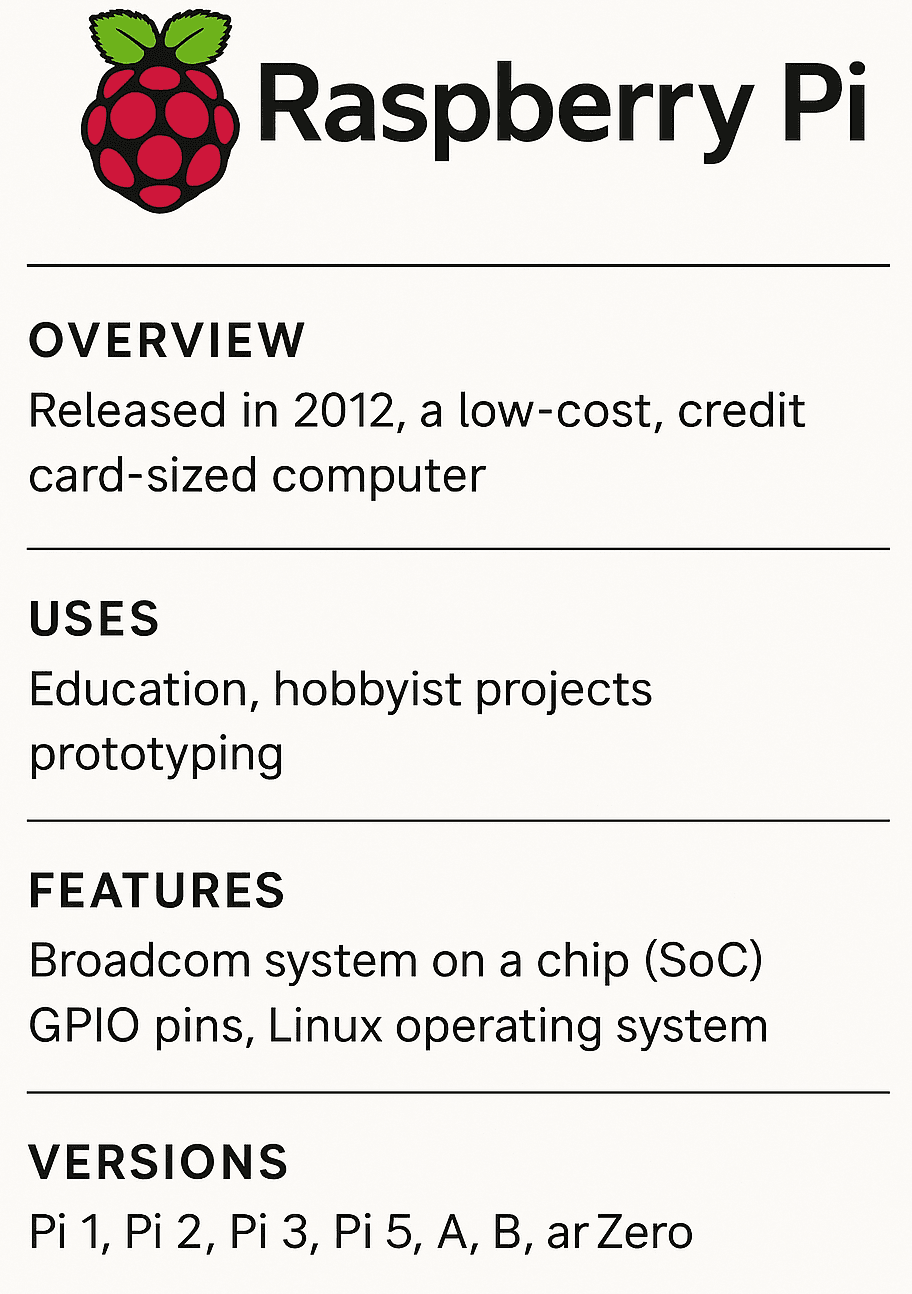
Raspberry Pi ( Generated by artificial intelligence)
Raspberry Pi, with its low cost and versatile usage capabilities, holds significant potential across various fields such as education, industry, research, and healthcare. Developers and researchers are pushing the boundaries of the device by employing it in creative projects and developing novel solutions. In the future, the potential of the Raspberry Pi is expected to expand further with the integration of more powerful hardware and software solutions. Beyond being merely a computer, the Raspberry Pi will continue to serve as a powerful tool for technological engagement and a starting point for innovative projects.
Balcı, Mehmet, and Uğur Yüzgeç. 2018. “Development of an Environmental Monitoring System Using Raspberry Pi Mini Computer.” Paper presented at the International Eurasian Conference on Science, Engineering and Technology. Accessed May 27, 2025. https://acikkaynak.bilecik.edu.tr/xmlui/handle/11552/1833.
Cox, Simon. 2012. “Wanna Build a Supercomputer? You'll Need Legos and Raspberry Pis...” Wired, September 2012. Accessed May 27, 2025. https://www.wired.com/2012/09/lego-super-gallery.
Hosny, Khalid M., Ahmed A. Fattah, Marwa S. Mohsen, and Heba F. Wanas. 2023. “Internet of Things Applications Using Raspberry-Pi: A Survey.” International Journal of Electrical and Computer Engineering 13 (1): 902–910. https://doi.org/10.11591/ijece.v13i1.pp902-910. Accessed May 27, 2025.
Jolles, Jolle. 2023. “Raspberry Pi: A Versatile Tool for Biological Sciences.” Raspberry Pi. Accessed May 27, 2025. https://www.raspberrypi.com/news/raspberry-pi-a-versatile-tool-for-biological-sciences/.
Mathe, Sudha Ellison, Srinivasan Natarajan, Vaibhav Joshi, and Subhamay Gangopadhyay. 2024. “A Comprehensive Review on Applications of Raspberry Pi.” Computer Science Review 52: 100636. https://doi.org/10.1016/j.cosrev.2024.100636. Accessed May 27, 2025.
Öziş, Hilal, İsmet Kandilli, and Melih Kuncan. 2020. “Face Recognition System Using Raspberry Pi.” Paper presented at the 4th International Zeugma Conference on Scientific Researches. Accessed May 27, 2025. https://acikerisim.siirt.edu.tr/server/api/core/bitstreams/0e311171-1ace-4f73-9382-2c139ea9551b/content.
Sağlam, Ali, Melike Taş, and Nurdan Baykan. 2020. “Development of Raspberry Pi-Based Hardware for Classification of Recyclable Waste by Material Type.” European Journal of Science and Technology 20: 593–598. Accessed May 27, 2025. https://dergipark.org.tr/tr/pub/ejosat/issue/56959/802692.
Şahin, Ayşenur, Sevcan Çil, and Ayhan İstanbullu. 2020. “Driver Fatigue Detection and Warning System with Raspberry Pi 4.” Journal of Science, Technology and Engineering Research 1 (1): 8–13. Accessed May 27, 2025. https://dergipark.org.tr/tr/pub/jster/issue/55055/746795.

Raspberry Pi
Definition(s) | Credit Card-Sized and Highly Versatile Single-Board Computer. A Low-Cost | ||||||||
|---|---|---|---|---|---|---|---|---|---|
Key Features | Compatible With Linux-Based Operating Systems USB HDMI Ethernet Ports GPIO (General Purpose Input/Output) Pins ARM-Based Processor RAM Options Ranging From 2 to 8 GB | ||||||||
Areas of Application | Facial Recognition Image Processing Automation Systems Biological Data Collection Internet of Things (IoT) Projects Computer Science Education | ||||||||
Henüz Tartışma Girilmemiştir
"Raspberry Pi" maddesi için tartışma başlatın
Key Features of the Raspberry Pi
The Role of Raspberry Pi in Education
Applications in Industry and Research
Applications in Biotechnology and Healthcare
Future Developments and Challenges
Bu madde yapay zeka desteği ile üretilmiştir.