
Bu içerik Türkçe olarak yazılmış olup yapay zeka ile otomatik olarak İngilizceye çevrilmiştir.
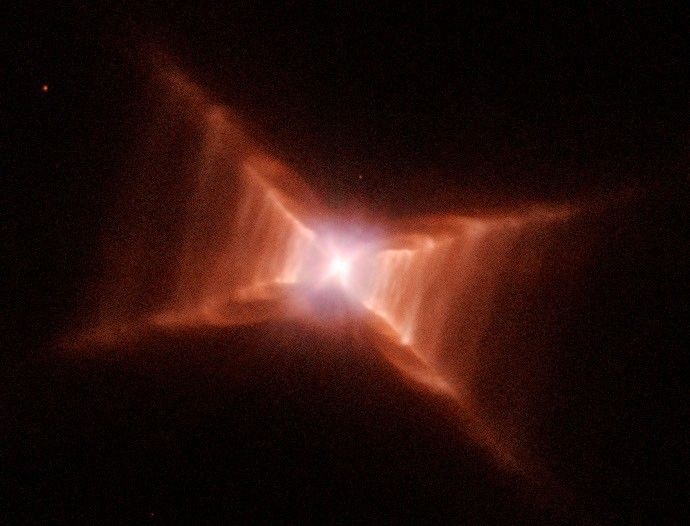
The Red Rectangle Nebula (HD 44179) is a reflection nebula noted for its distinctive shape and reddish hue, located in the direction of the Monoceros (Unicorn) constellation. This object, centered on the star HD 44179, is commonly referred to as the "Red Rectangle" due to its predominantly symmetric and rectangular-like appearance. First discovered in 1973, the nebula has gained significant importance in astrophysical research because of its unusual morphology and chemical composition.

The Red Rectangle Nebula (NASA)
The Red Rectangle Nebula is a nebula in the pre-planetary nebula phase, located approximately 2,300 light years (about 700 parsecs) from Earth. Its central star system, HD 44179, is a binary system composed of an A-type main-sequence star and a post-asymptotic giant branch (post-AGB) star. The gas and dust structures formed by past mass ejections from this system have played a key role in shaping the nebula’s morphological features.
The apparent width of the nebula is measured at approximately 1.5 arcseconds; however, when including its faint outer structures, this value can extend up to 10 arcseconds. Its true physical dimensions are estimated to be on the scale of several light years. Spectral observations reveal strong emission features in the near-infrared (NIR) and mid-infrared (MIR) wavelengths, in addition to intense H-alpha (Hα) emission. The reddish appearance of the nebula is associated with infrared radiation emitted by polycyclic aromatic hydrocarbon (PAH) molecules. Past mass loss events from the HD 44179 system have produced a dense bipolar dust disk and symmetric gas outflows, which are fundamental to the formation of the nebula’s geometric structure.
The Red Rectangle Nebula possesses a sharp and symmetric rectangular shape, a rarity among celestial objects. This structure is a bipolar configuration shaped by a thick-edged dust disk surrounding HD 44179. Light emitted from the central binary star system reflects off this dust disk, creating bright "X"-like patterns along the nebula’s edges. This morphology arises from the combination of symmetric bipolar gas outflows and a dense, axially symmetric dust disk. Observations indicate that this dust disk is inclined at an angle of approximately 60 degrees.
The Red Rectangle Nebula is also notable for its chemical composition. One of its most prominent features is that it is among the first celestial objects identified to contain polycyclic aromatic hydrocarbons (PAHs). PAHs are complex carbon-based molecules of significance in organic chemistry. These molecules are excited by ultraviolet radiation from the hot central stars and are observed primarily in infrared spectral bands. Furthermore, the nebula contains an environment where both oxygen-rich and carbon-rich compounds coexist. This suggests that the central star has undergone a complex chemical evolution during its transitional evolutionary phase.
The central system of HD 44179 is in the post-AGB phase, marking the final stage of evolution for an aging star. During this phase, the star has shed its outer layers, while its core has heated up and begun to illuminate the surrounding nebula. The gravitational influence of the companion star in the system contributes to the symmetric ejection of this gas. The central dust disk is a key outcome of this process and plays a crucial role in shaping the nebula’s distinctive morphology by reflecting the system’s light.
The Red Rectangle Nebula has been extensively studied using both ground-based telescopes and space telescopes. The Hubble Space Telescope has provided high-resolution images that have revealed the nebula’s sharp geometric structure. Additionally, infrared observing instruments such as the Spitzer Space Telescope and the Infrared Space Observatory (ISO) have delivered detailed spectral data on its chemical composition.
The Red Rectangle Nebula (HD 44179) is a unique object in astrophysics due to its morphology, chemical content, and the evolutionary state of its central star system. Its symmetric structure, dense dust disks, and presence of PAH molecules have made it an important laboratory for studying both stellar evolution and the formation of organic molecules. Future observations, particularly those with higher-resolution spectroscopic data, promise to provide further insights into the dynamics and chemistry of this system.

Henüz Tartışma Girilmemiştir
"Red Rectangle Nebula (HD 44179)" maddesi için tartışma başlatın
Technical Characteristics
Morphology and Structural Features
Spectroscopic and Chemical Properties
Central Star System and Evolutionary Process
Observations and Research