

Bu içerik Türkçe olarak yazılmış olup yapay zeka ile otomatik olarak İngilizceye çevrilmiştir.
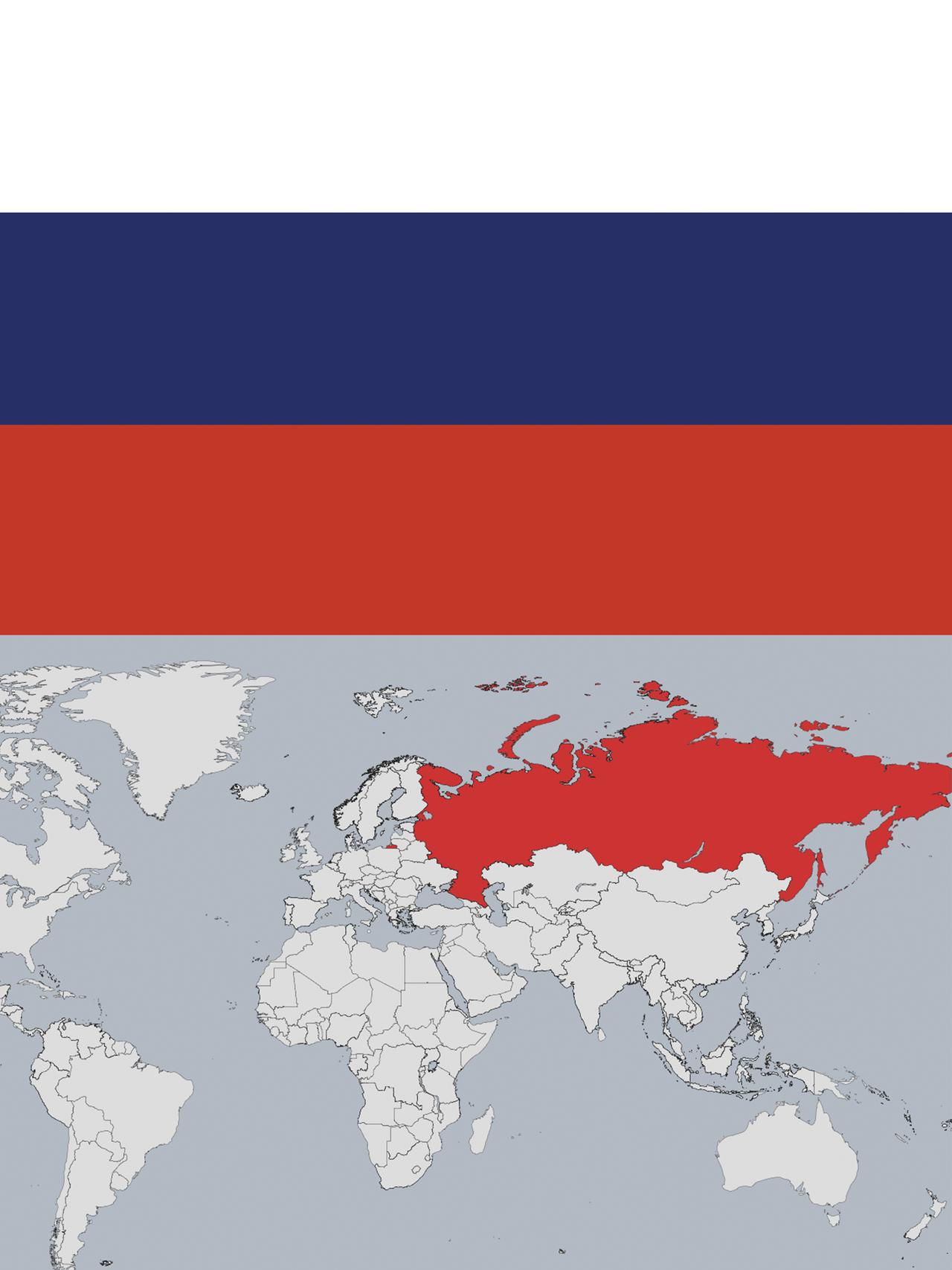
Russian Federation (Российская Федерация)
Official Language | Russian | ||||||||
|---|---|---|---|---|---|---|---|---|---|
Population | 140,820,810 (2024 estimate) | ||||||||
Area | 17,098,242 km² | ||||||||
Form of Government | Federal semi-presidential system | ||||||||
Head of State | Vladimir Vladimirovich Putin (since 7 May 2012) | ||||||||
Currency | Russian Ruble (RUB) | ||||||||
Time Zone | Russia has 11 time zones, ranging from UTC+3 to UTC+12 | ||||||||
Telephone Code | +7 | ||||||||
Internet Domain | .ru | ||||||||
GDP | 6.369 trillion USD GDP (2023) | ||||||||
GDP per Capita | 13,817.05 USD (2023) | ||||||||
Climate | Steppe climate in the south Humid continental climate in European Russia Subarctic climate in Siberia Tundra climate in the north | ||||||||
Ethnic Groups | Russian Tatar Ukrainian Bashkir Chuvash Chechen Circassian Avar Ossetian | ||||||||
Rusya Federation, spanning across Asia and Europe, is the largest country in the world by land area. With a vast territory of 17,075,400 km², Russia shares land borders with 14 countries. Its strategic location, natural wealth, and deep historical roots make it an influential actor in global politics. 【1】 The official language of the country is Russian, and its capital is Moscow. It has a federal constitutional republic structure and is governed by a presidential system. The State President holds executive power, while legislative authority rests with the Federal Assembly. 【2】
Historical phases including Tsarist Russia, the Soviet Union, and the current federal structure have shaped Russia into a nation that determines global political and economic balances. As one of the world’s richest countries in terms of natural gas, oil, and mineral reserves, it has an economy heavily reliant on the energy sector. In addition, Russia’s vast geography encompasses multiple climate zones and ecosystems, making it a country of rich biological diversity. Through advancements in industry, science, technology, and the military, Russia maintains a significant presence as a global power.

Flag and coat of arms of the Russian Federation
The Russian Federation has a population of 146.4 million, with the majority residing in European Russia. The average population density is calculated at 8.4 people per km², rising to 26.6 people per km² in European Russia and falling to as low as 1.2 people per km² in Siberia and the Pacific coast.
The level of urbanization is very high, with the vast majority of the population living in urban areas. Moscow and St. Petersburg are among the country’s largest metropolitan centers and serve as key economic, cultural, and political hubs. Major cities such as Novosibirsk, Yekaterinburg, Nizhny Novgorod, and Kazan are also significant population centers. The proportion of the population living in rural areas is steadily declining and currently accounts for approximately one-quarter of the total population.

Moscow (Photo: Astemir Almov, unsplash.com)
Following the dissolution of the Soviet Union, Russia experienced a population decline, with falling birth rates and migration contributing to population reduction since 1992. If this trend continues, a 30 percent population decline is projected by 2050.
Life expectancy varies by gender, with an average of 64.7 years for men and 76.6 years for women. Major causes of higher mortality rates among men include alcohol consumption, tobacco use, and cardiovascular diseases. Russia has implemented various policies to counteract population decline. Migration policies play an important role in managing this trend, and the state supports family programs to increase birth rates. However, low birth rates and high death rates remain insufficient to achieve population growth.
The Russian Federation is one of the world’s largest multiethnic states in terms of ethnic diversity. More than 190 ethnic groups live in the country. According to the 2010 census, 160 distinct ethnic groups reside within the Russian Federation. Russians constitute 80.9 percent of the total population, Ukrainians 1.4 percent, and Belarusians 0.4 percent, meaning that Slavic peoples make up 82.7 percent of the country’s population. The largest ethnic minority after the Slavs is a group encompassing various Turkic communities; approximately 12 million people, or 8.7 percent of the population, belong to various Turkic groups.【3】 In addition, Bashkirs, Chuvash, Chechens, Armenians, Avars, Belarusians, Kazakhs, Azerbaijanis, Kabardians, Yakuts, and Ingush are also among the country’s significant population groups.
Within Russia’s vast territory, certain regions are home to concentrated ethnic populations. The Tatar and Bashkir populations are especially concentrated in Tatarstan and Bashkortostan. The North Caucasus region hosts various ethnic groups such as Chechens, Avars, and Ingush. In Siberia, Turkic and Mongolic peoples such as the Yakuts and Buryats live.
The vast majority of ethnic groups speak Russian. In different regions, under autonomous administrations, they have the right to preserve their own languages. Russian is the official language of the country, but Tatar, Chuvash, Bashkir, Chechen, and Yakut are recognized as second official languages in regions where the respective ethnic groups are concentrated.
Ethnic and linguistic diversity has directly influenced Russia’s federal structure. The country has 21 autonomous republics. These republics are generally established in regions where a particular ethnic group predominates. Due to demographic changes and migration patterns, the populations of some minority groups have shown a declining trend over time.
The Russian Federation is a federation composed of 83 administrative units. The country consists of different types of administrative divisions as defined by its constitution: 21 republics (each with its own constitution and legislative and executive bodies), 9 krais (territories), 46 oblasts (regions), 2 cities with federal status (Moscow and Saint Petersburg), and 5 autonomous districts. Official sources list a total of 83 federal units. Each administrative unit has its own local governing bodies. The distribution of powers between the federal government and these units is regulated by law and managed to preserve the integrity of the federal system.
The President exercises significant executive authority and serves as commander-in-chief of the armed forces. The Prime Minister is responsible for the administration of the government and is appointed by the President, after which the appointment must be approved by the State Duma, the lower house of the Federal Assembly. The executive branch operates through the cabinet of ministers and various federal agencies. The legislative branch, known as the Federal Assembly, consists of two chambers: the State Duma and the Federation Council. The State Duma comprises representatives elected by the people, while the Federation Council consists of designated members from each federal unit representing their respective regions.【5】
Following the dissolution of the Soviet Union, the Russian Federation entered a process of reconfiguration on the international stage. The fundamental elements shaping its foreign policy are independence, the preservation of sovereignty, and the construction of a system based on a multipolar world order. Relations with global actors and regional powers prioritize economic cooperation, security agreements, and energy policies. While engaging in competition with Western countries, it seeks to develop strategic partnerships with China, India, the Middle East, and African nations. Through regional organizations such as the Eurasian Economic Union and the Shanghai Cooperation Organization, it strives to enhance its economic and political influence.
Russia–USA relations have followed an unstable trajectory since the end of the Cold War. Nuclear disarmament agreements such as the Strategic Arms Reduction Treaties (START I, II, III) aimed to maintain strategic balance between the two countries. However, tensions have arisen due to NATO’s eastward expansion, the Ukraine crisis, mutual sanctions, and the Syrian Civil War. Economic sanctions and military deterrence policies imposed by the USA on Russia have accelerated Moscow’s pivot toward Asia and Eurasia.
Relations between Russia and the European Union are shaped around energy, trade, and security policies. As one of Europe’s largest suppliers of natural gas and oil, Russia plays a critical role in energy supply security. Following the annexation of Crimea and the Ukraine crisis in 2014, the EU began imposing economic sanctions on Russia. The strengthening of Europe’s ties with NATO has complicated Moscow’s diplomatic relations with the EU.
Russia–China relations have deepened on the basis of economic and military cooperation. Energy trade is central to this relationship, with Russia being one of China’s largest suppliers of oil and natural gas. The close ties between Russia and China extend beyond economics into defense and technology. China is among the countries showing interest in Russia’s advanced defense technologies. The sales of the S-400 air defense system and the Su-35 fighter aircraft in the 2010s made China the first foreign customer to acquire these advanced systems from Russia.
The two countries regularly conduct joint military exercises: Chinese units occasionally participate in Russian strategic drills such as “Vostok” and “Tsentr,” while joint naval exercises under the name “Sea Cooperation” take place across regions from the Mediterranean Sea to the Sea of Japan. These activities strengthen inter-military communication. In terms of technology transfer, China benefited from Russian advisors and Soviet-era knowledge when developing its first nuclear submarine and its first crewed spacecraft.

Xi Jinping and Vladimir Putin in 2024 (Photo: President of Russia)
Cooperation in space continues to this day; in 2021, the two countries announced plans to establish a joint research base on the Moon. There is also close collaboration in the information technology and telecommunications sectors. Due to U.S. sanctions, Chinese companies such as Huawei have played a significant role in building Russia’s 5G infrastructure; Moscow has oriented itself toward constructing the majority of its 5G network using Chinese technology. China provides Russia with advanced production equipment and electronic components, while Russia supports China in areas where it excels, such as rocket engines and aircraft engines.
Cultural and educational partnerships also contribute to the soft power dimension of the relationship. In recent years, thousands of Chinese students have come to Russia for university education, while a significant number of Russian students pursue their studies at Chinese universities. Confucius Institutes in various Russian cities promote the Chinese language and culture, while institutions such as the Pushkin Institute in Beijing work to popularize the Russian language in China. U.S. sanctions policies against both countries have strategically brought Russia and China closer together.
Relations between Russia and India have historically been based on defense industry and energy cooperation. Moscow is among India’s largest arms suppliers and continues collaboration on projects such as the BrahMos missiles, Su-30 fighter jets, and nuclear reactor technology.
Russia is increasing cooperation with Kazakhstan, Kyrgyzstan, and Uzbekistan in trade, energy, and security. Kazakhstan, in particular, has developed strong economic ties with Russia within the Eurasian Economic Union and the Shanghai Cooperation Organization. In the Caucasus, Russia maintains strategic alliance relations with Armenia, while its relations with Azerbaijan and Georgia remain at a more distant level.
Relations between Türkiye and Russia have gained momentum in numerous areas—from economy to defense—since the end of the Cold War. Although they experienced ups and downs in the 1990s, a network of mutual dependence has developed since the 2000s and beyond.
In economic relations, energy and trade are the most prominent areas. As of 2023, Türkiye has become one of Russia’s largest trading partners. Türkiye imports energy resources from Russia, primarily natural gas and oil, while exporting agricultural products, textiles, and machinery to Russia. As of 2023, total trade volume between the two countries reached $55.5 billion.
One of the key energy projects between Türkiye and Russia is the TurkStream Natural Gas Pipeline. Opened on 8 January, 2020, this project enables the transport of Russian natural gas across the Black Sea to Türkiye and onward to Europe. Russia’s energy dependence on Türkiye has been strengthened through such projects, while Türkiye has become a major buyer of Russian natural gas.【6】
One of the strategic energy cooperation projects between Russia and Türkiye is the Akkuyu Nuclear Power Plant. Initiated by an agreement signed in 2010, this project will be Türkiye’s first nuclear power plant. Constructed by the Russian state nuclear corporation Rosatom, the plant will consist of four reactors with a total capacity of 4,800 megawatts. The first reactor is scheduled to enter service in 2023. Akkuyu NPP aims to enhance Türkiye’s energy supply security while simultaneously strengthening long-term strategic cooperation with Russia.

The construction of the Akkuyu Nuclear Power Plant is scheduled for 2025 (Akkuyu Nükleer ROSATOM)
The construction sector is also a vital component of economic cooperation between the two countries. Since the dissolution of the Soviet Union, Turkish construction firms have been highly active in Russia, undertaking over 2,000 projects worth a total of $102 billion between 1987 and 2023. Russia ranks as the top country where Turkish contractors have carried out the most work.
Tourism is another strong dimension of the relationship: Russia has been Türkiye’s largest source of tourists for years. The year 2019 was declared the “Turkish-Russian Culture and Tourism Year,” and during that same year a record 7.1 million Russian tourists visited Türkiye. This figure means that Russians accounted for more than 15 percent of all foreign tourists arriving in Türkiye. As of 2023, Russian tourist arrivals have approached pre-pandemic levels once again, reaching millions annually; in 2023 alone, the foreign exchange revenue generated by Russian tourists in Türkiye reached six billion US dollars.
Another aspect of human mobility involves Turkish citizens working or residing in Russia and Russian citizens settled in Türkiye. Thousands of Turks work in construction, trade and services in cities such as Moscow and St. Petersburg, while tens of thousands of Russian citizens reside permanently in Türkiye, particularly in Antalya, or own property there. This situation enhances people-to-people interactions and supports cultural rapprochement. In education and culture, the two countries strengthen their ties through university collaborations and language learning centers such as Turkology chairs in Russia and Russian Language centers in Türkiye.

Recep Tayyip Erdoğan and Vladimir Putin in 2018 (Photo: President of Russia)
Military cooperation between Türkiye and Russia has seen developments in recent years, particularly in the defense industry. Türkiye’s purchase of the S-400 air defense system from Russia has been one of the most notable aspects of the strategic military relationship between the two countries. While the Syria issue has at times created tensions in their military and security cooperation, the parties continue to maintain cooperation through diplomatic platforms such as the Astana process.
Diplomatic relations have at times experienced crises. The incident in 2015 when Türkiye shot down a Russian warplane triggered a crisis in bilateral relations. However, through diplomatic efforts, relations were restored from 2016 onward and cooperation strengthened. Today, Russia and Türkiye seek to coordinate their actions on regional issues such as Black Sea security, Middle East policies and developments in the Caucasus. Long-term energy projects such as the Akkuyu Nuclear Power Plant are among the factors reinforcing the strategic cooperation between the two countries.
Russia’s recent transformation into the country most heavily sanctioned globally has created a framework of forecast for nations at risk of facing similar global sanctions, with Türkiye being foremost among them.
In this context, Russia’s responses to sanctions serve as a valuable data source for countries that may face similar risks in the future. For nations like Türkiye, which hold an active position in global trade and energy flows, the Russian example functions as a laboratory for testing potential reactions and alternative strategies against severe sanctions.
The Russian Federation participates in numerous regional and global cooperation mechanisms. The Commonwealth of Independent States (CIS), established in 1991 following the dissolution of the Soviet Union, is a regional organization created by Russia to maintain relations with its former Soviet republics. Although the CIS operates within a framework of economic and political cooperation, it has not achieved full integration among its member states. Subsequently, in 2010, the Customs Union was established between Russia, Kazakhstan and Belarus, and in 2015 it evolved into the Eurasian Economic Union (EAEU) with the aim of strengthening regional economic integration. The EAEU continues its activities with objectives such as promoting free trade among member states, harmonizing common customs tariffs and investment policies.
In the field of regional security, Russia is one of the founding members of the Shanghai Cooperation Organization (SCO), established in 2001 together with China. Although the SCO was initially founded to address regional security and counter-terrorism, it has expanded over time to include economic cooperation and now operates with broad influence. The organization’s international significance has grown with the participation of countries such as China, India, Pakistan, Kazakhstan, Kyrgyzstan, Tajikistan and Uzbekistan. At the same time, the Collective Security Treaty Organization (CSTO), which aims to enhance military cooperation among former Soviet republics, has become one of the cornerstones of Russia’s regional security policy. This organization, whose members include Armenia, Belarus, Kazakhstan, Kyrgyzstan and Tajikistan, ensures military coordination among member states under mutual defense agreements.
Russia also participates in global cooperation frameworks. As a permanent member of the United Nations Security Council, Russia holds veto power, granting it a significant advantage on the international diplomatic stage. It uses this authority particularly to intervene in geopolitical developments in the Middle East, Ukraine and the Asia-Pacific region. Furthermore, to maintain influence over global economic policies, Russia plays an active role in international economic platforms such as the G20 and BRICS (Brazil, Russia, India, China and South Africa). BRICS countries are working to develop alternatives to Western-dominated financial systems by increasing economic cooperation.

2024 BRICS Summit (Photo: President of Russia)
In the context of regional trade, the Black Sea Economic Cooperation (BSEC) is a platform designed to strengthen Russia’s economic and commercial relations with countries bordering the Black Sea. Joint projects in energy, transportation and trade are being implemented with many countries, including Turkey. In the energy sector, Russia’s relations with the European Union (EU) are shaped within the framework of strategic cooperation based on its natural gas and oil exports. Projects such as Nord Stream and TurkStream are among the large-scale initiatives developed by Russia to secure its energy supply to Europe.
The Armed Forces of the Russian Federation consist of five main service branches aligned with the country’s defense strategies: Ground Forces, Aerospace Forces, Navy, Strategic Missile Forces, and Airborne Troops. This structure has been designed to safeguard Russia’s vast geographic borders and ensure national security.
The Ground Forces are one of the largest military units in Russia. Their primary responsibilities include conducting land operations, securing border integrity, and establishing deterrent power in strategic regions. The Ground Forces comprise motorized rifle units, tank units, missile and artillery units, as well as air defense elements. These units are equipped to operate effectively across diverse terrain and climatic conditions.

Russian Armed Forces (Photo: Ministry of Defence of the Russian Federation)
The Aerospace Forces were established in 2015 through the merger of the Air Force and the Space Defense Forces. Their core missions include protecting airspace, conducting strategic bombardment operations, defending against threats from space, and operating early warning systems against ballistic missile attacks. Additionally, they ensure the protection of state administrative centers, military command posts, and key administrative-political facilities.
The Navy is tasked with securing Russia’s maritime routes and defending against threats originating from the sea. The Navy consists of five main units: the Northern Fleet, the Pacific Fleet, the Black Sea Fleet, the Baltic Fleet, and the Caspian Flotilla. Its primary duties include conducting combat patrols with ballistic missile submarines and maintaining operational readiness against identified threats.
The Strategic Missile Forces form the cornerstone of Russia’s nuclear deterrence strategy. These forces are responsible for operating intercontinental ballistic missiles (ICBMs). Equipped with advanced missile systems, they aim to ensure the country’s strategic security and strengthen nuclear deterrence. They possess both mobile and fixed missile launchers with rapid reaction capabilities.
The Airborne Troops serve as the rapid response force of the Armed Forces of the Russian Federation. They possess the capability to conduct operations behind enemy lines. Composed of parachute brigades and special operations units, these forces rapidly deploy to strategic areas to fulfill military objectives. Equipped with light armored vehicles and mobile units, they are prepared for immediate intervention due to their high mobility. The military organization of the Russian Federation aims to maintain the nation’s defense capacity at its maximum level through the integration and coordination of these five main forces. Each force’s specific missions and capabilities have been defined in accordance with Russia’s vast geographic territory and strategic objectives.
Russia holds significant natural resource reserves and occupies a decisive position in the global energy market. Despite Western sanctions imposed after 2022, its economy has grown by developing new trade routes and enhancing its global influence. As of 2023, Russia’s GDP was recorded at approximately two trillion US dollars.
Following the sanctions, Russia adopted a strategy to reduce its economic dependence on external markets by promoting domestic production and establishing new supply chains. Relations with alternative trade partners such as China, India, Türkiye and Gulf countries have been strengthened, shifting the direction of foreign trade from the West to the East.
As of 2023, the Russian economy recorded approximately 3.6 percent growth, while the unemployment rate remained low at 3.2 percent. The country has consolidated its position in the global system by managing its internal economic variables. The trade surplus reached 14 billion US dollars in 2023. Exports amounted to 42.5 billion US dollars, while imports totaled 28.5 billion US dollars.
In response to Western efforts to exclude Russia from the SWIFT system, Russia integrated with China’s CIPS payment system and developed joint financial infrastructures with BRICS nations. The Russian Central Bank increased its gold reserves and sought financial independence through the digital ruble project. Despite sanctions, the banking sector continued to grow, enabling uninterrupted trade through financial cooperation with Asian and African countries.
Russia’s trade structure is heavily based on the export of energy resources and raw materials. Oil, natural gas, coal, metals and grain dominate its exports. In 2023, total exports were recorded at 42.5 billion US dollars, while imports reached 28.5 billion US dollars.
The industrial sector accounts for 36.7 percent of the national economy, with heavy industry, energy production and metallurgy holding the largest shares. Russia is one of the world’s largest natural gas producers, and its industrial structure is built on an energy-based model. However, advanced technology and consumer goods manufacturing constitute only a small portion of the economy.
As one of the world’s largest energy producers, Russia leverages its energy sector as a strategic advantage. In 2023, it produced an average of 11.3 million barrels of oil per day. A large portion of Russia’s energy production relies on fossil fuels. Nevertheless, significant projects are underway in hydropower and nuclear energy. Rosatom continues to advance nuclear energy projects, investing in nuclear power plants in numerous countries including Türkiye and Egypt.
Natural gas production reached 750 billion cubic meters, with the primary export market shifting from Europe to Asia. Under agreements with China, the capacity of the Power of Siberia gas pipeline has been expanded, and liquefied natural gas exports to India and other Asian countries have increased.
In response to price caps and sanctions on Russian oil, trade using local currencies has begun. Trade conducted in Chinese yuan, Indian rupees and Russian rubles has supported the regionalization of the global financial system along an Asian axis. Simultaneously, through joint projects with China to restructure trade systems, Russia has initiated trials of barter trade.
Russia’s agricultural sector accounts for approximately 4.3% of its GDP, with cereal production being one of the most important agricultural activities. In 2023, the country produced 90 million tons of wheat, becoming one of the world’s leading producers and enhancing food security by increasing agricultural exports.
Despite much of Russia’s agricultural land being subject to harsh climatic conditions, agricultural activity is concentrated especially in the southern regions. In response to sanctions imposed in 2022, Russia redirected its agricultural policies toward the domestic market and increased trade with friendly countries. Agricultural exports to China, India, Türkiye, Central Asian countries, and African nations have notably risen.
Modernization efforts in the agricultural sector have accelerated, with increased efficiency achieved through investments in digital farming technologies and automation. Russia has continued to remain a major player in the global market, particularly in fertilizer production. Government subsidies in agriculture have been expanded, and low-interest credit has been provided to domestic farmers to increase production capacity.
As the largest country in the world by land area, Russia possesses an extensive and complex transportation network. The country’s infrastructure system encompasses air, road, rail, and water transport. The railway network, stretching 85,494 kilometers, serves as a critical transport system linking major industrial centers and ports. Road networks total 1,283,387 kilometers in length, of which 927,721 kilometers are paved and 39,143 kilometers are constructed as highways. Air transport is vital due to the vast geographic expanse and long distances between cities. Russia has a total of 904 airports and 383 helipads.

Moscow Metro (Photo: Kandukuru Nagarjun, flickr.com)
Maritime and river transport are also actively utilized. The 102,000-kilometer inland waterway system forms a strategic network connecting the Baltic Sea, the White Sea, the Caspian Sea, the Azov Sea, and the Black Sea. The country has a total of 67 major ports, with Arkhangelsk, De Kastri, Kaliningrad, Murmansk, Novorossiysk, St. Petersburg, and Vladivostok being the most prominent.
In terms of energy transport, Russia has 177,700 kilometers of natural gas pipelines, 54,800 kilometers of oil pipelines, and 19,300 kilometers of refined products pipelines, placing it in a critical position in global energy supply. Additionally, Russia operates the world’s largest fleet of icebreakers to maintain sea routes in the north. Nuclear-powered heavy icebreakers ensure year-round accessibility during winter months. Russia’s transportation infrastructure has been developed to connect its vast territory and sustain economic activity, and ongoing modernization efforts continue to enhance its efficiency.
Russia is active in science and technology, particularly in sectors such as space research, defense industry, aerospace, and engineering. The country’s scientific infrastructure has been shaped by academic institutions, research centers, and industrial facilities inherited from the Soviet Union.
Russia’s space program is managed by Roscosmos. Space research encompasses human spaceflight, satellite systems, and rocket technology. The country’s space activities are conducted from launch sites including the Baikonur Cosmodrome (Kazakhstan), Vostochny Cosmodrome (Amur Oblast), Plesetsk Cosmodrome (Arkhangelsk Oblast), and Kapustin Yar (Astrahan Oblast). Baikonur, the largest spaceport in use since the Soviet era, will continue to be leased by Russia until 2050.
Roscosmos operates in various fields including rocket systems, unmanned aerial vehicles, space electronics, military missiles, and telecommunications systems. Russia has been a long-standing participant in the International Space Station (ISS) program and conducts both crewed and uncrewed space missions.
Russia develops various technologies in the defense industry. Key areas of focus include hypersonic missiles, unmanned aerial vehicles (UAVs), and artificial intelligence-based military systems. Research is also ongoing in air defense systems, electronic warfare technologies, and military satellite systems upon.
Russia conducts research in engineering and fundamental sciences through academic institutions and research institutes. Major areas of study include energy, materials science, artificial intelligence, and biotechnology. The country’s science and technology policies aim to support development in strategic sectors, with a focus on defense, space, and heavy industry.
The Russian Federation, the largest country in the world by area, is situated between the continents of Asia and Europe. Covering an area of 17,075,400 square kilometers, it accounts for approximately 11% of the world’s landmass, stretching from the Pacific Ocean in the east to the Baltic Sea in the west, from the Arctic Ocean in the north to the Black Sea and the Caspian Sea in the south.【1】 It is bordered by the Arctic Ocean to the north, the Pacific Ocean to the east, North Korea, China, Mongolia, Kazakhstan, Azerbaijan and Georgia to the south, and Ukraine, Belarus, Latvia, Estonia, Finland and Norway to the west. Additionally, the Kaliningrad Oblast, an exclave of the Russian Federation located outside the main continental borders, is surrounded by Poland, Lithuania and the Baltic Sea.【7】
The country’s topography features diverse landforms extending from east to west and north to south. The western region consists of vast lowlands and plains, which gradually give way to high plateaus, mountain ranges and broad valleys toward the east. The country is generally divided into five main regions: European Russia, the Ural Mountains, the West Siberian Plain, the Central and East Siberian Highlands, and the Far Eastern Mountain Region.【8】
European Russia lies west of the Ural Mountains and is composed of extensive lowlands. This region has been shaped by major rivers such as the Volga, Dvina and Pechora. The Ural Mountains are recognized as a major geological boundary between Europe and Asia, creating a distinct elevation shift toward the east. With an average height of 1,500 meters, this mountain range is particularly rich in mineral resources.【9】
The West Siberian Plain is a vast lowland region extending from the Ural Mountains to the Yenisey River and is considered one of the largest lowland areas in the world. Due to its proximity to sea level and extensive wetland areas, it contains large tracts unsuitable for agriculture. The Central and East Siberian Highlands form a rugged region encompassing vast forests, river valleys and high mountain ranges. Major rivers such as the Lena, Yenisey and Obi are key geographical features of this area.
Far Eastern Russia is characterized by high mountain ranges and active volcanoes. The Kamchatka Peninsula is one of Russia’s most active volcanic regions and is home to volcanoes such as Klyuchevskaya Sopka (4,750 m). Regions such as Sakhalin Island and the Kuril Islands frequently experience earthquakes due to tectonic activity. The country’s highest point is Mount Elbrus at 5,642 meters in the Caucasus Mountains, while its lowest point is the Caspian Sea at -28 meters.【10】

Caucasus Mountains (Photo: Rusya'nın yaban hayatı Official Website)
Russia’s topography exhibits great diversity, ranging from extensive forested areas to tundra, steppes and mountainous regions. Its complex terrain supports a variety of ecosystems, significantly influencing the distribution of climate, agriculture and natural resources.
Due to its vast territory, Russia encompasses several climate zones. The northern regions are under the influence of Arctic and subarctic climates, while the central areas experience a continental climate. In the southern regions, steppe and subtropical climate characteristics are observed. The Arctic region in the far north has a climate dominated by low temperatures throughout the year. Winter temperatures here can drop below -40°C. The subarctic zone covers a vast area including the taiga forests and is characterized by cold conditions for most of the year.
In central Russia, particularly in regions such as Moscow and Saint Petersburg, continental climate features prevail. Winters are long and harsh while summers are short and mild. Average temperatures in January range from -9°C to -16°C, while in July they range from 13°C to 23°C.【11】
The extreme continental climate found in the interior of Siberia results in cold conditions for most of the year. In regions such as Verkhoyansk and Oymyakon, winter temperatures can fall as low as -60°C. In contrast, summer temperatures can rise to 30°C, demonstrating the large temperature variations experienced in this region.
Along Russia’s Black Sea coast and in the Caucasus region, a subtropical climate is present. Summers in this area are hot and humid while winters are mild. Areas such as Sochi and Krasnodar enjoy relatively moderate temperatures throughout the year.
In eastern Russia, the influence of the Pacific Ocean produces a monsoon climate. This region experiences heavy rainfall during summer months while winters are dry and cold. Coastal cities such as Vladivostok are exposed to cold air masses from Siberia in winter but receive abundant precipitation in summer due to moist air from the sea.
The Russian Federation has a diverse vegetation cover. Across the country, vegetation changes distinctly from north to south. In the Arctic regions in the far north, harsh climatic conditions limit vegetation. Tundra dominates here, consisting mostly of lichens, mosses and dwarf shrubs.【9】
South of the tundra zone lies the taiga forest, which covers a large part of Russia. The taiga consists of extensive areas of dense coniferous trees. The main tree species in these forests are pine, spruce and fir. This region, stretching from European Russia to eastern Siberia, is of great importance for global oxygen production. Forest density decreases east of the Ural Mountains, and as one moves further east, the forests become more open and mixed.

Kenozero National Park (Photo: Rusya’nın Yaban Hayatı Resmi Web Sitesi)
Further south, Russia contains steppe regions. Steppes consist of vast grassland areas with soils particularly suitable for agricultural production. These areas, extending from the Ukrainian border through southern Russia to the Kazakh border, are of major importance for wheat production. The natural vegetation of this region consists of steppe grasses and shrubs.
In the southernmost parts of Russia, in the Caucasus and along the Black Sea coast, a different vegetation cover is shaped by the subtropical climate. These areas feature broadleaf forests, fruit trees and plant species characteristic of the Mediterranean climate. In regions such as Krasnodar and Sochi, tea and grape cultivation are widespread.
In eastern Russia, particularly on the Kamchatka Peninsula and in the Far East, volcanic terrain and coastal forests are common. Here, broadleaf trees and mixed forests occur in areas receiving heavy rainfall. Desert and semi-desert areas in the interior of the country are found along the shores of the Caspian Sea and near the border with Central Asia.
The Russian Federation holds approximately 20% of the world's fresh water reserves, and these resources are of major economic and ecological importance. The country contains major rivers, lakes, groundwater, and wetlands. Water resources are distributed across the Arctic Ocean, Pacific Ocean, Caspian Sea, Baltic Sea, and Black Sea basins.
Russia’s water resources are used in sectors such as hydropower generation, transportation, industry, agriculture, and fishing. The country’s main hydropower plants are:
Pollution of water resources has emerged due to industrialization and urbanization. Water quality has declined in rivers near major industrial centers. The Russian government has implemented various regulations to protect water resources.
Russia’s major rivers feed extensive watersheds and are used for a variety of purposes including energy production and transportation. The main rivers are: Volga River, Ob River, Yenisei River, Lena River and Amur River. The Volga River is the longest river in Europe (3,531 km). It is located in western Russia and flows into the Caspian Sea.
The rivers are important for hydropower generation, transportation, and drinking water supply. The Ob River (3,650 km), located in western Siberia, flows into the Arctic Ocean after joining with the Irtysh River. It serves as a vital water source for industrial cities in Siberia. The Yenisei River (3,487 km), Russia’s second longest river, hosts major hydropower plants including the Sayano-Shushensk and Krasnoyarsk facilities. The Lena River (4,400 km), located in eastern Siberia, flows into the Arctic Ocean and serves as a trade route for Yakutsk and other Siberian cities. The Amur River (2,824 km), on the border with China, is significant for agricultural irrigation and fishing.
The lakes of the Russian Federation are notable for their large surface areas and freshwater capacity. Lake Baikal, the world’s deepest freshwater lake (1,642 m), holds approximately 20% of the planet’s freshwater reserves. Listed as a UNESCO World Heritage Site, Lake Baikal is home to around 1,700 endemic species. Lake Ladoga, the largest freshwater lake in Europe, covers an area of 17,891 km² and is a key source of drinking water for St Petersburg and surrounding cities. Lake Onega, located in northwestern Russia, is valuable for freshwater fishing and drinking water supply. It is a transit point along the Volga-Baltic Waterway.

Baykal Gölü (Photo: Lone Wanderer@, flickr.com)
The Caspian Sea, technically a lake, is referred to as a sea due to its large surface area. Russia has a coastline along the northern part of the Caspian Sea and holds strategic importance in the region due to its oil and natural gas reserves.
Russia possesses rich groundwater resources. In major cities such as Moscow, Saint Petersburg, and Novosibirsk, the majority of drinking water demand is met from groundwater reserves. The wetlands of Western Siberia constitute one of the largest peatland areas in the world. These regions are ecologically significant for carbon storage.【12】
The Russian Federation is one of the countries with diverse ecosystems and rich biodiversity. Within its borders lie tundras, taigas, steppes, mountain ecosystems, and coastal habitats. These ecosystems support numerous endemic plant and animal species. The tundras in northern Russia are characterized by low temperatures and short summers. Species such as reindeer, Arctic fox, and snowy owl inhabit these regions.
The taiga forests, which cover a large part of Siberia, are among the largest forest ecosystems on Earth and play a role in the global carbon balance. These dense forest areas are home to predatory species such as the brown bear, Siberian tiger, and wolverine. The southern steppes and semi-desert regions, while important for agricultural activities, also harbor many rare species. In these ecosystems, the saiga antelope, steppe fox, and various rodents are common. Mountain ecosystems are concentrated especially in the Altai, Caucasus, and Ural Mountains. These mountains provide critical habitats for the snow leopard, mountain goat, and large predatory birds.

Brown Bear (Photo: Rusya’nın Yaban Hayatı Resmi Web Sitesi)
Russia’s freshwater resources are also significant for biodiversity. Lake Baikal, the deepest freshwater lake in the world, is home to approximately 1,700 endemic species. The Baikal seal is a rare mammal found only in this lake.
Russia has established numerous nature reserves and national parks to protect biodiversity. The country has more than 100 protected areas. Particularly, the Lake Baikal Nature Reserve, the Sikhote-Alin Reserve, and Sochi National Park are recognized as critical habitats for the survival of rare species. However, the impacts of industrialization and climate change threaten these ecosystems.
Among endangered species, the Siberian tiger is the most prominent. Although its population has increased in recent years, it remains under significant risk due to illegal hunting and habitat loss. The saiga antelope is also classified as endangered due to overhunting and the effects of climate change. In addition, the Baikal seal and the Caspian Sea’s sturgeon populations are other important species declining due to overfishing and pollution.

Sayga Antilope (Photo: Rusya’nın Yaban Hayatı Resmi Web Sitesi)
Russia has become a party to international agreements for biodiversity conservation and has developed national conservation policies. By signing the United Nations Convention on Biological Diversity (CBD) in 1994, it implemented ecosystem protection strategies. Under the "Strategy for the Conservation of Biodiversity in Russia" adopted in 2010, various projects are being carried out to protect endangered species and maintain ecosystem balance. However, environmental pollution and disruption of ecological balance in regions with intensive industrial activity make the government’s efforts in this area particularly crucial.
Under projects led by the environmental protection department under the Russian Presidency, special measures are being taken to protect rare and endangered species. Conservation programs aimed at increasing populations of species such as the Amur tiger, polar bear, Beluga whale, Far Eastern leopard, and snow leopard are part of state-supported ecological initiatives.
In this context, Russia’s biodiversity is vital for the sustainability of the global ecological balance. However, climate change, industrialization, and human-induced threats necessitate more effective measures to ensure the continuity of this biodiversity.
Russia has historically been a country that has hosted diverse religious groups. Today, the most widespread religion is Russian Orthodoxy. The majority of the population is affiliated with the Russian Orthodox Church. Orthodoxy was introduced to the country in 988 when Prince Vladimir of Kiev adopted Christianity. In 1448, the church in Moscow began operating independently from Constantinople, and in 1589 the patriarchate was established in Moscow. During the Soviet Union period, severe repression was directed against religion: churches were closed and religious figures were punished. With the celebrations of the 1000th anniversary of Christianity in 1988, pressure on religion diminished, and the Orthodox Church regained a prominent position in society. Today, there are more than 5,000 Orthodox religious institutions in the country. The close relationship between the state and the church enables the church to maintain its social and political influence.
The second most widespread religion in Russia is Islam. Approximately 20 million Muslims live in the country. Muslim communities began to exist on Russian territory after the Volga Bulgars adopted Islam in the 10th century. With the incorporation of Kazan in 1552 and Astrakhan in 1556 into Russian rule, large Muslim populations came under Russian administration. During the Tsarist period, pressure on Islam increased, and economic and social incentives were offered to Muslims to convert to Christianity. During the Soviet Union period, mosques were closed and religious activities were banned. After 1990, Muslim communities reorganized, new mosques were built, and religious freedoms were expanded. Tatarstan, Bashkortostan, Chechnya, Dagestan, and Ingushetia are regions with concentrated Muslim populations. Approximately 7,000 mosques are currently active in the country.

Moscow Central Mosque (Photo: Türkiye Diyanet Vakfı)
Buddhism is a significant belief system, especially in the eastern regions of the country. The Buryatia, Tuva, and Kalmykia Republics have substantial Buddhist populations. Buddhism is recognized as one of Russia’s four official traditional religions. More than 120 Buddhist temples and monasteries are active in the country.
Russia is officially a secular state, but the Russian Orthodox Church maintains close ties with the state. The 1997 Law on Freedom of Conscience and Religious Associations recognizes Orthodox Christianity, Islam, Judaism, and Buddhism as traditional religions. Although all religions are legally equal in status, the Russian Orthodox Church continues to be the most influential religious institution due to state support. Mosque construction for Muslim communities has been supported, and Islamic organizations have expanded their activities. Nevertheless, state control over religious minorities continues.
These holidays are designated as official holidays under Article 112 of the Russian Federation Labor Code. In addition to official holidays, there are various commemorative days and professional holidays specific to occupational groups.
Peterhof Palace is one of Russia’s most important historical and architectural structures. Built in the 18th century by Peter the Great, this palace was designed to rival the royal palaces of Western Europe. It is located west of Saint Petersburg on the shores of the Baltic Sea. The structure, renowned for its expansive gardens fountains and Baroque architecture, is listed on the UNESCO World Heritage List.
The palace complex consists of the Grand Palace the Upper Garden the Lower Park and various pavilions. One of its most striking features is the system of fountains known as the "Grand Cascade" which operates using natural water pressure. Additionally the Monplaisir Palace located on the shores of the Baltic Sea served as Peter the Great’s private residence.
Today Peterhof Palace is regarded as one of Russia’s most popular tourist destinations. Despite suffering extensive damage during World War II it has been restored to its former glory. The structure attracting visitors with its artistic and architectural details welcomes thousands of tourists each year.

Peterhof Palace (Photograph: Александр, pexels.com)
The Kremlin Palace is one of Russia’s most significant historical and political structures located in the capital city of Moscow. Built in the 15th century this palace served for many centuries as the residence of Russian tsars and as the center of the country’s governance. Today the Kremlin functions as the official residence of the President of the Russian Federation. The palace is situated within a large complex surrounded by high walls and houses numerous cathedrals government buildings and museums.
Architecturally the Kremlin is a collection of structures built by Russian and Italian masters. Within the palace complex are important historical artifacts such as the Uspenski Cathedral where tsars were crowned the Tsar Cannon and the Tsar Bell. Moreover the Grand Kremlin Palace built in the 19th century stands out with its gilded and magnificent halls.
Inscribed on the UNESCO World Heritage List in 1990 the Kremlin Palace is regarded as one of the most important symbols of Russia’s historical and cultural heritage. Today certain sections are open to tourists and the complex draws attention both for its historical structures and its strategic role as the center of state administration.

Kremlin Palace (Photograph: Bluesnap, pixabay.com)
Red Square is one of Moscow’s most important historical and cultural sites. Located east of the Kremlin Palace this square has witnessed many pivotal events in Russian history. It was established after the completion of the Kremlin’s walls in the 15th century and gradually became the center of the city. Throughout history it has served as a venue for executions military parades political rallies and celebrations. Listed on the UNESCO World Heritage List in 1990 alongside the Kremlin the square holds both tourist and cultural significance.
The Bolshoy Theatre is a central hub for opera and ballet arts and one of Moscow’s key cultural landmarks. Designed and constructed in 1824 by the renowned architect Joseph Bové, the theatre is a magnificent structure that reflects Russia’s artistic and architectural heritage. Throughout its history, the Bolshoy Theatre has hosted premieres of world-famous works such as Tchaikovsky’s Swan Lake (1877) and Marius Petipa’s Don Quixote (1869), staging countless classical masterpieces.

Bolshoy Theatre (Photograph: aled7, pixabay.com)
The Moscow Metro is more than just a public transportation system; it is an architectural marvel. The metro stations built during the Soviet era were designed to reflect the artistic and ideological sensibilities of their time. The majority of the stations resemble underground palaces, featuring grand arches, marble cladding, mosaics, and sculptures.
Saint Basil’s Cathedral is a historic structure located in Red Square in Moscow, the capital of Russia. It was built between 1555 and 1561 on the orders of Tsar Ivan IV to commemorate the victory over the Khanate of Kazan. The cathedral is regarded as one of the most important examples of Russian Orthodox church architecture and is designed as a complex of ten separate chapels.
The building’s architecture is shaped by Russian and Byzantine influences, with its colorful domes and interior decorations drawing particular attention. The interior features frescoes and religious icons, while the walls are adorned with botanical motifs and depictions of saints. A chapel dedicated to Saint Basil was added in 1588, gradually expanding the building’s religious and cultural functions. Listed as a UNESCO World Heritage Site, the cathedral is now used as a museum and remains open to visitors. It is preserved as an integral part of Moscow’s historical fabric.

Basilica of Saint Basil (Photo: Дмитрий Трепольский pexels.com)
The Pushkin Fine Arts Museum is a museum located in Moscow that houses one of Russia’s largest art collections. Established in 1896 as a fine arts museum affiliated with Moscow State University, the building designed by architect Roman Klein opened to the public in 1912. The museum’s founding purpose was to provide art education and offer the public access to a comprehensive art collection.
The museum’s collection encompasses a broad spectrum of art spanning from antiquity to the modern era. Artworks from Ancient Egypt, Greece, and Rome, as well as European Renaissance paintings, are on display. In addition, the museum regularly hosts international exhibitions. The building’s design incorporates classical architectural elements, and its interior layout is arranged to support the exhibition of artworks.
Taganay National Park is located in the Chelyabinsk Oblast of Russia, within the Southern Ural Mountains. It was designated as a national park in 1991 and covers an area of approximately 568 square kilometers, notable for its ecosystem diversity and natural landscapes.
The park harbors flora and fauna native to both Siberia and Europe. Wildlife species such as bears, lynxes, and wolverines inhabit the region. Forested areas and rich vegetation have made it an important destination for hiking and ecotourism. Visitors can access walking trails and designated observation areas.

Taganay National Park (Photo: Rusya’nın Yaban Hayatı Resmi Web Sitesi)
Russia’s traditional crafts reflect unique techniques and aesthetics developed over centuries across different geographic regions. Folk art products made from materials such as wood, clay, metal, and fabric have been passed down through generations and remain symbols of Russian culture today. For example, the nested wooden dolls known as Matryoshka emerged in Russia in the 1890s. Although various legends exist regarding the origin of the hollow wooden doll concept, the first Russian matryoshkas were produced in the late 19th century. Matryoshkas are typically carved from linden wood; the production process begins with the smallest, indivisible doll and continues by carving progressively larger dolls that fit inside one another. Decorative patterns painted on their surfaces range from traditional peasant girls in folk costumes to modern themes. Today, Matryoshka has become a global symbol of Russian culture.

Matryoshka (Photo: Katya36, pixabay.com)
Another traditional craft is ceramic pottery from the village of Gzhel near Moscow, named after the region. Gzhel has long been known for its rich clay deposits, and ceramic production has taken place there since the Middle Ages. The distinctive blue-and-white motifs on a white background associated with Gzhel porcelain emerged as an original style around the mid-19th century. Inspired by European and Chinese porcelain, these blue-and-white designs evolved into their current form during the Soviet era with elaborate floral and leaf compositions. Exquisitely crafted Gzhel vases, plates, and tea sets attract collectors not only in Russia but worldwide.

Gzhel Ceramics (Photo: culture.ru)
Hohloma (Khokhloma), a traditional wood decoration art developed in central Russia and along the Volga, features vibrant red and black botanical motifs painted on a golden-yellow background. Distinctive products include wooden spoons, bowls, and trays adorned with these designs. The technique originated in the 17th century in villages of the Nizhny Novgorod region and derives its name from the village of Hohloma, where artisans sold their wares. Thanks to the Volga River, Hohloma items gained fame across vast territories stretching from Central Asia to Iran and India. In production, wooden items are first coated with a special clay-based primer, then treated with linseed oil and polished with powdered metal—historically tin, now aluminum. Before firing, silver-like surfaces are hand-painted with floral, leaf, and bird motifs using heat-resistant paints. Finally, the items are varnished in multiple layers and fired in a kiln; when the varnish hardens, it turns golden, creating the signature “bal gold” hue of Hohloma. Due to this labor-intensive craft, Hohloma tableware and decorative objects have been valued as a Russian folkloric symbol since the 18th century.

Khokhloma (Photo: Irina_kukuts, pixabay.com)
Palekh miniatures, an original craft that emerged from the Russian iconographic tradition. The village of Palekh was a renowned center of icon painting since the 17th century; after the 1917 Revolution, due to anti-religious policies that banned icons, Palekh artists redirected their skills to a new medium. Inspired by the lacquered boxes produced in Fedoskino, Palekh masters began creating drawings on papier-mâché boxes using egg-yolk-based tempera paint. From the 1920s onward, scenes drawn from Russian fairy tales, epics, and folk songs were painted in a style that preserved the delicacy and refinement of traditional icons, on a black lacquer background.

Palekh miniature (Photograph: culture.ru)
Russian visual arts encompass a broad spectrum ranging from icons to contemporary painting. The literary atmosphere of the 19th century influenced the art of painting, and the depth found in the works of great novelists such as Leo Tolstoy and Fyodor Dostoevsky became a source of inspiration for artists.
In classical painting, Ivan Aivazovsky gained fame for his stormy seascapes, while members of the Peredvizhniki movement such as Ilya Repin and Vasily Surikov earned recognition for their realistic depictions of historical and social scenes. Repin, in particular, is known for works that held up a mirror to the life of the Russian people and became a staunch defender of realism in art.

Ivan Konstantinovich Aivazovsky, Ships at the Dock (Photograph: Sabancı Üniversitesi Sakıp Sabancı Müzesi)
At the beginning of the 20th century, Russia became a hub for avant-garde art movements. Within Russian Avant-Garde, artists such as Kandinsky and Malevich produced works that challenged the boundaries of art. Kandinsky’s experimental paintings from the 1910s are regarded as the beginning of abstract art, and he is known as the “father of abstract art.”
During the Soviet period, art was subordinated to the official ideology of Socialist Realism, but by the late 20th century, Russian painters once again produced original works within the global art scene. Today, institutions such as the Tretyakov Gallery and the Hermitage Museum showcase the legacy of Russian visual arts.
In the 19th century, Russian classical music found its national identity through Mikhail Glinka, while groups such as The Five elevated folk melodies into artistic forms. Meanwhile, Pyotr Ilyich Tchaikovsky is renowned for his achievements in symphonies, concertos, operas, and ballet music. Tchaikovsky, known as “the most popular Russian composer of all time,” has works that are internationally recognized. His composition “The Swan Lake” was first performed in 1877 at the Bolshoi Theatre in Moscow and eventually became known as “the most famous ballet in the world.”
The Bolshoi Ballet Company, founded in 1776 as part of the Bolshoi Theatre, and the Mariinsky Ballet, active since the 18th century (formerly known as the Kirov), represent the classical ballet tradition. The Bolshoi Theatre in particular is one of the world’s most famous opera and ballet stages and has become a symbol of Russian culture. Dancers such as Anna Pavlova, Galina Ulanova, Maya Plisetskaya, Rudolf Nureyev, and Mikhail Baryshnikov, who emerged from these institutions, are key figures in 20th-century ballet.
Russia possesses one of the richest traditions in world literature. The 19th century is known as the “Golden Age of Russian literature,” during which authors such as Alexander Pushkin, Leo Tolstoy, and Fyodor Dostoevsky produced novels along the path opened by Pushkin in poetry. Tolstoy, author of War and Peace and Anna Karenina, and Dostoevsky, author of Crime and Punishment and The Brothers Karamazov, hold a significant place not only in Russian literature but in world literature as well. Alongside them, Nikolai Gogol, Ivan Turgenev, and Anton Chekhov presented to the world exemplary works of Russian realism and psychological depth. The works of these authors have been translated into many languages and introduced the concept of the “Russian soul” to global culture.

The portrait of Pushkin by Ivan Aivazovsky (Photo: culutre.ru)
From the beginning of the 20th century, Russian cinema took its first steps with the film Stenka Razin (1908) and developed innovative techniques during the silent era through directors such as Eisenstein, Pudovkin, Vertov, and Dovzhenko. Eisenstein’s montage in The Battleship Potemkin transformed the language of cinema. In the 1930s during the socialist realism period, musical comedies and war films gained prominence; Nikolai Ekko made technological advances with Russia’s first sound film (1931) and first color film (1936). In the post-Soviet period, directors such as Andrei Tarkovsky, Panfilov, Shukshin, Mikhalkov, and Ryazanov achieved international success. Today, figures such as Andrei Zvyagintsev and Aleksey German are prominent.
Russian theatre, with roots dating back to the 17th century, began with its first performance at the imperial court in 1672. The theatrical tradition rapidly developed under imperial patronage in the 18th century and was solidified with the establishment of the first state theatre in 1756 and the Bolshoi Theatre in 1825. In the 19th century, Konstantin Stanislavski and Vladimir Nemirovich-Danchenko founded the Moscow Art Theatre in 1898 and developed modern acting methods; Stanislavski’s “system” became influential worldwide. During the Soviet period, figures such as Meyerhold and Lyubimov engaged in political theatre. Today, the annual Golden Maska Theatre Festival honors the country’s best theatre and opera-ballet productions, preserving the tradition.
Russia has achieved notable success in various sports. At the Olympic Games, Russia has consistently ranked among the top nations in the medal standings. The 2014 Sochi Winter Olympics, hosted by Russia, hold a significant place in the nation’s sporting history. Russian athletes won a total of 33 medals (13 gold, 11 silver, 9 bronze) in Sochi, topping the medal table and setting new national records for both gold medals and total medals.
When considering the Olympic history of the Soviet Union and Russia together, they hold a record-level accumulation of medals. Gymnast Larisa Latynina held an unbroken record for 50 years with 18 Olympic medals (9 gold, 5 silver, 4 bronze) won between 1956 and 1964. This record, which remained unchallenged for 48 years, was finally surpassed in 2012 at the London Olympics by swimmer Michael Phelps.
Russia excels particularly in artistic figure skating, gymnastics, ice hockey, and chess. Russian (and Soviet) figure skaters have established a distinct school of excellence. In pairs figure skating, Soviet and Russian skaters won every Olympic gold medal from the 1964 Innsbruck Winter Olympics to the 2006 Torino Winter Olympics.
Russia has also achieved considerable success in gymnastics. Russian athletes won every Olympic gold medal in individual rhythmic gymnastics from Sydney 2000 to Rio 2016. Notably, Evgeniya Kanayeva became the first and only gymnast to win two consecutive Olympic gold medals in rhythmic gymnastics, achieving this feat at the 2008 Beijing and 2012 London Olympics.
Ice hockey is considered Russia’s “national sport” during the Soviet era. The Soviet ice hockey team, known as the “Red Machine,” won seven gold medals in nine Winter Olympics between 1956 and 1988. The Soviet Union also won the Ice Hockey World Championship 22 times in its history.
In recent years, Russia has enhanced its soft power by hosting major international youth and cultural events. One of the most recent of these is the World Youth Festival. Organized under the initiative of the Russian Federation, the event took place from 1 to 7 March, 2024, in the federal region of “Sirius” in Sochi, by presidential decree. Russia had previously hosted the World Youth and Student Festivals in Moscow in 1957 and 1985, and in Sochi in 2017; the 2024 event continued this tradition by reaffirming its mission to bring together younger generations around the ideals of peace, cooperation, and development.

World Youth Festival 2024 (Photo: Nazlı Kemerkaya)
Russian cuisine originated as a continuation of the ancient Slavic food culture and has been influenced over time by various other culinary traditions. With the Mongol invasion in the 13th century, Russians adopted techniques such as meat cooking methods, yogurt production, and pickling from the Mongols. From the 17th century onward, French cuisine began to influence the tables of Russian nobility, leading to the popularization of dishes such as Boeuf Stroganoff and Charlotte.
Due to its abundant grain production, Russian cuisine features a rich variety of baked goods. Bread varieties such as Borodinskiy, rizhskiy, and riga are fundamental to the cuisine. In addition, foods such as pirozhki (stuffed poğaça), blini (thin pancakes similar to crepes), medovik, karpatka, pavlova, and pelmeni (dumplings resembling mantı) are among the most well-known dishes in Russian cuisine.
Desserts

Tula Priyanik (Photo: Nazlı Kemerkaya)
The National Anthem of the Russian Federation, Gosudarstvenny Gimn Rossiyskoy Federatsii (Госуда́рственный гимн Росси́йской Федера́ции), is the country’s official national anthem. Adopted in 2000, its melody was composed by Aleksandr Aleksandrov, who also composed the anthem of the Soviet Union. The lyrics were written by Sergey Mikhalkov and emphasize Russia’s greatness, the unity of its peoples, and its historical heritage.
National Anthem of Russia
The Kievan Rus' was the first East Slavic state, emerging in the mid-9th century when East Slavic tribes invited the Scandinavian Rurik dynasty to rule. Its capital, Kiev, occupied a strategic position at the intersection of trade routes connecting the Khazar Khaganate and the Islamic world with the Viking routes to the north. In 988, Prince Vladimir I’s adoption of Orthodox Christianity established strong cultural ties with Byzantium and transformed the political and social structure of the realm. During the 10th and 11th centuries, Kievan Rus' reached its golden age under Yaroslav the Wise: written laws (Russkaya Pravda) were codified and Kiev became a major cultural center of Eastern Europe. However, after Yaroslav’s death, the lack of a clear hereditary succession system led to the fragmentation of the state into regional principalities.
The most serious external threats faced by the Kievan Rus' came from Turkic steppe peoples: the Pechenegs and the Cumans. From the 9th century onward, Pecheneg raiders exerted pressure on the southern borders, launching intermittent attacks on Rus' territories for nearly two centuries and even besieging Kiev in 968. In the late 11th century, the Cumans (known in Rus' chronicles as “Polovtsi”) replaced the Pechenegs and similarly threatened the principality. These nomadic incursions disrupted trade routes, destroyed villages, and created a breaking point in society; as central authority weakened, some regions were forced to rely on their own defenses.
In the 13th century, the Mongol-Turkic invasion inflicted one of the greatest blows in the history of the Kievan Rus'. Under the command of Batu Khan, a grandson of Genghis Khan, the Mongols invaded from the east between 1237 and 1240, destroying major cities such as Ryazan, Vladimir, and Kiev. The fall of Kiev in 1240 is regarded as the end of the old political unity centered on the city. Batu Khan established the Golden Horde (Kipchak Khanate) in the city of Sarai in 1242 and brought the Rus' principalities under his dominion. The Rus' principalities became semi-autonomous, paying tribute to the Golden Horde for approximately 240 years. This period is known in Russian history as the “Tatar Yoke.”
At the same time, Mongol rule also influenced the development of certain institutions in Russian lands. In particular, the Orthodox Church gained relative autonomy through tax exemptions and protective privileges granted by the Mongols; church lands were exempt from taxation and clergy were exempt from military service.【13】 As a result, the Church became a unifying social force throughout the Mongol period and preserved the cultural heritage. Russian princes, meanwhile, maintained their rule by remaining subordinate to the Mongol khans; this strengthened absolutist tendencies within the local administrative structure. On the other hand, the Mongol invasion weakened Russian ties with the West, leading to economic and cultural isolation. This isolation is considered one of the reasons why Russia followed a different developmental path from Western Europe in later centuries.
Under Mongol domination, the Principality of Moscow, initially just one of many principalities, rose to prominence from the 14th century onward through close cooperation and strategic diplomacy with the Golden Horde. The princes of Moscow acquired the privilege of collecting taxes on behalf of the Golden Horde from other principalities, thereby gaining economic power. Especially during the reign of Prince Ivan Kalita (1325–1340), Moscow began to absorb neighboring principalities thanks to its stable governance and favorable relations with the Mongol Khan. In 1380, Russian forces under Dmitri Donskoy achieved the first major victory against the Golden Horde army at the Battle of Kulikovo. This victory boosted Russian self-confidence and strengthened Moscow’s claim to leadership; however, Golden Horde dominance continued for some time. In 1480, during a confrontation at the Ugra River, Ivan III rejected the Golden Horde’s tax demands without engaging in battle, prompting the Mongol army to withdraw. This olay is regarded as the end of Tatar suzerainty. During his reign from 1462 to 1505, Ivan III also annexed independent Russian principalities such as Novgorod (1478) and Tver (1485); his successor Vasili III incorporated the last remaining autonomous regions, Pskov (1510) and Ryazan (1521).
Thus, Moscow became a centralized power by uniting the majority of Russian lands under a single bayrak. Ivan III viewed himself as the successor to the rulers of all Rus and adopted the legacy of the Byzantine Empire, governing Moscow under the ideology of the “Third Rome.” Geographically, the center of gravity of the Russian state shifted from the south to the northeast (the Moscow basin); trade routes were redirected toward the Volga River and the White Sea, while former centers such as Kiev lost their significance.
In the 16th century, the Principality of Moscow embarked on the construction of a true empire. Under Ivan III’s grandson, Ivan IV (Ivan the Terrible), a transformation occurred: on 16 January 1547, at the age of just 16, Ivan abandoned the traditional title of “prince” and was crowned “Tsar of All Rus.” This marked a decisive break symbolizing the Moscow state’s claim to be the successor of the Eastern Roman (Byzantine) imperial legacy. With the title of Tsar, central authority was strengthened; Ivan implemented a harsh internal policy known as the Oprichnina to break the power of the boyar aristocracy. During this period, the territorial expansion of the Tsardom of Russia accelerated rapidly. Ivan IV conquered the Khanate of Kazan in 1552 and the Khanate of Astrakhan in 1556, bringing the Tatar states along the Volga under his control.

Ivan the Terrible (Photo: Art Gallery ErgsArt - by ErgSap)
Thus, for the first time, Russian borders reached the Caspian Sea and the foothills of the Urals; the former territories of the Golden Horde began to be incorporated into Russia. These conquests made Russia the ruler of vast steppe regions inhabited by numerous ethnic groups, mostly Muslim Turkic peoples. Indeed, with the fall of Kazan, the Kazan Tatars, Bashkirs, and various Turkic tribes became subjects of the Tsardom. Ivan’s eastern expansion campaigns extended as far as the Siberian Khanate: In 1582, a Cossack leader named Yermak Timofeyevich defeated the Siberian Khan, initiating Russian advance into Western Siberia. Thus, the Tsardom of Russia expanded deep into Eurasia.
In terms of internal administration, a weakening of state authority became evident after Ivan’s reign. The period from 1598 to 1613, known as the “Time of Troubles,” was a crisis marked by interregnum, succession struggles, famine, and intervention by Poland-Lithuania.
In 1610, Poles briefly occupied Moscow. However, in 1612, a national uprising led by Minin and Pozharski liberated Moscow. In 1613, the Zemsky Sobor (Assembly of the Land) elected Michael I Romanov as tsar, founding a new dynasty. The Romanov Dynasty brought stability that would last nearly 300 years. Michael and his successors ended the civil war and reestablished central authority.
In the 17th century, Russia gained territory in the west from the Polish-Lithuanian Commonwealth, taking control of eastern Ukraine and Kyiv through the 1667 Treaty of Andrusovo. In the south, it continued to confront the Crimean Tatars, who were under Ottoman protection. Crimean mounted raiders launched incursions as far as the vicinity of Moscow, rendering the southern borders insecure. For example, in 1571, the army of the Crimean Khanate occupied Moscow. Although Russian tsars were unable to defeat the Crimean Khanate directly, they defended their southern frontier through Cossacks and fortresses.
Throughout the 17th century, the social structure in Russia also changed: Peasants became increasingly bound to landowners due to rising tax burdens and the destruction caused by wars. In 1649, laws were enacted that formalized serfdom a system akin to slavery. While this intensified social tensions, it facilitated the aristocracy’s administration of the empire’s vast territories.
In foreign relations, one of the key developments in the early period was the laying of the seeds of Ottoman-Russian rivalry. In the late 17th century, Russia entered into wars with the Ottoman Empire and its vassal, the Crimean Khanate, seeking access to the Black Sea. After joining the Holy League in 1686, the Russians launched large-scale campaigns against the Ottomans for the first time following the Second Siege of Vienna. During the Azov Campaigns (1695–96), the young Tsar Peter I (Peter the Great) captured the Ottoman fortress of Azov, securing Russia’s first access to the Black Sea. However, after the Pruth River Campaign, the Ottomans recaptured Azov and relieved Poland from Russian pressure. These events marked the beginning of a prolonged rivalry between Russia and the Ottoman Empire.
This early period culminated in the incorporation of a vast territory stretching from the steppes of Eastern Europe to the Ural Mountains, from the boreal forests of the north to the Black Sea steppes in the south. By the 1700s, the Tsardom of Russia had become a major power in both Europe and Asia and now set its sights on imperial status.
The Russian Empire was established in 1721 when the Senate proclaimed Peter the Great (Peter I) as Emperor. This event marked a pivotal turning point, signifying Russia’s transition from a regional Eastern European kingdom to a multiethnic global empire. Peter, having secured the Baltic coast through victory in the Great Northern War (1700–1721) against Sweden, made Saint Petersburg the new capital. The city was constructed as a window to the West, and Peter’s comprehensive Westernization reforms laid the foundations of the empire’s identity.
During the 18th and 19th centuries, the Russian Empire frequently clashed with the Ottoman Empire. The Russo-Ottoman wars, which occurred approximately twelve times from the late 17th century to the 19th century, constituted a prolonged rivalry that reshaped the power balance in Eurasia. Initially, the Ottomans kept Russia under pressure through the Crimean Khanate, which controlled territories north of the Black Sea. As the Grand Duchy of Moscow grew stronger from the late 15th century onward, the Ottomans and Russians began to confront each other in Eastern Europe and the Black Sea region. By the 17th century, the Ottoman state began to perceive Russia as a threat, and relations were generally defined by conflict.
The Russian Empire was also in intense interaction with numerous Turkic Muslim peoples within and around its borders. The expansion of Tsarist Russia led many Turkic communities to come under new rule.

The Ottoman-Russian War painting, Abdülmecid Efendi (Photograph: Sakıp Sabancı Müzesi Koleksiyon ve Arşiv)
In domestic policy, the imperial administration struggled to manage this multiethnic structure. Even during the reign of Catherine II, officials recognized the difficulty of assimilating the empire’s “new subjects.” The state simultaneously promoted the Russian language and Orthodox Christianity while granting privileges to local nobilities to maintain balance. This policy sowed the seeds of nationalist movements, particularly in regions such as Poland, the Baltics, and the Caucasus. Similarly, among Turkic peoples, by the end of the 19th century, signs of national awakening began to emerge among educated Tatars and Azerbaijanis.
The 1905 Revolution and the subsequent limited constitutional order the establishment of the Duma revealed that the empire was beginning to unravel. The defeat in the Russo-Japanese War of 1905 and the revolutionary wave also affected the multiethnic structure. Representatives from communities such as the Tatars, Azerbaijanis, and Kazakhs began entering the Duma to voice their demands. Although the Tsarist regime made some concessions after 1905, it maintained its repressive stance.
In 1914, Russia entered World War I and fought against Germany and Austria on the Eastern Front and against the Ottoman Empire on the Caucasian Front. The economic collapse and millions of casualties brought about by the war shattered the Russian Empire from within. In 1917, the February Revolution that began in Petrograd led to the abdication of Tsar Nicholas II and the end of the 300-year Romanov dynasty. Although the Provisional Government briefly maintained power, it was overthrown in October of the same year by the Bolsheviks under the leadership of Vladimir Lenin. Thus, the Russian Empire gave way to a far more radical system of governance and ideology.

The Russian Atlas, produced during the Great Petro period (Photo: Histrft.ru)
After the Bolsheviks seized power in the October Revolution of 1917, the construction of a new state began across much of the former Tsarist Russia. The Russian Civil War from 1917 to 1922 ended with the victory of the Bolshevik Red Army, and on 30 December 1922 the Union of Soviet Socialist Republics (USSR) was established. The founding republics — the Russian SFSR, Ukrainian SSR, Belarusian SSR, and Transcaucasian SFSR — were formally granted equal rights; however, in practice all decisions were made by the Communist Party leadership in Moscow, and local administrations complied with these directives.
After Lenin’s death, Stalin assumed power and from 1928 onward embarked on policies of rapid industrialization and the collectivization of agriculture. During this period, peasants lost their land and livestock, and those who resisted were brutally suppressed. In World War II, despite Nazi Germany’s invasion, the USSR emerged victorious in 1945 and incorporated Eastern Europe into its sphere of influence. In the bipolar world that followed the war, the Cold War with the United States, marked by nuclear arms competition and the space race, elevated the Soviet Union to the status of a global power.
The multiethnic structure of the USSR became evident through the consolidation of diverse peoples inherited from the Tsarist era under a single umbrella. In Central Asia, the policy of “Drawing National Borders” led to the creation of five separate republics — Uzbekistan, Turkmenistan, Tajikistan, Kazakhstan, and Kyrgyzstan — whose boundaries often divided ethnic groups to serve a divide-and-rule strategy. Soviet authorities, particularly during World War II, forcibly deported entire Turkic and Muslim communities such as the Crimean Tatars and the Ahiska Turks, labeling them collectively as “traitors to the homeland” and relocating them to Central Asia. During these deportations, many people died from starvation and disease.
The Afghan War, which began in 1979, and the economic stagnation of the 1980s deepened the systemic problems within the Soviet Union. Mikhail Gorbachev’s policies of Perestroika (restructuring) and Glasnost (openness), launched in 1985, weakened central authority and emboldened suppressed nationalist movements. As communist regimes collapsed across Eastern Bloc countries in 1989, the Baltic republics declared independence, and within the Russian SFSR, leaders such as Yeltsin began challenging Moscow’s authority.
Following the failed August 1991 coup attempt, the Soviet Union rapidly entered a process of dissolution. On 8 December 1991, the leaders of Russia, Ukraine and Belarus announced the end of the USSR and established the Commonwealth of Independent States (CIS). On 25 December, Gorbachev resigned, and the next day the Soviet Union officially ceased to exist. Thus, fifteen republics declared their independence. Turkic republics such as Kazakhstan, Kyrgyzstan, Uzbekistan, Turkmenistan and Azerbaijan gained for the first time the opportunity to establish their own nation-states. However, the complex ethnic boundaries drawn during the Soviet era and the presence of Russian minorities in these regions continued to serve as sources of tension among the new states.
The Russian Federation emerged in 1991 with the dissolution of the Soviet Union. Although it carried historical continuity it was a new state. Under the leadership of Boris Yeltsin the new Russia attempted a rapid transition to a multi-party democracy and a free market economy. As a result of rapid privatizations known as “shock therapy” state-owned factories and natural resources were transferred at very low prices to oligarchs (powerful families with unverified sources of income). Russia in the 1990s was shaken by economic collapse hyperinflation organized crime and political instability; the government halted debt payments in 1998 and the ruble lost value. During the same period Yeltsin’s administration lost international influence due to its weakening state authority while fighting a separatist movement in Chechnya.
In 1999 Yeltsin transferred power to Vladimir Putin. From the 2000s onward Putin undertook measures to strengthen the central state ensure economic stability and break the influence of oligarchs. Thanks to rising oil and natural gas prices Russia’s GDP grew rapidly household incomes increased and the chaos of the 1990s eased. However this development was largely based on state-controlled strategic sectors and raw material exports leading to the emergence of a “new oligarch” class around the Kremlin. In the political sphere media and opposition were largely brought under control; federal governors were appointed by decree reinforcing authoritarian governance.

In 2000, Vladimir Putin (Photo: kremlin.ru)
Putin’s era also stood out in foreign policy through efforts to reclaim former spheres of influence. The 2008 war with Georgia the annexation of Crimea in 2014 and the 2015 military intervention in Syria concrete manifestations of Russia’s renewed claim to global power. These steps increased tensions with the West but the Russian Federation became an important balancing element in the international system due to its vast geography and nuclear arsenal. Although the war in Ukraine that began in 2022 reopened debate about Russia’s position in world politics the country continues to exert influence in the global power balance by preserving its historical legacy and imperial ambitions.
Дикая природа России. САЙГАК [JPG]. Accessed March 18, 2025.http://nature.kremlin.ru/animals/112
Accessed March 18, 2025.
Ambassador Mark A. Green. “Crimean Tatars and Russification.” Wilson Center. Accessed March 18, 2025.Accessed adresi.
Ansari75. "От Кремля до ЦУМа. Самые внушительные памятники архитектуры России"
Astemir Almov. aerial photo of city [JPG]. Accessed March 18, 2025.https://unsplash.com/photos/aerial-photo-of-city--kgrPSetNW8
Avcı, Sedat. “Rusya.” TDV İslam Ansiklopedisi. Accessed March 9, 2025.https://islamansiklopedisi.org.tr/rusya
Bolshayastrana. “Список самых красивых городов России, куда точно стоит отправиться в путешествие.” Accessed March 13, 2025.Accessed Adresi.
Bolshayastrana. “Туризм в России: популярные туристические направления.” Bolshayastrana Web Sitesi. Accessed March 12, 2025.https://bolshayastrana.com/blog/turizm-v-rossii-top-populyarnyh-napravlenij-239
Brown Bear [JPG]. Accessed March 18, 2025.http://nature.kremlin.ru/animals/1
Convention on Biological Diversity. "Russian Federation-Country Profile." CBD Website. Accessed March 9, 2025.https://www.cbd.int/countries/profile?country=ru
Culture. "Кухни России: традиционные блюда и их история." Accessed March 16, 2025.Accessed adresi.
Culture.ru. "Guide to the Silver Age." Accessed March 18, 2025.https://www.culture.ru/s/gid-po-serebryanomu-veku/
Culture.ru. "Gzhel." Accessed March 18, 2025.https://www.culture.ru/s/slovo-dnya/gzhel/
Culture.ru. "How Did Matryoshkas Appear?" Accessed March 18, 2025.https://www.culture.ru/s/vopros/matreshki/
Culture.ru. "Загадки узоров русских росписей." Accessed March 16, 2025.https://www.culture.ru/materials/139105/zagadki-uzorov-russkikh-rospisei
Culture.ru. "Народные промыслы России." Accessed March 18, 2025.https://www.culture.ru/s/narodnye-promysly-rossii/
Culture.ru. "Традиционная технология палехской лаковой миниатюры." Accessed March 18, 2025.Accessed adresi.
Dustin, Hosseini. “The Effects of the Mongol Empire on Russia.” Geohistory. Accessed March 10, 2025.Accessed adresi.
Elena Vasilkova. “27 декабря знаменитой гимнастке Ларисе Латыниной исполняется 90 лет.” rg.ru. Accessed March 18, 2025.https://rg.ru/2024/12/27/legenda-1.html
Embassy of the Russian Federation in the Islamic Republic of Pakistan. “General Information.” Rusya Federasyonu Pakistan İslam Cumhuriyeti Büyükelçiliği. Accessed March 12, 2025.https://pakistan.mid.ru/en/countries/russia/about/
Embassy of the Russian Federation in the Republic of Ghana. “General information about Russia.” Rusya Federasyonu Gana Cumhuriyeti Büyükelçiliği. Accessed March 7, 2025.https://ghana.mid.ru/en/about_russia/general_information_about_russia/
Embassy of the Russian Federation in the Republic of Singapore. “Religion in Russia.” Rusya Federasyonu Singapur Cumhuriyeti Büyükelçiliği. Accessed March 13, 2025.Accessed Adresi.
Embassy of the Russian Federation in the Republic of Singapore. “Russian Geography - Regions of Russia.” Embassy of the Russian Federation in the Republic of Singapore. Accessed March 9, 2025.Accessed adresi.
Foreign Economic Relations Board. "Russia Information Note." DEİK Website. Accessed March 13, 2025.https://www.deik.org.tr/uploads/rusya-bilgi-notu-ocak-2024.pdf
History. "Soviet Union."History Resmi Website. Accessed March 18, 2025.https://www.history.com/topics/european-history/history-of-the-soviet-union
Katya36. Matruşka [JPG]. Accessed March 18, 2025.Accessed adresi.
LiveJournal. “Слово Паисия Пчельника.” Accessed March 16, 2025.https://paisiypchelnik.livejournal.com/244471.html
MARIA, AGRANOVICH. “Всемирный фестиваль молодежи будет проходить в России раз в шесть лет.” rgru. Accessed March 18, 2025.Accessed adresi.
Ministry of Defence of the Russian Federation. “Aerospace Forces.” Ministry of Defence of the Russian Federation Website. Accessed March 10, 2025.https://eng.mil.ru/en/structure/forces/aerospace/mission.htm
Ministry of Defence of the Russian Federation. “Airborne Forces.” Ministry of Defence of the Russian Federation Website. Accessed March 10, 2025.https://eng.mil.ru/en/structure/forces/airborne/mission.htm
Ministry of Defence of the Russian Federation. “Land Forces.” Ministry of Defence of the Russian Federation Website. Accessed March 10, 2025.https://eng.mil.ru/en/structure/forces/strategic_rocket/mission.htm
Ministry of Defence of the Russian Federation. “Mission and Objectives of the Russian Armed Forces.” Ministry of Defence of the Russian Federation Web Sitesi. Accessed March 10, 2025.https://eng.mil.ru/en/mission/tasks.htm
Ministry of Defence of the Russian Federation. “Navy.” Ministry of Defence of the Russian Federation Web Sitesi. Accessed March 10, 2025.https://eng.mil.ru/en/structure/forces/navy/mission.htm
Ministry of Defence of the Russian Federation. “Strategic Missile Forces.” Ministry of Defence of the Russian Federation Web Sitesi. Accessed March 10, 2025.https://eng.mil.ru/en/structure/forces/ground/mission.htm
Ministry of Economic Development of the Russian Federation. “Russia and Turkey discuss expansion of cooperation in the tourism sector.” Ministry of Economic Development of the Russian Federation Web Sitesi. Accessed March 12, 2025.Accessed adresi.
Ministry of Foreign Affairs of the Republic of Turkey. "Rusya Federasyonu'nun Siyasi Görünümü." Ministry of Foreign Affairs of the Republic of Turkey Website. Accessed March 12, 2025.https://www.mfa.gov.tr/rusya-siyasi-gorunumu.tr.mfa
Ministry of Foreign Affairs of the Republic of Turkey. "Turkey-Russia Relations." Ministry of Foreign Affairs of the Republic of Turkey Website. Accessed March 12, 2025.https://www.mfa.gov.tr/turkiye-rusya-siyasi-iliskileri.tr.mfa
Ministry of Foreign Affairs of the Republic of Türkiye. "The Economy of the Russian Federation." Ministry of Foreign Affairs of the Republic of Türkiye Website. Accessed March 12, 2025.https://www.mfa.gov.tr/turkiye-rusya-siyasi-iliskileri.tr.mfa
Ministry of Trade of the Republic of Turkey. "Russia Federation Country Report (2024)." Ministry of Trade of the Republic of Turkey Website. Accessed March 9, 2025.Accessed adresi.
Ministry of Trade of the Republic of Turkey. "Russia Federation Market Information." Ministry of Trade of the Republic of Turkey Website. Accessed March 9, 2025.Accessed adresi.
Ministry of Trade of the Republic of Türkiye. "Russia Country Profile." Ministry of Trade of the Republic of Türkiye Website. Accessed March 9, 2025.Accessed adresi.
Olimpic.ru. “Фигурное катание на коньках.” Accessed March 18, 2025.Accessed adresi.
Packworld Türkiye. “Masal Diyarlarını Aratmayan Mimarisiyle Moskova Kızıl Meydan.” Packworld Türkiye Web Sitesi. Accessed March 13, 2025.Accessed Adresi.
Peterhof Museum. "Peterhof History." Peterhof State Museum Reserve. Accessed March 13, 2025.https://en.peterhofmuseum.ru/objects/peterhof
President of Russia. At an expanded meeting of the BRICS Summit. Photo by: Sergei Bobylev, brics-russia2024.ru Host Photo Agency. Kremlin. Accessed March 13, 2025.http://en.kremlin.ru/events/president/transcripts/75375/photos/78812
Pushkin Museum. "History of Museum." Pushkin Museum Web Sitesi. Accessed March 13, 2025.https://pushkinmuseum.art/museum/history/about_museum/index.php?lang=en
RHM Historical Museum. "Saint Basil's Cathedral." RHM Historical Museum Web Sitesi. Accessed March 13, 2025.https://en.shm.ru/museum/hvb/
Ria. "Главные события в экономике России в 2024 году: рост вопреки." Accessed March 13, 2025.https://ria.ru/20241224/ekonomika-1990944189.html
Robert E. Berls JR. “The State of the Russian Economy: Balancing Political and Economic Priorities.” NTI. Accessed March 18, 2025.Accessed adresi.
Rosie, Pentreath. “What are the lyrics to Russia’s national anthem, and what do they mean?” Classic fm the most relaxing music. Accessed March 16, 2025.Accessed adresi.
Royal Church Museum. "Royal Church Museum History." Peterhof State Museum Reserve. Accessed March 13, 2025.https://en.peterhofmuseum.ru/objects/peterhof/tserkovniy_korpus
Rusyanın Yaban Hayatı. "ЖИВОТНЫЕ." Rusyanın Yaban Hayatı Web Sitesi. Accessed March 12, 2025.http://nature.kremlin.ru/animals
Rusyanın Yaban Hayatı. "ЗАПОВЕДНЫЕ ТЕРРИТОРИИ." Ministry of Defence of Foreign Affairs of theRussian Federaiton Website. Accessed March 12, 2025.http://nature.kremlin.ru/reserves
Sportmaster. "Что такое «Красная машина» в хоккее." Accessed March 18, 2025.Accessed adresi.
The Ministry of Foreign Affairs of theRussian Federaiton. “The Concept of the Foreign Policy of the Russian Federation.” Ministry of Defence of Foreign Affairs of the Russian Federation Website. Accessed March 12, 2025.https://mid.ru/en/foreign_policy/fundamental_documents/1860586/
The World Factbook. "Russia." Go to CIA.gov. Accessed March 7, 2025.
Torigian, Joseph. “Historical Legacies and Leaders’ Worldviews: Communist Party History and Xi’s Learned (and Unlearned) Lessons.” OpenEdition Journals. Accessed March 18, 2025.https://journals.openedition.org/chinaperspectives/7548#:~:text=,28
Trepanier, Lee. “The Russian Empire (1721-1917).” *Voegelin View.* Accessed March 18, 2025.Accessed adresi.
UNESCO. “Kremlin and Red Square, Moscow.” World Heritage Convention. Accessed March 13, 2025.https://whc.unesco.org/en/list/545/
Unal, Toktas. “MOSKOVA METROSU GEZİ REHBERİ.” Unal Toktas Web Sitesi. Accessed March 16, 2025.Accessed adresi.
Wild Nature of Russia. KAFKAS DOĞA KORUMA ALANI [JPG]. Accessed March 18, 2025.http://nature.kremlin.ru/reserves/12
World Youth Festival. "О Фестивале." World Youth Festival Web Sitesi. Accessed March 18, 2025.Accessed adresi.
Yiğit, Ali. "RUSYA FEDERASYONU’NDA YAŞAYAN TÜRK TOPLULUKLARININ ANADİLLERİNİ KULLANMA ORANLARINDAKİ BÖLGESEL FARKLILIKLAR." e-Journal of New World Sciences Academy 7, no. 2 (2012): 17-34.
İpkoparan, Begüm. “Rusya Mutfağı.” Türkiye Turizm Ansiklopedisi. Accessed March 16, 2025.https://turkiyeturizmansiklopedisi.com/rusya-mutfagi
здоровое-питание "Русская кухня: от истоков до наших дней." Здоровое-питание. Accessed March 16, 2025.
[1]
Ministry of Trade of the Republic of Türkiye, "Russia Country Profile," Ministry of Trade of the Republic of Türkiye Website, Accessed March 9, 2025,https://ticaret.gov.tr/data/5ef4643b13b8767a5802184f/Rusya%20%C3%9Clke%20Profili-2024.pdf
[2]
Ministry of Trade of the Republic of Türkiye. "Russia Federation Country Report (2024)." Ministry of Trade of the Republic of Türkiye Website. Accessed March 9, 2025, p. 2.
[3]
Yiğit, Ali. “RUSYA FEDERASYONU’NDA YAŞAYAN TÜRK TOPLULUKLARININ ANADİLLERİNİ KULLANMA ORANLARINDAKİ BÖLGESEL FARKLILIKLAR.” e-Journal of New World Sciences Academy 7, no. 2 (2012): 17–34.
[5]
Ministry of Trade of the Republic of Türkiye. "Russia Country Profile." Ministry of Trade of the Republic of Türkiye Website. Accessed March 9, 2025.https://ticaret.gov.tr/data/5ef4643b13b8767a5802184f/Rusya%20%C3%9Clke%20Profili-2024.pdf
[6]
Ministry of Trade of the Republic of Türkiye, "Russia Country Profile," Ministry of Trade of the Republic of Türkiye Website, Accessed March 9, 2025,https://ticaret.gov.tr/data/5ef4643b13b8767a5802184f/Rusya%20%C3%9Clke%20Profili-2024.pdf
[1]
Ministry of Trade of the Republic of Türkiye, "Russia Country Profile," Ministry of Trade of the Republic of Türkiye Website, Accessed March 9, 2025,https://ticaret.gov.tr/data/5ef4643b13b8767a5802184f/Rusya%20%C3%9Clke%20Profili-2024.pdf
[7]
A.g.e., 3.
[8]
Embassy of the Russian Federation in the Republic of Singapore. "Russian Geography - Regions of Russia." Accessed March 9, 2025.https://singapore.mid.ru/en/russia_and_singapore/about_russia/russian_geography_regions_of_russia/
[9]
Sedat Avcı, “Rusya,” TDV İslam Ansiklopedisi, Accessed March 9, 2025,https://islamansiklopedisi.org.tr/rusya
[10]
The World Factbook, “Russia,” Go to CIA.gov. Accessed March 7, 2025,https://www.cia.gov/the-world-factbook/countries/russia/
[11]
Ministry of Trade of the Republic of Türkiye. "Russia Country Profile." Ministry of Trade of the Republic of Türkiye Website. Accessed March 9, 2025.https://ticaret.gov.tr/data/5ef4643b13b8767a5802184f/Rusya%20%C3%9Clke%20Profili-2024.pdf
[9]
Sedat Avcı, “Rusya,” TDV İslam Ansiklopedisi, Accessed March 9, 2025,https://islamansiklopedisi.org.tr/rusya
[12]
Convention on Biological Diversity, “Russian Federation-Country Profile.” CBD Website, Accessed March 9, 2025.
[13]
Dustin Hosseini, “The Effects of the Mongol Empire on Russia,” Geohistory, Accessed March 10, 2025,https://geohistory.today/mongol-empire-effects-russia/#:~:text=While%20the%20church%20had%20been,Hosking%2C%2057

Russian Federation (Российская Федерация)
Official Language | Russian | ||||||||
|---|---|---|---|---|---|---|---|---|---|
Population | 140,820,810 (2024 estimate) | ||||||||
Area | 17,098,242 km² | ||||||||
Form of Government | Federal semi-presidential system | ||||||||
Head of State | Vladimir Vladimirovich Putin (since 7 May 2012) | ||||||||
Currency | Russian Ruble (RUB) | ||||||||
Time Zone | Russia has 11 time zones, ranging from UTC+3 to UTC+12 | ||||||||
Telephone Code | +7 | ||||||||
Internet Domain | .ru | ||||||||
GDP | 6.369 trillion USD GDP (2023) | ||||||||
GDP per Capita | 13,817.05 USD (2023) | ||||||||
Climate | Steppe climate in the south Humid continental climate in European Russia Subarctic climate in Siberia Tundra climate in the north | ||||||||
Ethnic Groups | Russian Tatar Ukrainian Bashkir Chuvash Chechen Circassian Avar Ossetian | ||||||||
Henüz Tartışma Girilmemiştir
"Russian Federation" maddesi için tartışma başlatın
Demographic Structure
Ethnic Structure
Political and Administrative Structure
International Relations
Relations with the United States of America (USA)
Relations with the European Union (EU)
Relations with the People’s Republic of China
Relations with India
Relations with Central Asia and the Caucasus
Relations with Türkiye
Regional and Global Cooperation
Military Structure and Organization
Economy
Trade and Industry
Agriculture
Transportation and Infrastructure
Science and Technology
Geography
Topography and Land Structure
Climate
Vegetation
Water Resources
Rivers
Lakes
Groundwater and Wetlands
Biodiversity and Wildlife
Religion
Official Holidays and National Celebrations
Tourism
Peterhof Palace
Kremlin Palace
Red Square
Bolshoy Theatre
Moscow Metro
Saint Basil’s Cathedral
Pushkin Museum
Taganay National Park
Culture
Traditional Crafts
Visual Arts
Music and Ballet
Literature
Cinema and Theatre
Sports
Social Activities
Russian Cuisine
Soups
Main Dishes and Meat Dishes
Fish Dishes
Dough Products and Breads
National Anthem of the Russian Federation
History
Kievan Rus'
Principality of Moscow
Tsardom of Russia
Russian Empire
Soviet Union
Russian Federation