


Bu içerik Türkçe olarak yazılmış olup yapay zeka ile otomatik olarak İngilizceye çevrilmiştir.
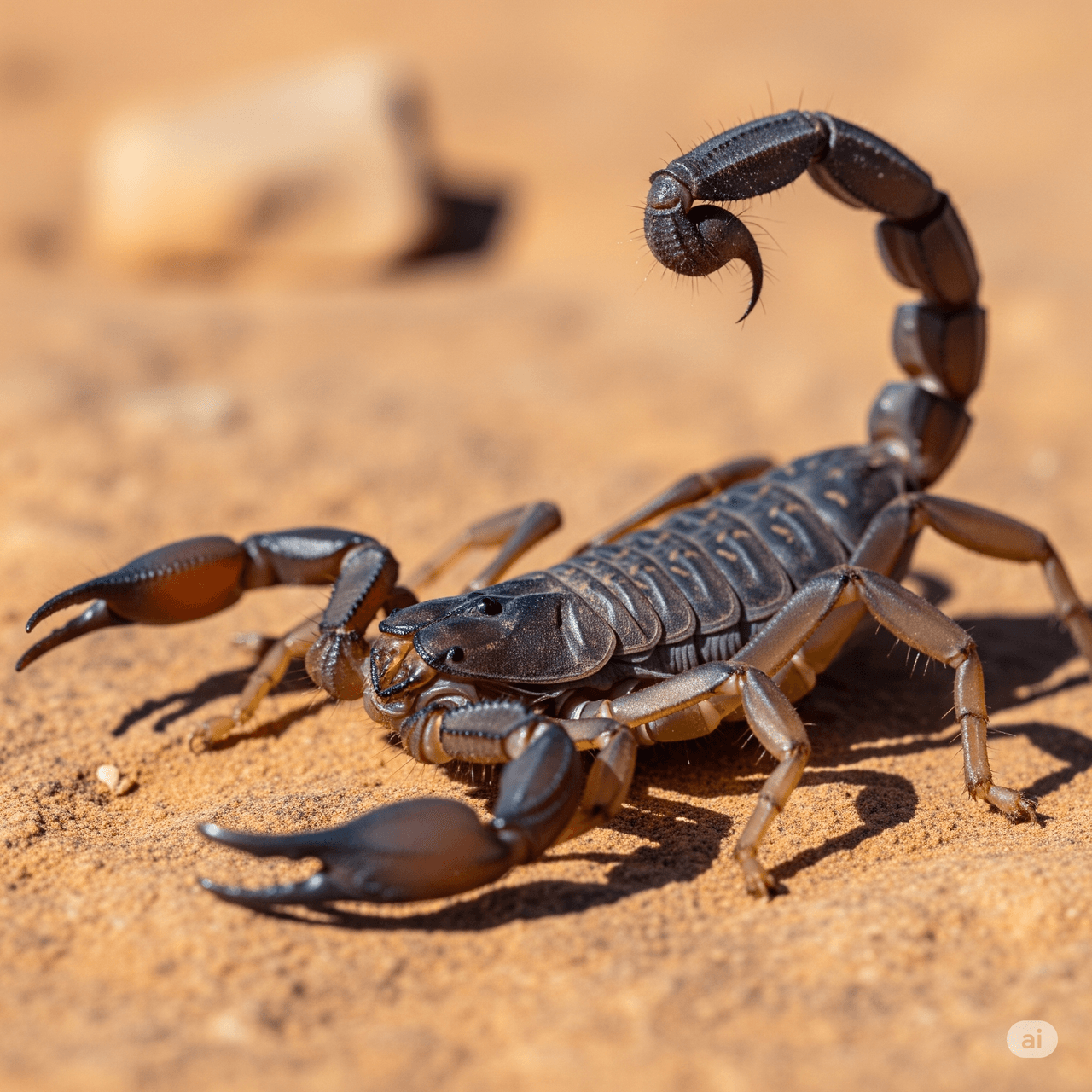
Scorpion (Scorpiones)
Team(s) | Scorpiones | ||||||||
|---|---|---|---|---|---|---|---|---|---|
Class | Arachnida | ||||||||
Branch | Arthropoda | ||||||||
Type Count | ~2,500 | ||||||||
Habitat | All continents except polar regions | ||||||||
Diet(s) | Carnivorous insects and small invertebrates | ||||||||
Reproduction(s) | Live birth young carried on the mother's back | ||||||||
Venom | Neurotoxins, enzymes, antimicrobial peptides | ||||||||
Medical Importance | Venom components are used in pharmacological research | ||||||||
Scorpions (Scorpiones) are arthropods with an ancient evolutionary history dating back approximately 435 million years, adapted to terrestrial life and equipped with venomous stingers. These creatures are widely distributed across the globe, particularly in hot and arid climates, ranging from deserts to tropical rainforests. Scorpions are notable for their venomous stingers used in predation and defense, nocturnal behavior, and complex reproductive strategies. These traits provide important insights into their ecological roles and their position within biological diversity.
Scorpions belong to the subphylum Chelicerata and the class Arachnida. Approximately 2,500 scorpion species have been described today, distributed among various families including Buthidae, Scorpionidae, Hemiscorpiidae, and Chaerilidae. The family Buthidae is known for containing species of medical importance. Molecular phylogenetic studies have revealed more detailed evolutionary relationships among scorpions and demonstrated that venom genes in some species evolved independently.
The fossil record of scorpions extends back to the Silurian period and provides critical information about their transition from marine to terrestrial environments. Early fossil specimens indicate that scorpions possessed gill-like structures that evolved over time into organs adapted for terrestrial respiration. These adaptations enabled scorpions to successfully colonize a wide range of ecosystems.

Scorpion Fossil (Generated by Artificial Intelligence)
The body of scorpions consists of two main parts: the prosoma (cephalothorax) and the opisthosoma (abdomen). The prosoma contains two pairs of appendages—the chelicerae and pedipalps—and four pairs of walking legs. The pedipalps are used for capturing prey and defense, while the chelicerae function in feeding. Additionally, the pectines, located on the ventral side of the body, play a crucial role in detecting environmental vibrations and locating prey.
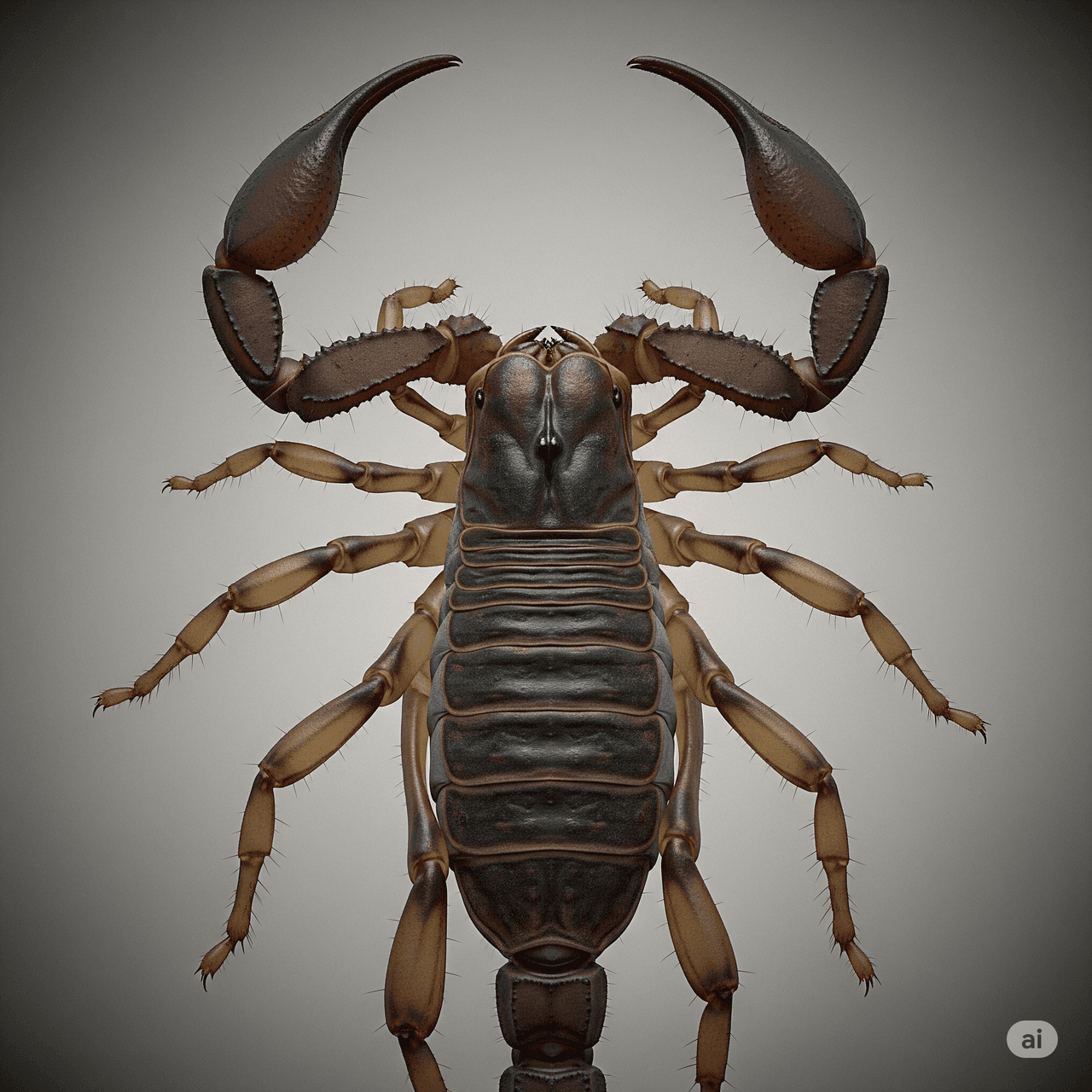
Scorpion Body Structure (Generated by Artificial Intelligence)
The telson at the tip of the scorpion’s metasoma (tail) contains venom glands and a stinger. Venom is used to immobilize prey and for defense. Venom composition varies among species, and the venom of some species can have neurotoxic effects on mammals. Scorpions are typically nocturnal, ambushing prey and feeding via external digestion.
Scorpions inhabit a variety of environments, from deserts to tropical rainforests. They commonly shelter beneath rocks, within tree bark, or in burrows they dig themselves. Their cuticle exhibits fluorescence under ultraviolet light, which facilitates their detection by researchers during nocturnal observations.

Scorpion Burrows (Generated by Artificial Intelligence)
Scorpion reproductive processes vary among species but generally involve complex courtship rituals. The male guides the female to accept a spermatophore, a packet of sperm. In some species, males may use their venom to calm the female during mating.
Scorpions exhibit ovoviviparous or viviparous reproductive strategies. The female develops embryos internally and carries the young on her back after birth. The offspring remain on their mother’s back until they complete their first molts, during which they are protected by her. This form of parental care is a significant adaptation that enhances offspring survival rates.
The lifespan of scorpions varies depending on species and environmental conditions. Some species live only a few years, while others can live up to 20 years. The frequency of reproduction and number of offspring also differ among species; some reproduce multiple times per year, while others reproduce only once.
Al-Azawi, Zeina Nabil. "Behavior Study Of Mating and Caring Young in Scorpions Androctonus crassicauda (Scorpiones: Buthidae)." ResearchGate, 2020. Accessed May 22, 2025. https://www.researchgate.net/publication/343821187_Behavior_Study_Of_Mating_and_Caring_Young_in_Scorpions_Androctonus_crassicaudaScorpionesButhidae
Das, B., & Mukherjee, A. K. (2025). *Scorpion Venom* (First). CRC Press. Accessed May 22, 2025. https://doi.org/10.1201/9781003540816
Howard, R. J., Edgecombe, G. D., Legg, D. A., Pisani, D., & Lozano-Fernandez, J. (2019). Exploring the evolution and terrestrialization of scorpions (Arachnida: Scorpiones) with rocks and clocks. *Organisms Diversity & Evolution*, *19*(1), 71–86. Accessed May 22, 2025. https://doi.org/10.1007/s13127-019-00390-7
Lourenço, W. R. (2018). Scorpions and life-history strategies: from evolutionary dynamics toward the scorpionism problem. *The Journal of Venomous Animals and Toxins Including Tropical Diseases*, *24*(1). Accessed May 22, 2025. https://doi.org/10.1186/s40409-018-0160-0
Santibáñez-López, C. E., Aharon, et al. (2022). Phylogenomics of scorpions reveal contemporaneous diversification of scorpion mammalian predators and Mammal-Active sodium channel toxins. *Systematic Biology*, *71*(6), 1281–1289. Accessed May 22, 2025. https://doi.org/10.1093/sysbio/syac021
Stockmann, Roland. "Introduction to Scorpion Biology and Ecology." In *Scorpion Venoms*, edited by P. Gopalakrishnakone, 1–29. Springer, 2014. Accessed May 22, 2025. https://link.springer.com/referenceworkentry/10.1007/978-94-007-6647-1_14-1

Scorpion (Scorpiones)
Team(s) | Scorpiones | ||||||||
|---|---|---|---|---|---|---|---|---|---|
Class | Arachnida | ||||||||
Branch | Arthropoda | ||||||||
Type Count | ~2,500 | ||||||||
Habitat | All continents except polar regions | ||||||||
Diet(s) | Carnivorous insects and small invertebrates | ||||||||
Reproduction(s) | Live birth young carried on the mother's back | ||||||||
Venom | Neurotoxins, enzymes, antimicrobial peptides | ||||||||
Medical Importance | Venom components are used in pharmacological research | ||||||||
Henüz Tartışma Girilmemiştir
"Scorpion" maddesi için tartışma başlatın
Taxonomy and Evolutionary History
Taxonomic Classification
Fossil Record and Transition to Terrestrial Life
Morphology and Ecological Adaptations
Body Structure and Sensory Organs
Venom and Predatory Strategies
Habitat and Distribution
Reproductive Biology and Life Cycle
Reproductive Behavior
Development and Parental Care
Lifespan and Reproductive Potential