

Bu içerik Türkçe olarak yazılmış olup yapay zeka ile otomatik olarak İngilizceye çevrilmiştir.
Type of Geographical Indication | Mahreç Sign | ||||||||
|---|---|---|---|---|---|---|---|---|---|
Registration Number | 1098 | ||||||||
Registration Date | 05.05.2022 | ||||||||
Product / Product Group(s) | Bakery and Confectionery Products Desserts Dough Products | ||||||||
Province(s) | Isparta | ||||||||
Applicant/Registrant(s) | Senirkent Municipality | ||||||||
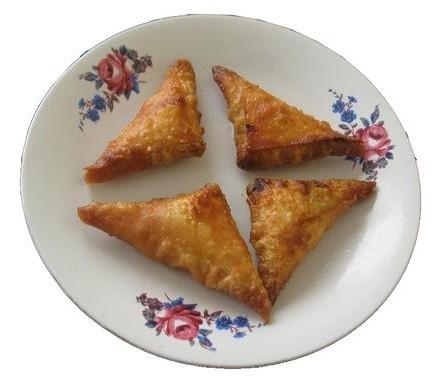
Senirkent samsa dessert is a regional dessert with a long history, unique to the district of Senirkent in the province of Isparta. It was officially registered as a geographical indication by the Türk Patent ve Marka Kurumu on 05.05.2022. This product is made by placing a filling of crushed dry phyllo, grape molasses, and walnut kernels between thin sheets of dough prepared from flour, water, and salt, rolling them into a muska shape, frying them, and then soaking them in syrup. The distinctive production method and the skill required to prepare it underscore the dessert’s strong link to its geographical origin and its unique character.
Senirkent samsa dessert is made from dough rolled into thin sheets using wheat flour, water, and salt, which are then processed through a specific procedure. The filling is prepared by mixing crushed dry phyllo, ground walnut kernels, and grape molasses. After shaping the dessert into a muska form, three to six small holes are made on its surface to ensure that the oil and syrup fully penetrate the interior during frying and syrup soaking. This step ensures that both the frying and syrup absorption processes occur uniformly. The fried muska-shaped desserts are then immersed in cold syrup while still hot, allowing the phyllo particles in the filling to absorb the syrup and create the dessert’s characteristic texture.
The production of Senirkent samsa dessert consists of several stages requiring skilled craftsmanship:
The geographical boundary for Senirkent samsa dessert is limited to the district of Senirkent in the province of Isparta. Due to its deep historical roots, its significance among regional desserts, the unique characteristics of its production method tied to this specific region, and its established link to the geographical area, all stages of production must be carried out within this defined boundary.
Compliance with the registration criteria for Senirkent samsa dessert is monitored by a control body established under the coordination of the Senirkent Municipality. This body consists of three members: one expert each from the Senirkent Municipality, the Senirkent District Directorate of Agriculture and Forestry, and the Senirkent Chamber of Tradesmen and Artisans. Monitoring is conducted annually on a regular basis, and additional inspections may be carried out as needed or in response to complaints. Inspections focus on the suitability of ingredients, adherence to the production method, and the correct use of the geographical indication mark and emblem. The monitoring body may seek support from external experts or institutions when necessary.
Türk Patent ve Marka Kurumu. "Senirkent Samsa Tatlısı Coğrafi İşaret Sicil Belgesi." Accessed October 25, 2025. https://ci.turkpatent.gov.tr/Files/GeographicalSigns/665bdae7-7028-4452-b513-2daafadcc876.pdf
Türk Patent ve Marka Kurumu. "Senirkent Samsa Tatlısı." Coğrafi İşaretler Portalı. Accessed October 25, 2025. https://ci.turkpatent.gov.tr/cografi-isaretler/detay/1602

Type of Geographical Indication | Mahreç Sign | ||||||||
|---|---|---|---|---|---|---|---|---|---|
Registration Number | 1098 | ||||||||
Registration Date | 05.05.2022 | ||||||||
Product / Product Group(s) | Bakery and Confectionery Products Desserts Dough Products | ||||||||
Province(s) | Isparta | ||||||||
Applicant/Registrant(s) | Senirkent Municipality | ||||||||
Henüz Tartışma Girilmemiştir
"Senirkent Samsa Sweet" maddesi için tartışma başlatın
Product Characteristics
Production Method
Geographical Boundary
Monitoring