


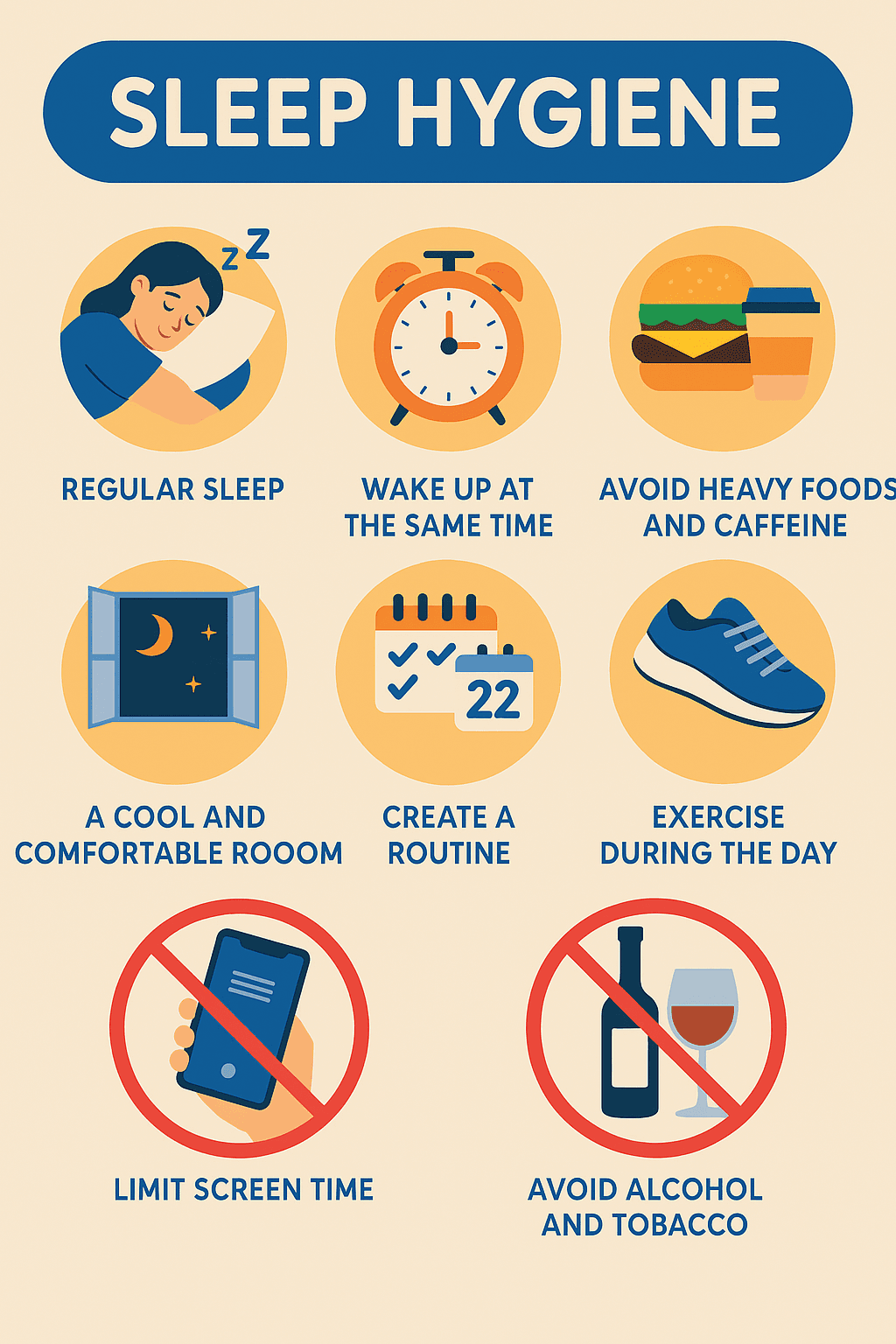
Sleep Hygiene
Type(s) | Psychological-Physiological Phenomenon | ||||||||
|---|---|---|---|---|---|---|---|---|---|
Field | Health Sciences / Behavioral Psychology | ||||||||
Scope(s) | Environmental and behavioral adjustments to improve sleep quality | ||||||||
Application | Prevention and management of sleep disorders | ||||||||
Sleep hygiene is defined as the principles and practices that improve sleep quality. These principles and practices encompass the regulation and improvement of behavioral and environmental factors. Sleep hygiene includes daily practices, habits, and environmental adjustments necessary to enhance sleep quality throughout the night. Adequate sleep hygiene is associated with increased sleep satisfaction and quality, and a reduction in the frequency of sleep disturbances.
Sleep is a basic physiological need, like air, water, and food, and an important component of health. Sleep plays a significant role in regulating metabolic processes, emotional regulation, physical performance, memory, and learning. Sleep hygiene is important for maintaining sleep health. Inadequate sleep hygiene often leads to impairments in daily life activities due to the inability to achieve quality sleep and daytime alertness. Sleep hygiene practices are important for improving sleep quality.
Sleep hygiene strategies involve the regulation of behavioral and environmental factors that can be used in the treatment of some sleep disturbances. Sleep hygiene education is commonly used within strategies for coping with sleep disorders. These adjustments are an effective, inexpensive, and side-effect-free approach in the management of sleep disorders.
Sleep hygiene principles and practices are addressed in the following sub-dimensions:
Sleep hygiene adjustments are widely used for insomnia, circadian rhythm disorders, and sleep disorders such as obstructive sleep apnea. Furthermore, sleep hygiene programs play a key role in the treatment of insomnia and the reduction of excessive daytime sleepiness, increasing sleep satisfaction, the quality and nature of sleep, and reducing the frequency of sleep disorders. Sleep hygiene can be carried out 전쟁 with a multi-component behavioral therapy that includes sleep physiology, stimulus control therapy for dysfunctional beliefs, sleep restriction, and relaxation training.
Studies have shown that inadequate sleep hygiene is associated with poor sleep quality, especially in university students, nurses working in hospitals, and medical students. In a study conducted on university students, it was found that male students had poorer sleep hygiene than female students, and factors such as living away from parental supervision, poor perception of quality of life, smoking and alcohol use, excessive internet use, and inconsistencies in sleep hours negatively affected their sleep hygiene. Another study found that thinking, planning, or worrying in bed was the most common behavior among students that most negatively affected sleep hygiene. Sleep hygiene education provided to patients discharged from the coronary intensive care unit (CICU) was observed to improve their sleep quality in the third month after discharge. In a study conducted with psychiatric patients, sleep hygiene education was also found to provide a statistically significant improvement in patients' sleep status.
Warning: The content in this article is for general encyclopedic information purposes only. The information here should not be used for diagnosis, treatment, or medical guidance. You should always consult a physician or qualified healthcare professional before making decisions about health-related matters. The article author and KÜRE Encyclopedia do not accept any responsibility for situations that may arise from the use of this information for diagnostic or therapeutic purposes.
Güneş, Zeynep. “The Role and Strategies of Sleep Hygiene in Maintaining Sleep Health.” Akademik Tıp Dergisi (Academic Journal of Medicine) 27, no. 2 (June 2018): 188–198. Accessed May 21, 2025. https://doi.org/10.17827/aktd.351436
Odabaşıoğlu, Mehmet Ercan, Tahir Dedeoğlu, Zeynettin Kasırga, and Fatih Sünbül. “Sleep Hygiene among University Students.” Gümüşhane University Journal of Health Sciences 6, no. 4 (December 2017): 204–212. Accessed May 21, 2025. https://dergipark.org.tr/tr/pub/gumussagbil/issue/32215/368366
Uğurlu, Nezihe, Esra Günay, Özlem Baykal, and Ayla Keçeci. “Assessment of Psychiatric Patients’ Sleep Status Before and After Sleep Hygiene Education.” Journal of Psychiatric Nursing 9, no. 1 (2018). Accessed May 21, 2025. https://phdergi.org/TR/jvi.aspx?un=PHD-60490&volume=9&issue=1
Yıldız, Fatma Tok, and Hatice Tel Aydın. “The Effect of Sleep Hygiene Education on Sleep Quality in Patients After Coronary Intensive Care.” Turkish Journal of Critical Care Nursing 17, no. 1 (2013): 1–7. Accessed May 21, 2025. https://dergipark.org.tr/en/pub/ybhd/issue/49362/630487

Sleep Hygiene
Type(s) | Psychological-Physiological Phenomenon | ||||||||
|---|---|---|---|---|---|---|---|---|---|
Field | Health Sciences / Behavioral Psychology | ||||||||
Scope(s) | Environmental and behavioral adjustments to improve sleep quality | ||||||||
Application | Prevention and management of sleep disorders | ||||||||
Henüz Tartışma Girilmemiştir
"Sleep Hygiene" maddesi için tartışma başlatın
The Importance of Sleep Hygiene
Sleep Hygiene Strategies and Principles
Regulation of the Sleep Environment:
Regulation of Sleep Timing:
Regulation of Daily Activities:
Regulation of Food and Drink Intake:
Regulations Regarding Mental Control:
Situations Where Sleep Hygiene is Used
Research and Findings
Bu madde yapay zeka desteği ile üretilmiştir.