
+2 Daha

Definition(s) | A Type Of Noodle Made From Buckwheat Flour Unique To Japan. | ||||||||
|---|---|---|---|---|---|---|---|---|---|
Origin(s) | Japan (Especially Nagano Prefecture) | ||||||||
Main Ingredient | Buckwheat (Fagopyrum Esculentum) Flour | ||||||||
Preparation Method | Served Hot And Cold | ||||||||
Soba is a type of noodle native to Japan, with buckwheat (Fagopyrum esculentum) flour as its primary ingredient. This product holds traditional and regional significance in Japanese cuisine and is consumed in various forms, particularly in Nagano Prefecture, where buckwheat is extensively cultivated. Soba noodles can be served both hot and cold, and they vary depending on factors such as the proportion of flour used, the method of production, and the accompanying sauces.

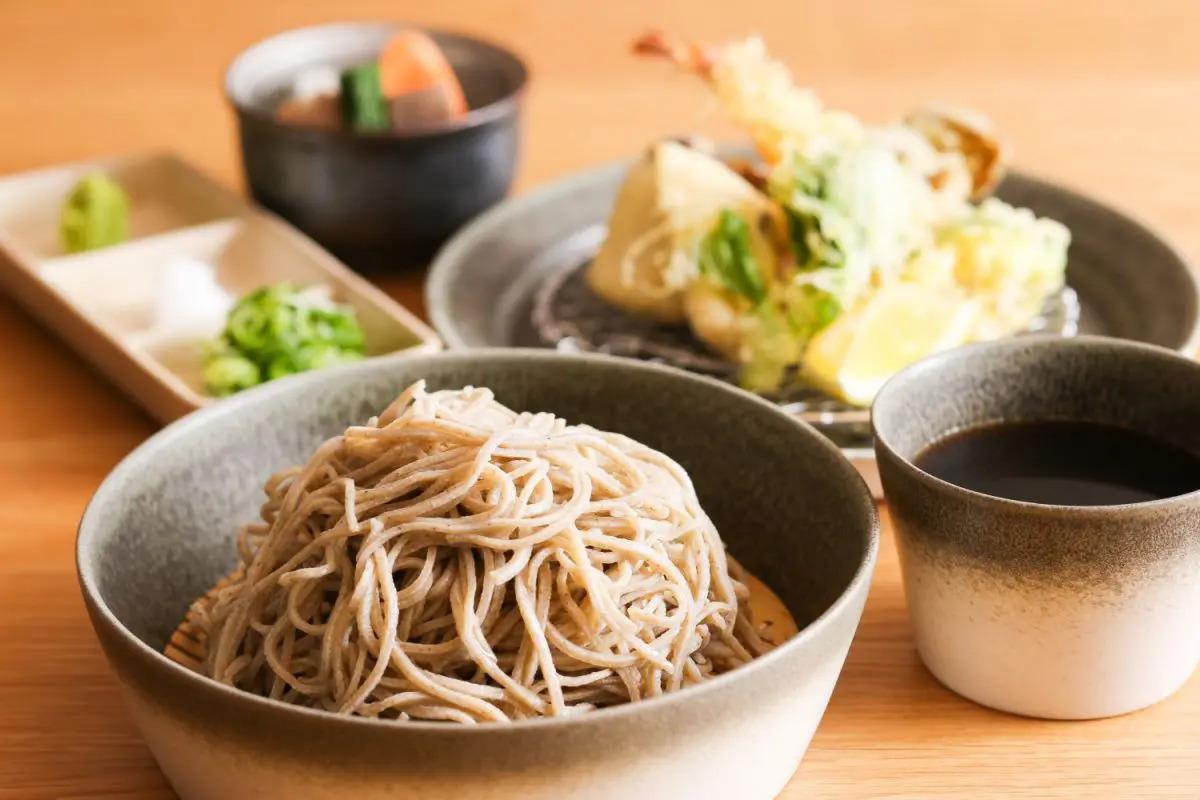
Cold-serve Soba Noodles (Pexels)
While buckwheat flour is the main ingredient in the production of soba noodles, additional binding agents such as wheat flour, plant fibers, or starches from potatoes or seaweed are often used. A common type known as nihachi soba typically contains a ratio of 80% buckwheat flour to 20% wheat flour. Noodles made with 100% buckwheat flour are called juwari soba, and these are gluten-free. However, since buckwheat flour lacks gluten and cannot develop viscosity or a cohesive structure on its own, binding ingredients such as wheat flour, egg, or grated mountain yam are commonly added to enhance structural integrity.
Soba noodles are consumed in various ways. Mori soba and zaru soba, which are served cold, are presented on sieve-like bamboo trays and accompanied by a chilled dipping sauce called tsuyu. Kake soba is a variety served in hot tsuyu broth. Bukkake soba is served in a shallow bowl, with the tsuyu poured directly over the noodles. In some types, toppings such as mountain vegetables (sansai), grated yam (tororo), or tempura are added as garnishes. After the meal, the remaining tsuyu is often mixed with soba-yu—the starchy water in which the noodles were boiled—and consumed as a warm drink.
In the Nagano region, soba has developed in various local forms:
The quality of soba noodles depends on the chemical and physical properties of the flour used, ingredient ratios, and processing conditions. The strong gel-forming capacity of buckwheat starch contributes to the noodle’s texture. However, because buckwheat flour lacks gluten, formulations without added wheat flour generally show lower dough stability, water absorption, and viscosity. Additionally, physical treatments such as steaming, autoclaving, fermentation, and extrusion can have positive or negative effects on noodle quality. For instance, steaming and autoclaving can enhance textural characteristics by increasing the degree of starch gelatinization; however, excessive gelatinization may cause the noodles to disintegrate during cooking.
Japan National Tourism Organization (JNTO). "An Insider's Guide to Soba." Accessed July 11, 2025. https://www.japan.travel/en/au/story/insiders-guide-soba/.
Go! NAGANO. "All About Soba Noodles." Accessed July 11, 2025. https://www.go-nagano.net/en/trip-idea/id16354.
Flickr. "Soba Noodles & Tempura Lunch." Accessed July 11, 2025. https://www.flickr.com/photos/kinosakionsen/52271577434/.
Pexels. "Soba Noodles on Plate." Accessed July 11, 2025. https://www.pexels.com/photo/soba-noodles-on-plate-26727317/.
Puligundla, P., Lim, S. Buckwheat noodles: processing and quality enhancement. Food Sci Biotechnol 30, 1471–1480 (2021). Accessed July 11, 2025. https://doi.org/10.1007/s10068-021-00960-6.

Definition(s) | A Type Of Noodle Made From Buckwheat Flour Unique To Japan. | ||||||||
|---|---|---|---|---|---|---|---|---|---|
Origin(s) | Japan (Especially Nagano Prefecture) | ||||||||
Main Ingredient | Buckwheat (Fagopyrum Esculentum) Flour | ||||||||
Preparation Method | Served Hot And Cold | ||||||||
Henüz Tartışma Girilmemiştir
"Soba Noodles" maddesi için tartışma başlatın
Composition and Preparation
Modes of Consumption
Regional Variations
Factors Affecting Quality
Bu madde yapay zeka desteği ile üretilmiştir.