


Bu içerik Türkçe olarak yazılmış olup yapay zeka ile otomatik olarak İngilizceye çevrilmiştir.
+1 Daha
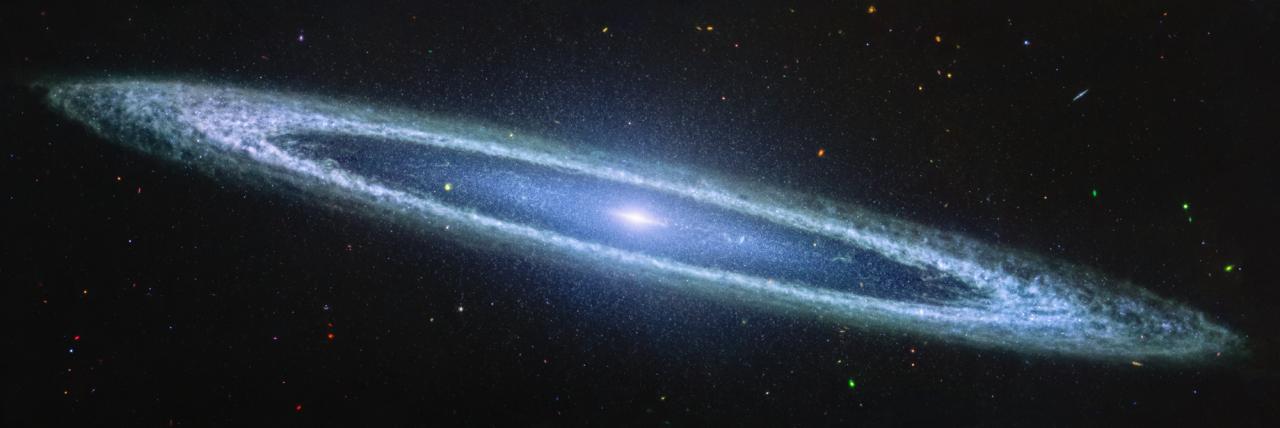
The Sombrero Galaxy (Messier 104 or M104) is one of the galaxies featured in modern astronomical studies due to its spiral structure and distinctive morphological features. It derives its name from its resemblance to the Mexican "sombrero" hat when observed. This appearance arises from the combination of its bright central bulge and a prominent dusty disk.

Artificially Visualized Image of the Sombrero Galaxy.
The Sombrero Galaxy was first observed in 1781 by French astronomer Pierre Méchain and later added to Charles Messier’s catalog in 1784 as M104. However, it did not appear in the initial printings of the Messier Catalogue.
In the 20th century, spectroscopic measurements conducted by Vesto M. Slipher revealed that the galaxy is rotating and moving away from Earth. These findings served as key references in foundational cosmological studies by Edwin Hubble, including galaxy classification and the theory of the expanding universe.

Sombrero Galaxy as captured by the James Webb Space Telescope. (NASA)
Located in the direction of the Virgo constellation, the Sombrero Galaxy is approximately 29 million light-years (8.9 Mpc) away. With an apparent magnitude of +8.0, it is bright enough to be observed with small telescopes. Due to its inclination of about 84 degrees, it is seen nearly edge-on, allowing for clearer observation of its structural components.

Location of the Sombrero Galaxy. (NASA.
Its primary physical parameters are as follows:
The central region of the Sombrero Galaxy features a large and luminous bulge. This structure is spheroidal in shape and consists predominantly of an old stellar population. Such massive bulges may result from past mergers or internal dynamical processes.
The dark dust lane observed along the galactic disk is composed of interstellar dust and typically lies in the foreground of the galactic plane. Infrared observations indicate limited star formation activity in this region. While the disk contains abundant gas and dust, the rate of star formation remains relatively low.
Studies using the Hubble Space Telescope (HST) and other observational instruments have revealed that the galaxy hosts over 2,000 globular clusters. This number significantly exceeds the number of globular clusters in the Milky Way, suggesting that the Sombrero Galaxy is more massive overall.
Observations in X-ray and radio wavelengths have confirmed the presence of a supermassive black hole at the center of the Sombrero Galaxy. The black hole’s mass is substantial relative to the galaxy’s total mass. Its existence has been corroborated through analysis of the dynamics of surrounding gas and spectroscopic data.
X-ray and radio observations indicate the presence of a high-mass black hole at the center of the Sombrero Galaxy. This is confirmed by the motion of surrounding gas and spectral analyses.
Spectral analyses reveal the presence of stellar populations with varying ages and metallicities. The central region is dominated by old, metal-rich stars, while the disk contains predominantly younger, metal-poor stars. Additionally, investigations using Hα and [O III] emission lines have detected low-level nuclear activity (LLAGN) in the galactic center.
The Sombrero Galaxy serves as an important observational target for research on galaxy morphology and evolution due to the diversity of its structural components and physical properties. Its central bulge, large number of globular clusters, presence of a supermassive black hole, and prominent dust lane provide valuable insights into galaxy formation and dynamical processes. Future high-resolution telescope observations are expected to yield further data on the origin and evolutionary history of this galaxy.
NASA. "Hats Off to NASA's Webb: Sombrero Galaxy Dazzles in New Image." NASA Science - James Webb Space Telescope. Last modified July 12, 2023. Accessed April 25, 2025. https://science.nasa.gov/missions/webb/hats-off-to-nasas-webb-sombrero-galaxy-dazzles-in-new-image/.
NASA. "Messier 104 (The Sombrero Galaxy)." NASA Science – Hubble Messier Catalog. Last modified April 17, 2024. Accessed April 25, 2025. https://science.nasa.gov/mission/hubble/science/explore-the-night-sky/hubble-messier-catalog/messier-104/.
NASA. "Sombrero Galaxy." NASA Science - Hubble Space Telescope. Accessed April 25, 2025. https://science.nasa.gov/asset/hubble/sombrero-galaxy/.
NASA. Messier 104 (Sombrero Galaxy) – Hubble Lithograph. PDF file. Last modified July 2023. Accessed April 25, 2025. https://science.nasa.gov/wp-content/uploads/2023/07/hubble-litho-m104-sombrero-galaxy.pdf.

Henüz Tartışma Girilmemiştir
"Sombrero Galaxy" maddesi için tartışma başlatın
Discovery and History
Location and General Properties
Structural Features
Central Bulge
Dust Lane and Disk Structure
Halo and Globular Cluster System
Central Supermassive Black Hole
Evolutionary Processes and Galaxy Classification
Observational Studies and Spectral Properties