


Bu içerik Türkçe olarak yazılmış olup yapay zeka ile otomatik olarak İngilizceye çevrilmiştir.
Studio monitor is a type of loudspeaker designed to ensure the most accurate, neutral, and faithful reproduction of sound in professional audio production processes such as recording, mixing, and broadcasting. Unlike consumer-grade loudspeakers, studio monitors do not artificially boost low or high frequencies to make the sound more pleasing to the listener. Instead, they aim to provide a flat frequency response that allows the sound to be heard exactly as it was recorded at the source. This enables audio engineers and producers to obtain an objective reference point for ensuring that the music or audio content they create will be consistently perceived across different playback systems.
The establishment of industry standards and technical evolution of studio monitors were largely shaped by the specific needs of broadcasting institutions. The British Broadcasting Corporation (BBC) determined that the average commercial loudspeakers used by the public were unsuitable as broadcast monitors, as their varying acoustic characteristics led to incorrect compensation during mixing and distorted listening experiences.【1】 In response to these shortcomings, the BBC Research Department began developing its own loudspeaker parameters characterized by minimal audible distortion and maximum performance.【2】
These research efforts laid the foundation for modern studio monitor design by centering key criteria such as low distortion, flat frequency response, tonal neutrality, and consistency between units.【3】 In subsequent years, innovations such as polymer cone materials emerged, and the monitor models developed by the BBC were widely accepted as industry reference standards for many decades.【4】
A studio monitor typically consists of multiple drivers that divide the audio spectrum. In the most common “two-way” designs, a small and lightweight driver that produces high frequencies is called a “tweeter,” while a larger driver responsible for low and mid frequencies is called a “woofer.” The audio signal is split and directed to the respective drivers via a filter circuit known as a “crossover.”
To focus on the critical mid frequencies where vocals are most prominent and to avoid potential phase cancellations at crossover points, “single-driver” monitors without a crossover circuit are also used. These designs serve as an additional reference tool during mixing, particularly for establishing midrange balance. In addition to two-way systems, three-way systems that distribute the frequency range across more drivers are also preferred in professional environments.
Cabinet designs have a decisive impact on a monitor’s low-frequency (bass) output and are broadly categorized into two approaches: ported and sealed systems.
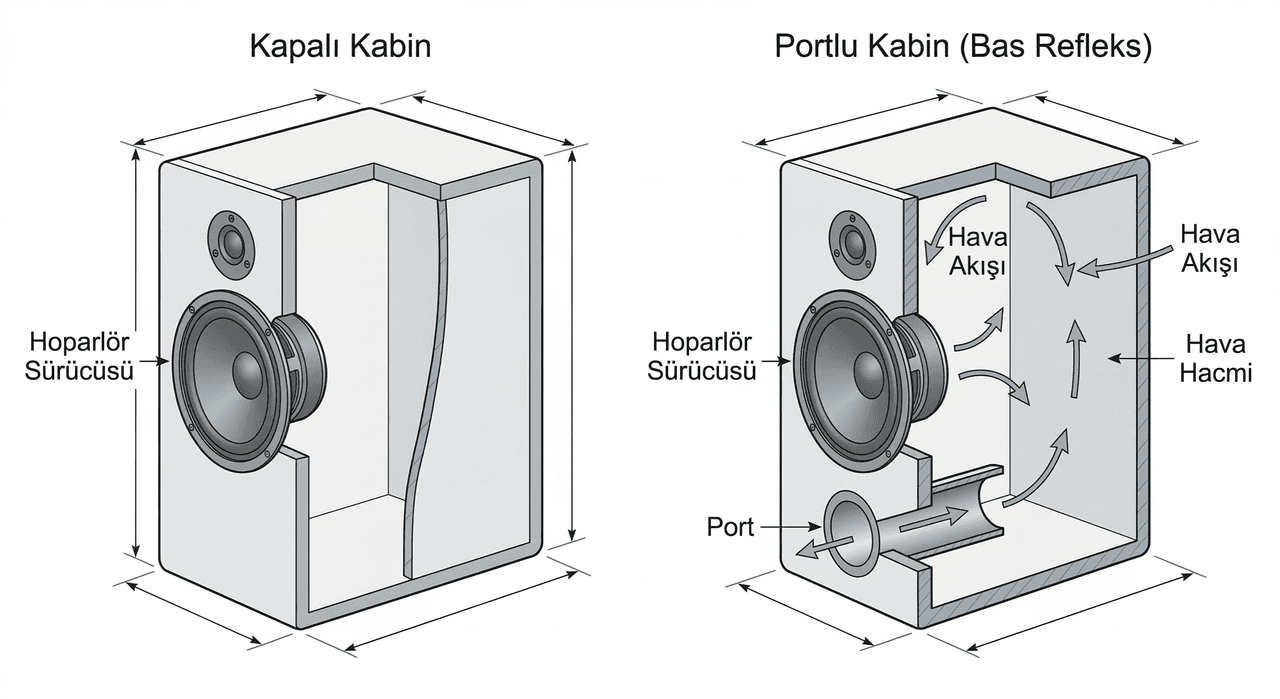
Physical differences between ported and sealed cabinet designs and their air flow cycles. (Generated by AI.)
In ported monitors, a hole (port) is cut into the cabinet to allow energy radiating from the rear of the woofer to escape. This design enables the speaker to achieve higher sound pressure levels at lower frequencies, improving efficiency. However, ported designs may produce unwanted resonances or turbulent air noise at certain frequencies. When operating below the port’s tuning frequency, the sound level in ported systems drops sharply at a rate of 24 dB per octave.【5】
Sealed cabinet monitors have no port. Although they are less efficient and have more limited bass response, the absence of port resonance allows low frequencies to be produced without ringing, resulting in tighter and more accurate bass reproduction. In sealed systems, the frequency roll-off follows a gentler slope of approximately 12 dB per octave.【6】
The quality and reliability of studio monitors are measured by several objective performance criteria:
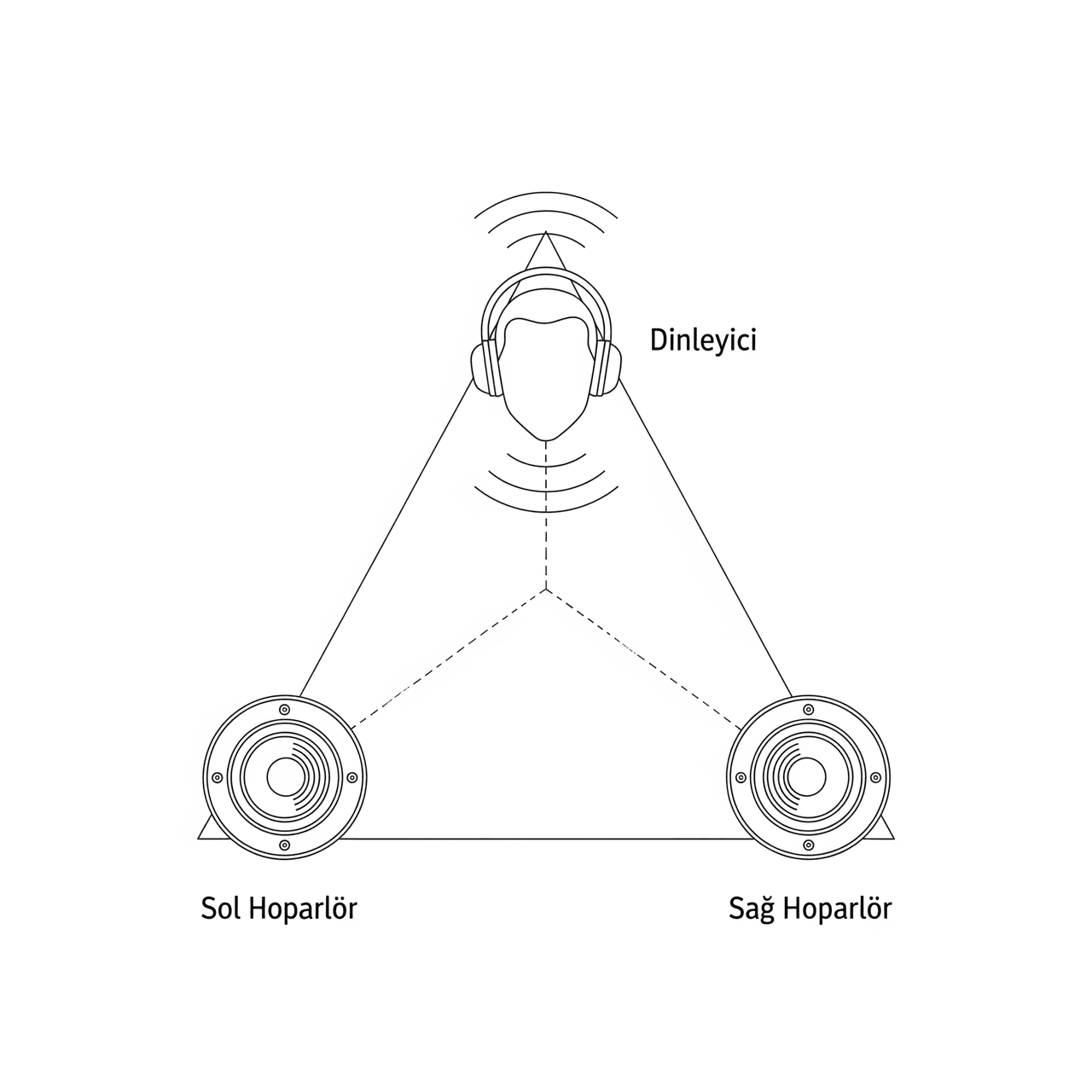
Example of a near-field studio monitor setup and listening triangle. (Generated by AI.)
The placement of studio monitors within a room directly affects the accuracy of the perceived sound. The most standard setup is the “near-field” configuration. In this arrangement, the two monitors and the listener form an equilateral triangle, with the angle between the left and right monitors set at 60 degrees.【7】 The tweeters should be positioned at ear level, and the monitors should be angled inward approximately 30 degrees toward the listener’s ears.
Monitors should be placed as far as possible from room corners and walls. Proximity to walls causes standing waves and resonance buildup in the low frequencies. Additionally, the distance between the monitors and the rear wall must be carefully adjusted to prevent phase cancellation between the direct sound from the speaker and its reflection off the wall.
Regardless of how high the hardware quality of the monitors may be, the acoustics of the room in which they are used ultimately affects the final sound. Because reflections from reflective surfaces can cause phase cancellations, it is recommended to use isolation pads or acoustic stands to prevent vibrations from transferring to supporting surfaces.
Many modern studio monitors include built-in equalization (EQ) controls designed to compensate for room acoustic issues. These features help balance excessive low-frequency buildup from wall reflections or harsh high-frequency peaks, preserving the neutrality of the reference sound. When a subwoofer is added to the system to accurately monitor very low frequencies, the crossover frequency is typically set to ensure that low frequencies are reproduced by the subwoofer while the remaining frequencies are handled by the main monitors.
D. E. L. Shorter. "The Development of High-Quality Monitoring Loudspeakers: A Review of Progress." BBC Research Department. Report No. L-041. 1958. Accessed March 19, 2026. https://downloads.bbc.co.uk/rd/pubs/reports/1958-31.pdf
D. E. L. Shorter. "The Influence of Loudspeaker Directivity and Orientation on the Effective Audience Area in Two-Channel Stereophonic Reproduction." BBC Research Department. Report No. L-053. 1963. Accessed March 19, 2026. https://downloads.bbc.co.uk/rd/pubs/reports/1963-01.pdf
Grewe, Yannik, Ulli Scuda, Adrian Murtaza, Markus Kahelin, and Nuno Duarte. *Studio Recommendations for 3D-Audio Productions with MPEG-H Audio*. Technical Paper. Erlangen, Germany: Fraunhofer Institute for Integrated Circuits IIS, 2020. https://www.iis.fraunhofer.de/content/dam/iis/de/doc/ame/wp/FraunhoferIIS_TechnicalPaper_Studio_Recommendations_3DAudio-MPEG-H.pdf
Harris, L. E., P. R. Newell, and K. R. Holland. "The ‘Bass Transmission Index’: A New Concept for Evaluating Loudspeaker Performance." *Proceedings of the Institute of Acoustics* (2018). https://eprints.soton.ac.uk/426110/1/RS2018_HarrisEtAl_Final.pdf
Seydor, Paul. "The BBC Monitor: Birth of a Legend." The Absolute Sound's Illustrated History of High End Audio. Accessed March 19, 2026. https://massless.info/images/The%20BBC%20Monitor.pdf
[1]
D. E. L. Shorter. "The Development of High-Quality Monitoring Loudspeakers: A Review of Progress." BBC Research Department. Report No. L-041. 1958. Erişim tarihi: 19 Mart 2026. https://downloads.bbc.co.uk/rd/pubs/reports/1958-31.pdf
[2]
D. E. L. Shorter. "The Development of High-Quality Monitoring Loudspeakers: A Review of Progress." BBC Research Department. Report No. L-041. 1958. Erişim tarihi: 19 Mart 2026. https://downloads.bbc.co.uk/rd/pubs/reports/1958-31.pdf
[3]
Seydor, Paul. "The BBC Monitor: Birth of a Legend." The Absolute Sound's Illustrated History of High End Audio. s. 306-307. Erişim tarihi: 19 Mart 2026. https://massless.info/images/The%20BBC%20Monitor.pdf
[4]
Seydor, Paul. "The BBC Monitor: Birth of a Legend." The Absolute Sound's Illustrated History of High End Audio. s. 306-307. Erişim tarihi: 19 Mart 2026. https://massless.info/images/The%20BBC%20Monitor.pdf
[5]
Harris, L. E., P. R. Newell, ve K. R. Holland. "The ‘Bass Transmission Index’: A New Concept for Evaluating Loudspeaker Performance." Proceedings of the Institute of Acoustics (2018). https://eprints.soton.ac.uk/426110/1/RS2018_HarrisEtAl_Final.pdf
[6]
Harris, L. E., P. R. Newell, ve K. R. Holland. "The ‘Bass Transmission Index’: A New Concept for Evaluating Loudspeaker Performance." Proceedings of the Institute of Acoustics (2018). https://eprints.soton.ac.uk/426110/1/RS2018_HarrisEtAl_Final.pdf
[7]
Grewe, Yannik, Ulli Scuda, Adrian Murtaza, Markus Kahelin, ve Nuno Duarte. Studio Recommendations for 3D-Audio Productions with MPEG-H Audio. Technical Paper. Erlangen, Germany: Fraunhofer Institute for Integrated Circuits IIS, 2020. https://www.iis.fraunhofer.de/content/dam/iis/de/doc/ame/wp/FraunhoferIIS_TechnicalPaper_Studio_Recommendations_3DAudio-MPEG-H.pdf

Henüz Tartışma Girilmemiştir
"Studio Monitor" maddesi için tartışma başlatın
History and Development
Design and Hardware Features
Driver Types and Configurations
Cabinet Design: Ported and Sealed Systems
Performance Criteria
Placement and Acoustics in the Studio
Listening Position and Setup
Acoustic Treatment and Calibration