


Bu içerik Türkçe olarak yazılmış olup yapay zeka ile otomatik olarak İngilizceye çevrilmiştir.
+2 Daha
Supercomputers are high-performance computing systems capable of executing vastly more operations per second than conventional computers. They are used in fields requiring immense computational power, such as scientific research, engineering simulations, weather forecasting, climate modeling, and biological analysis.
The development of supercomputers dates back to the 1960s. In 1964, the CDC 6600 was introduced as the fastest computer of its time, three times faster than the IBM 7030 Stretch. Subsequent systems saw an increase in the number of processors, the development of parallel processing architectures, and the implementation of specialized cooling solutions. With technological advancement, performance levels have reached teraflops (10¹²), petaflops (10¹⁵), and today exaflops (10¹⁸).
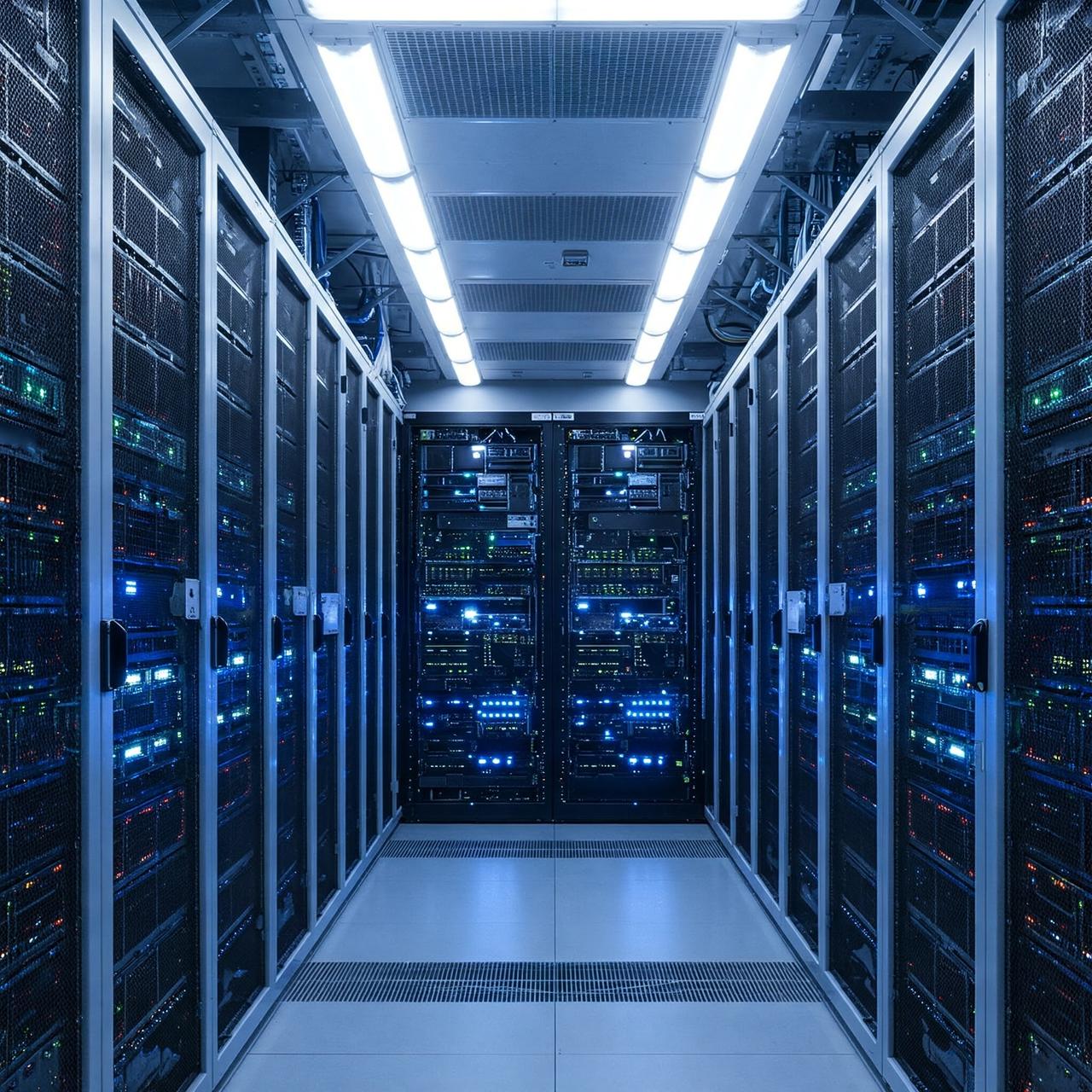
An image of a supercomputer (generated by artificial intelligence).
Supercomputers typically house thousands of processor cores. Thanks to their parallel processing capability, large datasets can be analyzed simultaneously. Memory architectures, data pathways, and network infrastructures are designed for high bandwidth and low latency. Cooling systems are specially engineered. Performance is generally measured in FLOPS.
Supercomputers operate on the classical computing model and process data in binary form. Quantum computers uses quantum bits (qubits) and operates based on principles of quantum mechanics such as superposition and entanglement. Quantum computers can offer higher computational efficiency for certain specialized algorithms. However, supercomputers remain the preferred choice for broader and more stable computations. Quantum computers are still limited in terms of general-purpose use. Quantum computers calculate all possible states between 0 and 1 simultaneously.
Efforts to develop high-performance computing infrastructure in Türkiye accelerated in the 2000s. One example is the National High Performance Computing Center (UYBHM), established within Istanbul Technical University. Türkiye’s supercomputing infrastructure has also been enhanced through various projects supported by TÜBİTAK. Türkiye’s most advanced computer, the Turkish National Science Infrastructure (TRUBA), was commissioned in early 2024.
Supercomputer systems have high energy demands. As the number of processors and computational volume increase, so does energy consumption. Cooling systems also significantly contribute to this demand. This has prompted evaluation of the environmental impact of computing infrastructure.
Supercomputers are also used in cryptography, military simulations, and defense technologies. In some countries, these systems operate on closed networks for national security purposes. Such applications enhance the strategic importance of supercomputers.
The future of supercomputer technology is expected to move toward hybrid systems, where classical and quantum computing approaches are integrated. Additionally, research continues into energy-efficient system designs.
Alces Flight. "A Future-Ready Playbook for Supercomputing: Reflections and Predictions for 2025." Accessed May 6, 2025. https://alces-flight.com/a-future-ready-playbook-for-supercomputing-reflections-and-predictions-for-2025/.
NVIDIA. "What Is an Exaflop?" NVIDIA Blog. Accessed May 6, 2025. https://blogs.nvidia.com/blog/what-is-an-exaflop/.
Restackio. "Military Applications of Supercomputing." Accessed May 6, 2025. https://www.restack.io/p/ai-for-disaster-response-answer-military-supercomputing-cat-ai.
TÜBİTAK Bilim and Technology Magazine. "Süper Bilgisayarlar." *Bilim ve Teknik*, Volume 43, no. 692 (2019): 44–49. https://services.tubitak.gov.tr/edergi/yazi.pdf?dergiKodu=4&cilt=43&sayi=692&sayfa=44&yaziid=29843.
TÜBİTAK ULAKBİM. "MODSIMMER TRUBA Data Center and ARF - One of the World's Most Powerful Supercomputers - In Service Now!" Accessed May 6, 2025. https://ulakbim.tubitak.gov.tr/en/haber/modsimmer-truba-data-center-and-arf-one-worlds-most-powerful-supercomputers-service-now.
İstanbul Teknik University. "Süper Bilgisayar Nedir?" SüperBilg. Accessed [Date]. https://superbilg.itu.edu.tr/droow-portfolio/super-bilgisayar-nedir/.

Henüz Tartışma Girilmemiştir
"Supercomputers" maddesi için tartışma başlatın
History
Technical Characteristics
Applications
Difference from Quantum Computers
Supercomputer Development in Türkiye
Energy Consumption and Environmental Impact
Security and Military Applications
Future Trends