
The Crab Nebula
Catalog Names | Messier 1 (M1), NGC 1952, Taurus A | ||||||||
|---|---|---|---|---|---|---|---|---|---|
Constellation | Taurus | ||||||||
Distance(s) | Approximately 6.500 light-years (2.000 parsecs) | ||||||||
Angular Size | Approximately 6 x 4 arcminutes | ||||||||
Actual Diameter | Approximately 11 light-years | ||||||||
Apparent Magnitude | +8.4 magnitude | ||||||||
Structure(s) | Supernova remnant (SN 1054) | ||||||||
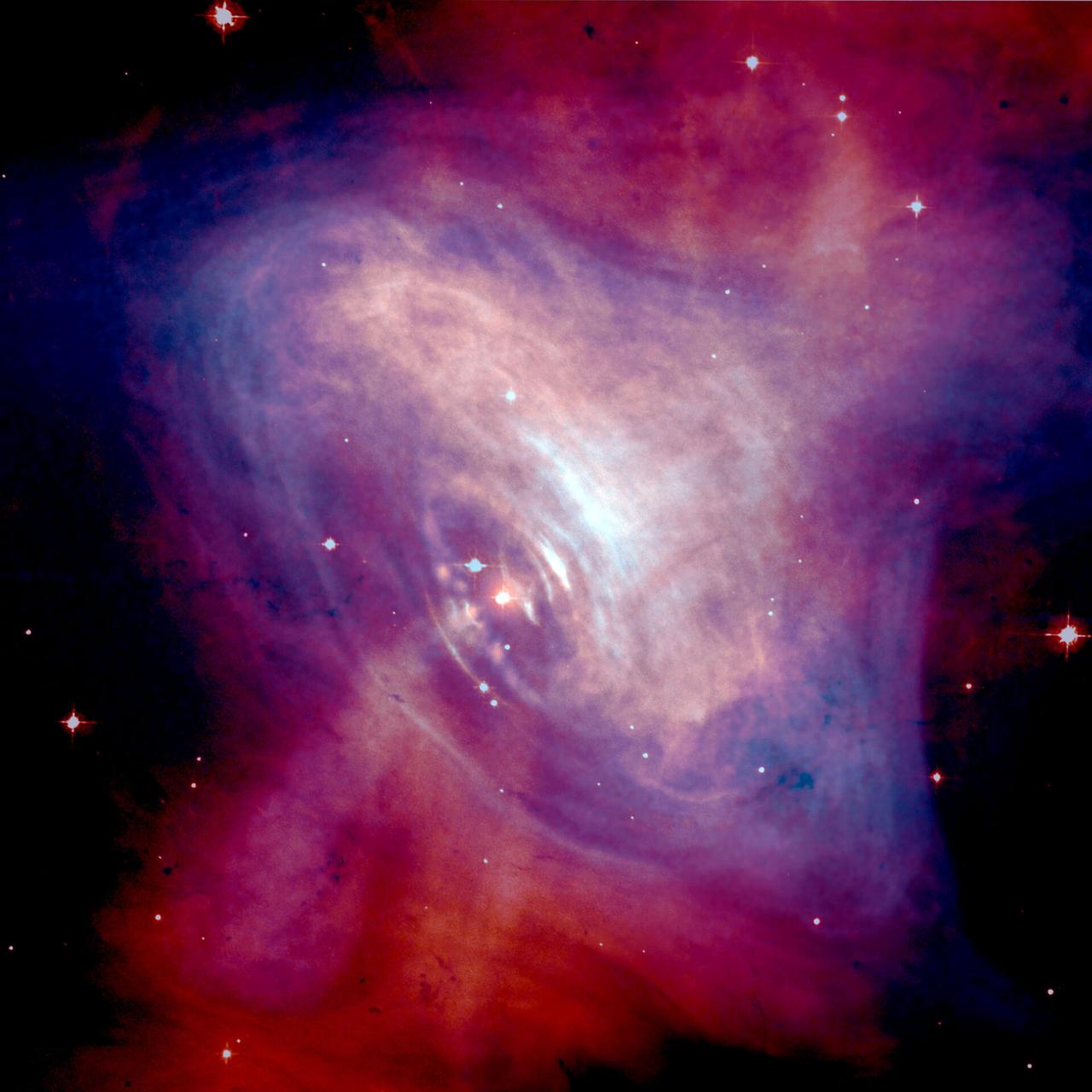
The Crab Nebula (Messier 1), also known by its catalog number NGC 1952, is the remnant of a supernova explosion recorded by Chinese and Arab astronomers in the year 1054. Located in the constellation Taurus, the nebula is approximately 6,500 light-years from Earth. Today, it can be observed across nearly the entire electromagnetic spectrum and is considered an important reference object for multi-wavelength observations.
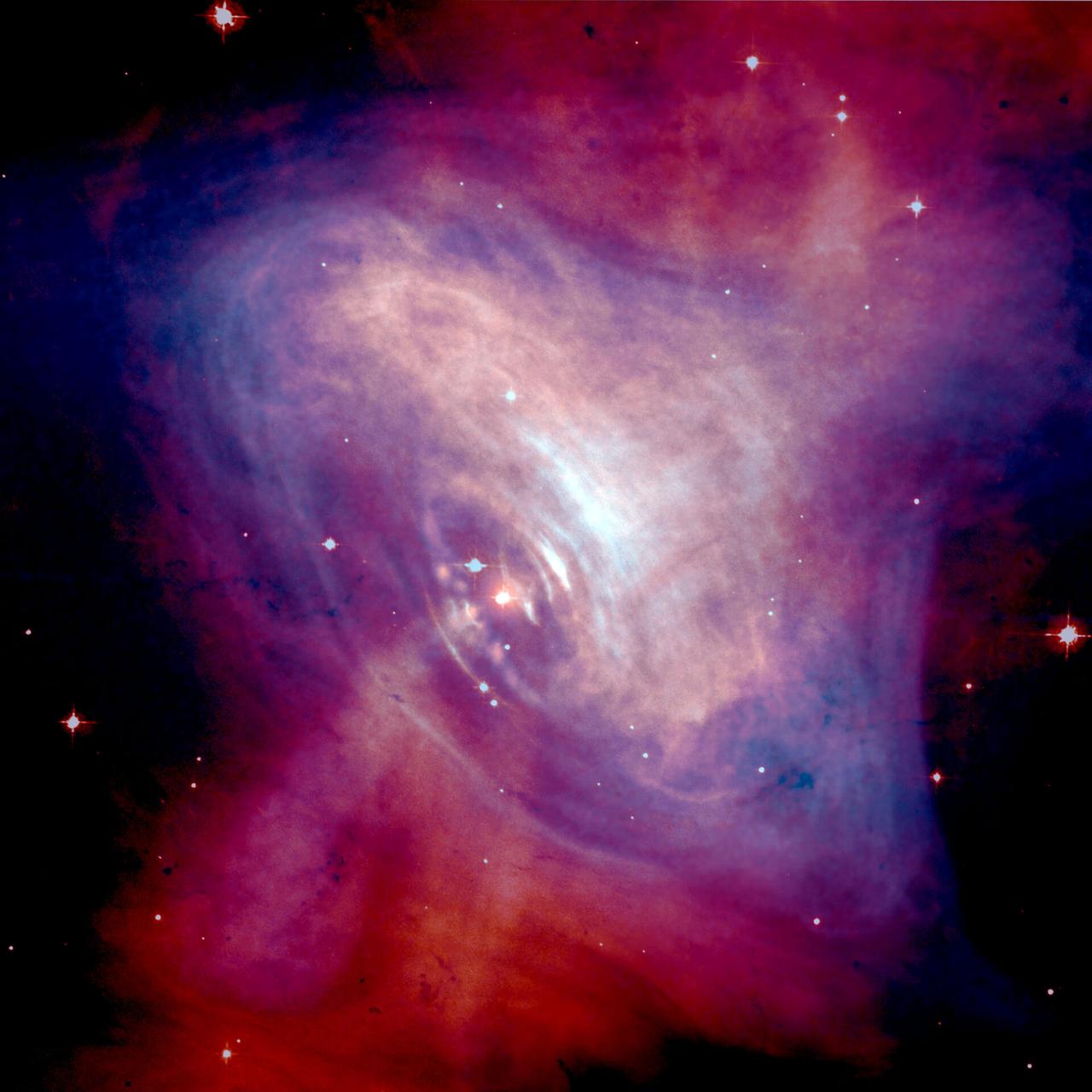
The Crab Pulsar as Imaged by the NASA/ESA Hubble Space Telescope (ESA)
The Crab Nebula formed as a result of a supernova explosion occurring in the final stages of a Sun-like star's life, which involved the ejection of a large amount of mass. The expanding cloud of gas and plasma left behind continues to emit energy, powered by a neutron star (pulsar) located at its center.
The Crab Pulsar is a neutron star that remains from the supernova explosion, spinning about 30 times per second. It produces regular pulse signals across almost every region of the electromagnetic spectrum—radio, optical, X-ray, and gamma-ray. The pulsar's rotational energy powers the inner region of the nebula, which is filled with high-energy particles and magnetic fields.
The nebula consists of filamentary structures made up of ionized hydrogen (H II), helium, oxygen, nitrogen, iron, and other elements. These filaments are remnants of the star's outer layers ejected during the supernova explosion.
The Crab Nebula is the remnant of a supernova explosion observed in A.D. 1054. It features two main shock zones within its expanding gas and plasma structures: an inner shock and an outer shock. The inner shock is associated with the pulsar wind produced by the neutron star (Crab Pulsar) at the center. This wind arises due to the acceleration of charged particles caused by the pulsar's powerful magnetic field and high rotational speed. These particles emit high-energy electromagnetic radiation in the nebula's inner regions.
The outer shock results from the interaction between the expanding supernova remnant and the interstellar medium. In this zone, the outer shell begins to decelerate upon colliding with surrounding low-density hydrogen and other gases, generating shock heating, ionization, and radiation emission. Both shock regions provide favorable conditions for particle acceleration, and hence synchrotron radiation emitted from the nebula can be observed across many regions of the electromagnetic spectrum.
The Crab Nebula is a significant source in radio astronomy at low frequencies. It produces a strong and continuous radio emission, particularly around 1 GHz. This emission is largely due to the synchrotron mechanism involving electrons accelerated along magnetic field lines. Furthermore, the Crab Pulsar, discovered in 1968, emits periodic radio pulses. These pulses, linked to the neutron star's rotation, have been observed to gradually slow down over time.
In the visible spectrum, the Crab Nebula stands out due to the brightness of its filamentary structures. These filaments show strong emission lines at wavelengths such as Hα (656.3 nm) and [O III] (particularly at 500.7 nm). Observations indicate that these lines originate from ionized hydrogen (H II regions) and doubly ionized oxygen (O++). These spectral lines provide information about the nebula’s temperature and density structure and also allow determination of expansion velocities via spectroscopy.
Space telescopes such as the Chandra X-ray Observatory and XMM-Newton have detected high-energy X-ray emissions from the inner regions of the Crab Nebula. These emissions originate from high-temperature gases surrounding the pulsar and from electrons accelerated in magnetic fields. Additionally, gamma-ray observations are explained by inverse Compton scattering, where high-energy electrons collide with photons and boost them to higher energies. The presence of these high-energy photons reflects the intense dynamics of the electromagnetic environment within the nebula.
The Crab Nebula has been expanding non-uniformly since the supernova explosion about 1,000 years ago. Spectroscopic analyses indicate that the average expansion speed of the filaments ranges from 1,500 km/s to 2,000 km/s. However, this expansion is not constant; over time, the nebula loses energy through electromagnetic radiation and exhibits a trend of slowing expansion.

Crab Nebula: A Dead Star Creates Celestial Destruction. (NASA)
As the pulsar’s rotational energy decreases, changes occur in the nebula structure near the center due to variations in the pulsar wind. These changes can be monitored both morphologically and spectroscopically. Irregular motions observed in the inner region further reveal the effects of plasma turbulence and magnetic reconnection processes. Observations suggest that the evolution of the Crab Nebula is shaped not only by mechanical expansion but also by magnetic and particle physics processes.
The Crab Nebula serves as a reference object in astrophysics for a variety of studies:
As the directly observable remnant of the 1054 supernova explosion, the Crab Nebula plays a critical scientific role in understanding the physical processes following such events. Data gathered through multi-wavelength observations offer extensive insights into neutron stars, high-energy astrophysical phenomena, and stellar evolution processes. Due to its observational continuity and technical investigability, the Crab Nebula functions as a significant laboratory in contemporary astrophysics.
European Space Agency. “NGC 1952 Crab Nebula Pulsar Imaged by the NASA/ESA Hubble Space Telescope.” ESA Multimedia, May 2003. Accessed 10 July 2025. Access Address.
European Space Agency. “Smoked Crab Nebula NGC 1952.” ESA/Hubble FITS Liberator. Accessed 10 July 2025. Access Address.
NASA. “Crab Nebula: A Dead Star Creates Celestial Havoc.” NASA Science – Hubble. Accessed 10 July 2025. Access Address.

The Crab Nebula
Catalog Names | Messier 1 (M1), NGC 1952, Taurus A | ||||||||
|---|---|---|---|---|---|---|---|---|---|
Constellation | Taurus | ||||||||
Distance(s) | Approximately 6.500 light-years (2.000 parsecs) | ||||||||
Angular Size | Approximately 6 x 4 arcminutes | ||||||||
Actual Diameter | Approximately 11 light-years | ||||||||
Apparent Magnitude | +8.4 magnitude | ||||||||
Structure(s) | Supernova remnant (SN 1054) | ||||||||
Henüz Tartışma Girilmemiştir
"The Crab Nebula (Messier 1)" maddesi için tartışma başlatın
Location and Basic Characteristics
The Central Neutron Star: The Crab Pulsar
Gas and Plasma Structure
Supernova Remnant and Shock Waves
Electromagnetic Observations
Radio Waves
Visible Light
X-rays and Gamma Rays
Dynamic Structure and Evolution Over Time
Astrophysical Significance
Bu madde yapay zeka desteği ile üretilmiştir.